

Kali Forms is often used for fast, lightweight WordPress forms: contact forms, feedback forms, job applications, appointment requests, quote forms, payment forms, and other lead-generation flows. These forms are easy for visitors to complete, but that also means they can become easy targets for bots.
Spam in Kali Forms is not only an inbox problem. A fake submission can create a low-quality lead, trigger an email notification, pollute stored entries, affect form reports, or waste time for the team that reviews incoming requests.
This guide explains how to protect Kali Forms from spam using CleanTalk as the main filtering layer on your WordPress website, along with Kali Forms-specific controls such as reCAPTCHA, Cloudflare Turnstile, honeypot protection, required fields, submission review, and careful handling of payment or file-upload forms.
This approach is relevant for websites that use Kali Forms for contact forms, customer feedback forms, request quote forms, appointment forms, donation forms, booking forms, job applications, payment forms, registration forms, or other frontend data-collection workflows.
Kali Forms – Contact Form and Drag-and-Drop Builder
Kali Forms is a WordPress form builder with a drag-and-drop interface and predesigned templates. WordPress.org describes Kali Forms as a contact form plugin that can be used to create contact forms, payment forms, feedback forms, and more. It also lists templates and workflows such as job applications, appointments, customer feedback forms, donation forms, request quote forms, reservation forms, booking forms, and simple booking forms with payment in Kali Forms Pro.
It can be used for:
- contact forms;
- feedback forms;
- appointment request forms;
- quote request forms;
- donation forms;
- payment forms;
- job application forms;
- reservation and booking forms;
- customer feedback forms;
- contest or tournament registration forms;
- forms with conditional logic;
- multi-page forms;
- forms with file uploads or signatures, depending on version and add-ons.
As WordPress.org shows, Kali Forms is currently used on over 10,000 websites and has 89 user reviews with an average rating of 4.8. WordPress.org also shows version 2.4.11, last updated 2 months ago, tested up to WordPress 6.9.4, and requiring PHP 5.6 or higher.
Plugin Homepage | Documentation
Why Kali Forms Attracts Spam
Kali Forms is usually placed on public-facing WordPress pages. That is where real visitors submit questions, requests, applications, bookings, payments, or feedback.
That is also where bots can submit fake entries.
Common spam cases include:
- fake contact form messages;
- repeated quote requests;
- low-quality appointment requests;
- fake job applications;
- bot-filled feedback forms;
- spam entries in stored submissions;
- repeated payment or donation form attempts;
- fake booking or reservation requests;
- disposable email addresses;
- suspicious uploaded files;
- spam submissions that trigger unnecessary email notifications.
Kali Forms can be used for more than a simple “Contact us” form. If the form sends notifications, stores entries, accepts payments, collects files, or sends data to another tool, spam can affect the entire workflow behind the form.
That is why protection should work before the submission becomes an entry, notification, lead, or payment-related record.
Anti-Spam Plugin by CleanTalk for WordPress
The next tool we’re going to use is the Anti-Spam plugin by CleanTalk.
Here’s a short overview:
- CleanTalk is a cloud-based spam protection service for websites.
- It automatically blocks spam without CAPTCHA challenges.
- It protects many types of forms, including contact forms, registrations, comments, surveys, payment forms, and subscription forms.
- It helps stop automated bots and suspicious human spam submissions.
- It uses spam detection signals such as IP address, email address, sender behavior, and global spam activity.
- It lets website owners create custom filtering rules for specific cases.
- It allows blocking or filtering by IP, email, and country.
- It works quietly in the background and is easy to install and configure.
For Kali Forms, this is especially useful because many forms are connected to practical business actions: answering leads, reviewing applications, booking calls, collecting feedback, or processing payment-related requests.
According to WordPress.org, Anti-Spam by CleanTalk for WordPress has over 200,000 active installations, with 3,168 reviews and an average rating of 4.7.
Plugin Homepage at cleantalk.org | Latest release at GitHub.com | Website cleantalk.org
Install the CleanTalk Anti-Spam plugin
Show Instructions
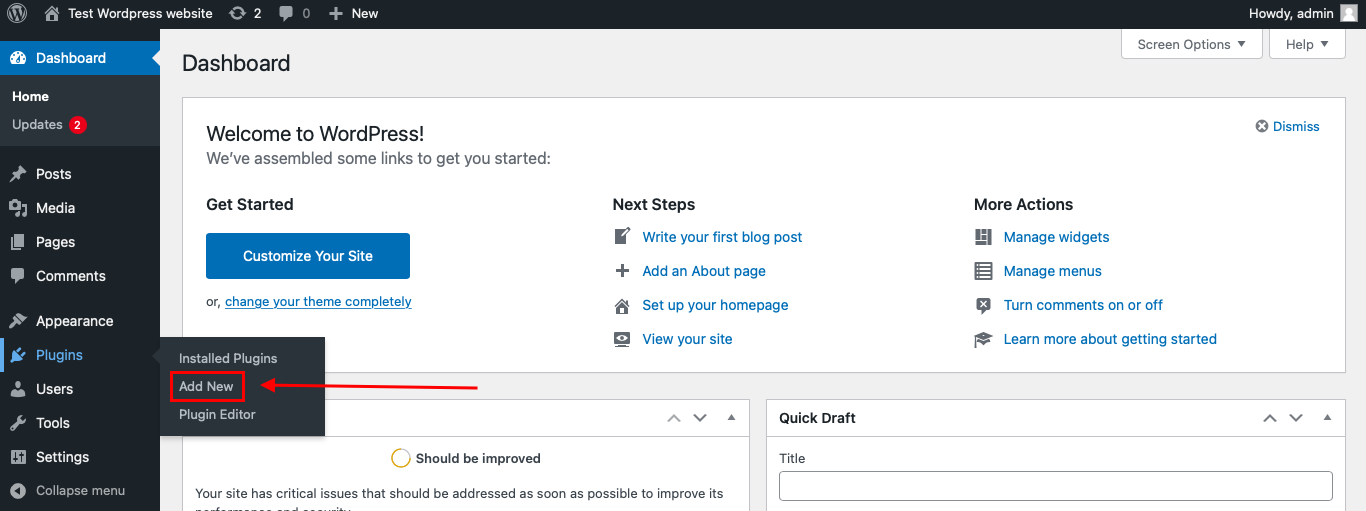
To install the Anti-Spam plugin, go to your WordPress admin panel → Plugins → Add New.
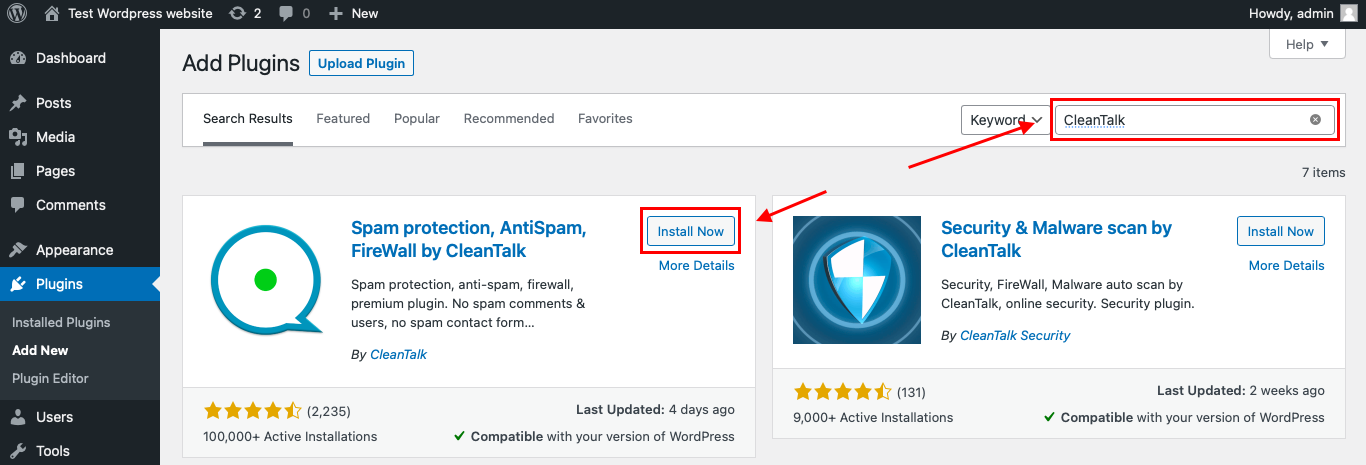
Then enter «СleanTalk» in the search box and click the Install button for «Spam protection, Anti-Spam, FireWall by CleanTalk».
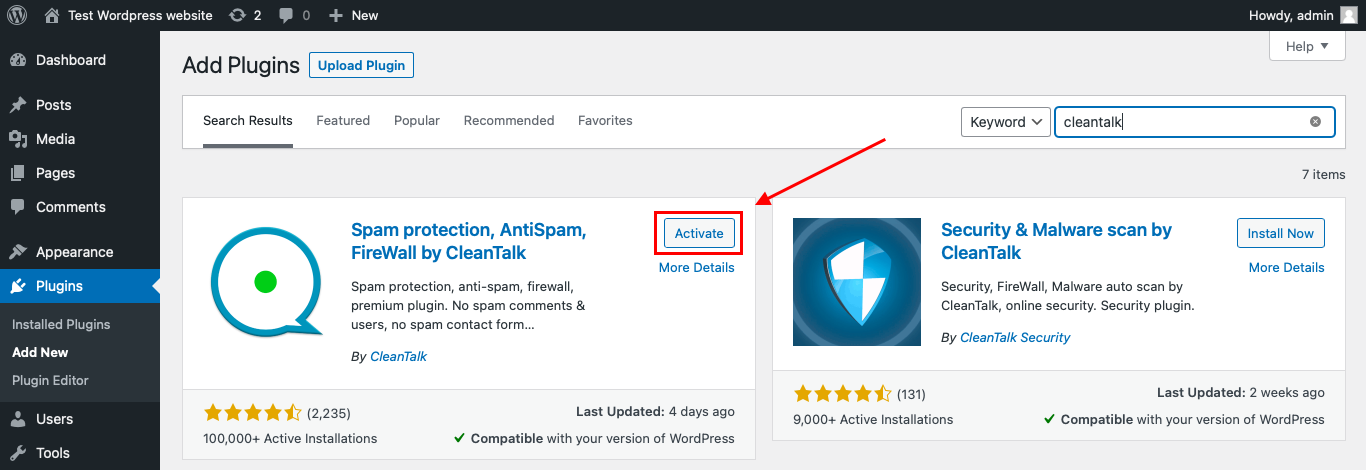
After installing the plugin, click the «Activate» button.
After it is done go to the plugin settings and click the «Get Access Key Automatically» button. Then just click the «Save Settings» button.
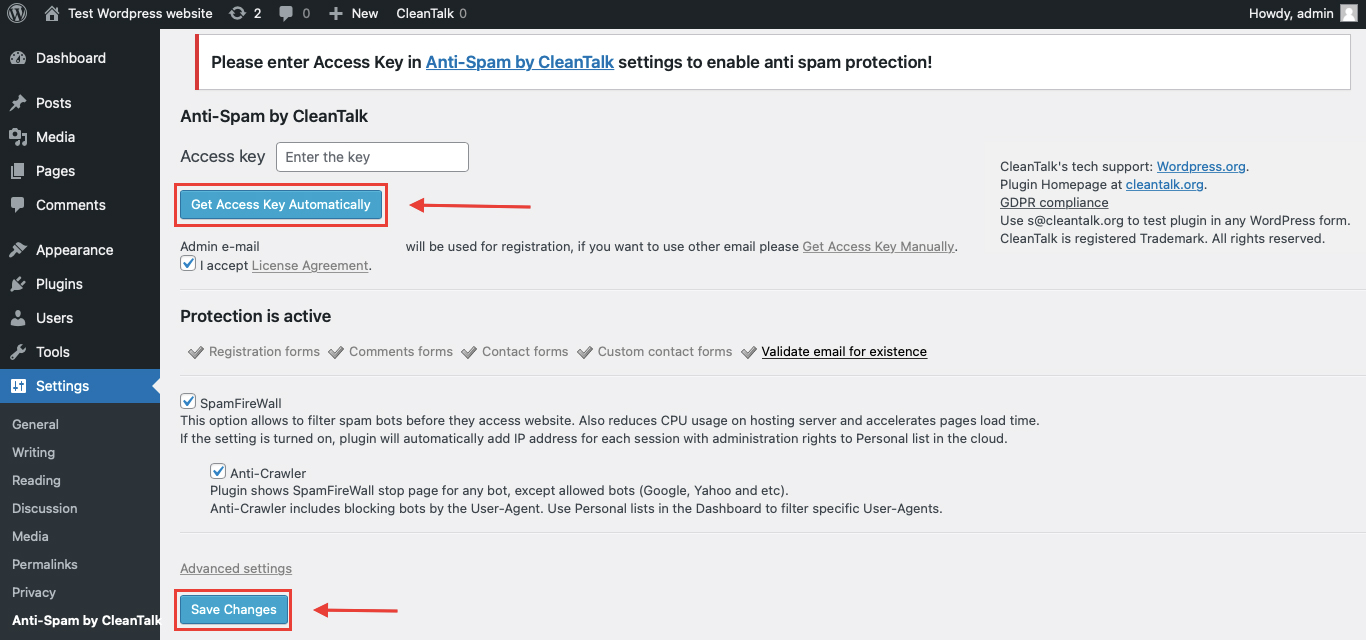
That’s it! From now you know how to completely protect your HivePress from spam.
You don’t need to rebuild your Kali Forms setup. Keep your existing forms, templates, notifications, and form logic, and CleanTalk will check suspicious submissions in the background.
How to Check Spam Protection for Kali Forms
You can test the work of Anti-Spam protection for your Kali Forms by using a test email:
stop_email@example.com
- Open page with your form (don’t forget to add the shortcode in the page content) in Incognito browser tab.
- Fill out the Contact form using stop_email@example.com as sender’s email.
- Send the form.
- You should see a message from the Anti-Spam plugin confirming that a spam submission was blocked.
*** Forbidden. Sender blacklisted. Anti-Spam by CleanTalk. ***
After submitting the form, you should see a block message about the blocked form submission:
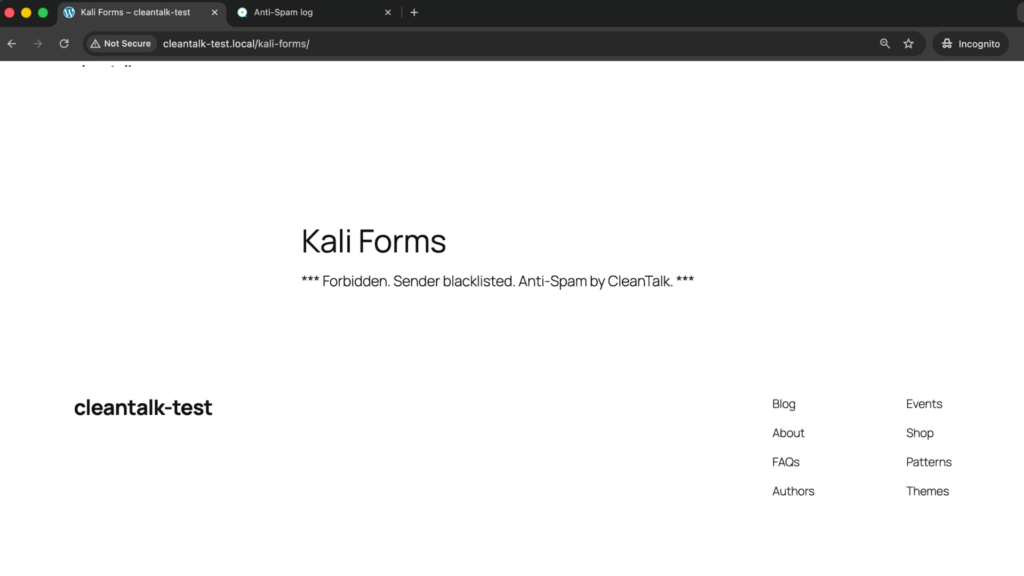
The protection works only for website visitors, not for website admins. Be sure to test the form protection using Incognito mode.
This is important because Kali Forms may behave differently for logged-in admins and public visitors. Testing outside the admin session helps confirm that protection works in the real user flow.
Cloud Dashboard
In addition, in the CleanTalk Cloud Dashboard, you can find extra details about submissions processed by CleanTalk, including Kali Forms submissions and other WordPress forms.
The dashboard can help review:
- IP and email of the sender;
- sender activity history across other websites connected to the CleanTalk cloud;
- geolocation of the sender;
- date and time of the submission;
- page URL where the form was submitted;
- cloud decision: Approved or Denied;
- cloud explanation for the decision, such as blacklisted email, bad IP reputation, or spam text;
- tools to move senders to Block or Allow lists.
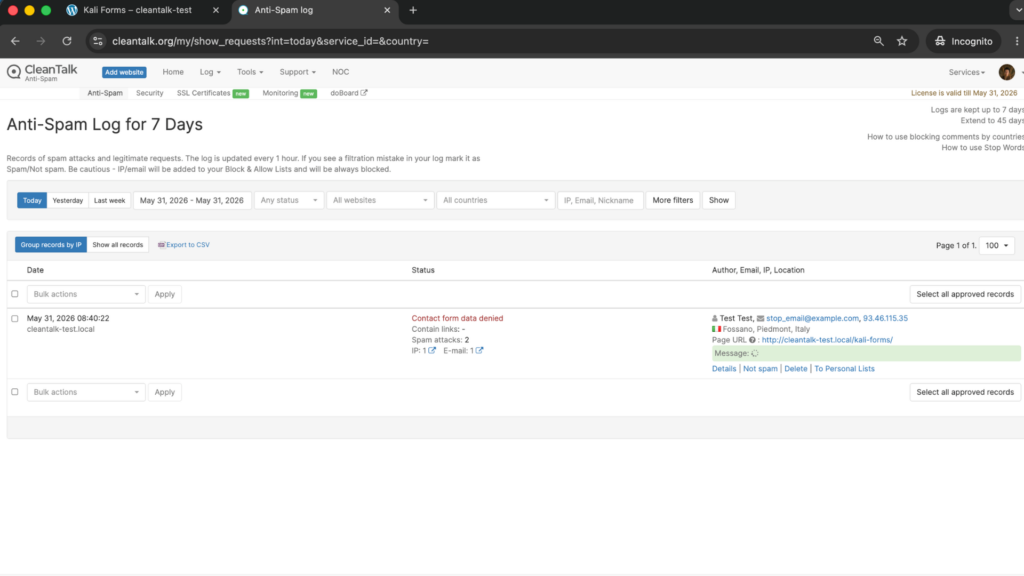
This is useful for Kali Forms because spam may arrive through different form types: a basic contact form, a quote form, a job application, a booking form, or a payment-related form.
The dashboard helps you understand which form is being targeted and whether the problem comes from repeated IPs, disposable emails, fake contact details, suspicious text, or automated submissions.
Kali Forms Features That Matter for Spam Protection
Kali Forms includes several features that directly affect how spam should be handled. Some are built into the free plugin, while others depend on Kali Forms Pro or add-ons.
Drag-and-Drop Contact Forms
Kali Forms is built around quick form creation with a drag-and-drop builder. That makes it easy to publish contact forms, feedback forms, and lead forms quickly.
The spam risk is also simple: the easier a form is to publish publicly, the faster bots can find and submit it.
Templates and High-Intent Forms
WordPress.org lists several templates and use cases for Kali Forms, including job applications, appointment forms, customer feedback forms, donation forms, request quote forms, reservation forms, and booking forms. Some of these templates are part of Kali Forms Pro.
These forms often need more careful review than a basic message form because they can affect business workflows.
reCAPTCHA, Turnstile, and Honeypot Protection
WordPress.org says Kali Forms is designed to use a combination of Google reCAPTCHA and a spam honeypot system. The plugin page also lists Google reCAPTCHA and Cloudflare Turnstile as external spam protection services used to verify that submissions are made by humans and not automated bots.
Kali Forms documentation also includes a dedicated “Spam protection” section and a reCAPTCHA anti-spam field.
These tools can be useful, but they should be configured carefully. CAPTCHA-style tools can add friction, while honeypots are invisible to users but may not stop more advanced bots alone.
Payment Forms
Kali Forms can be used for payment forms. WordPress.org describes payment forms as one of the plugin’s use cases, and the plugin page includes payment-related tags. Kali Forms documentation also lists a Payments add-on and a guide for creating a PayPal payment form.
For payment forms, spam can create fake payment attempts, incomplete records, and unnecessary admin review.
Form Notifications and Stored Submissions
Kali Forms documentation includes sections for emails configuration, guided emails, form notifications, SMTP settings, storing form submissions, and exporting form submissions to CSV or Excel.
This means spam can affect both email notifications and stored form data.
Conditional Logic, Multi-Step Forms, and Add-ons
Kali Forms Pro includes more advanced workflows such as conditional logic, multi-page forms, partial entries, and submission handling, according to WordPress.org.
When forms become more complex, spam protection should be reviewed together with the logic of the form. A bot submission may trigger the wrong branch, send incomplete data, or create a low-quality partial entry.
Additional Protection Options for Kali Forms
CleanTalk should be the main anti-spam layer, but Kali Forms websites can also benefit from form-specific controls.
Use CAPTCHA Only Where Needed
Kali Forms supports CAPTCHA-style protection through Google reCAPTCHA and Cloudflare Turnstile. These tools are useful for heavily abused forms, but they may add friction.
For normal contact forms, it can be better to use CleanTalk as the background filtering layer and enable visible verification only when spam volume requires it.
Keep Honeypot Protection Enabled
A honeypot is invisible to real users but may catch simple bots that fill hidden fields automatically.
It is useful as a low-friction layer, especially for public contact and feedback forms.
Review Email Notifications
Spam can create a notification problem even before it becomes a data problem.
If a Kali Forms form sends alerts to a sales, support, HR, or booking team, make sure spam filtering works before notifications are sent.
Validate Required Fields
Required fields should collect the data your team actually needs, such as name, email, phone number, message, date, service type, or appointment details.
Do not add too many required fields, but make sure bots cannot submit empty or useless forms.
Protect Payment and Donation Forms
For payment-related forms, a form submission should not be treated as a completed payment.
Check payment status, failed attempts, and suspicious contact details before granting access, fulfilling a request, or sending a confirmation that implies payment was completed.
Watch Forms with File Uploads or Signatures
If your Kali Forms setup uses file uploads, signatures, or other advanced fields, review submissions more carefully.
Limit file types and file sizes where possible, and do not open suspicious files from unknown senders.
Why Kali Forms Spam Is Different from Regular Contact Form Spam
A basic contact form spam message is usually just an unwanted email.
Kali Forms spam can affect more than that.
Depending on the form setup, a fake submission may become:
- a sales lead;
- a job application;
- a booking request;
- a customer feedback entry;
- a donation or payment-related attempt;
- a stored form submission;
- a notification to the team;
- an exported CSV row;
- a partial entry;
- a suspicious uploaded file.
That is why the protection setup should match the form’s purpose.
A job application form, a booking form, a payment form, and a simple contact form do not need the same level of review.
Comparison of Anti-Spam Approaches for Kali Forms
| Solution | Main role | Strengths | Limitations | Best use case |
|---|---|---|---|---|
| CleanTalk | Main WordPress-side anti-spam filtering | Works in the background, checks suspicious submissions, no CAPTCHA friction for real users | Should be combined with form-level settings for high-risk workflows | WordPress sites using Kali Forms |
| Kali Forms honeypot | Low-friction bot trap | Invisible to visitors, useful against simple bots | Advanced bots may bypass it | Public contact and feedback forms |
| Google reCAPTCHA | Human verification | Familiar anti-bot method, supported by Kali Forms | Can add friction for real users | Heavily abused public forms |
| Cloudflare Turnstile | Low-friction verification | Alternative to traditional CAPTCHA, supported by Kali Forms | Still needs proper setup and testing | Conversion-sensitive forms |
| Required fields | Basic data quality control | Reduces empty or incomplete entries | Bots can still fill required fields | Lead and appointment forms |
| Payment status review | Workflow protection | Prevents fake form entries from being treated as paid actions | Applies only to payment forms | Donations, paid bookings, payment forms |
| Stored submission review | Cleanup and monitoring | Helps identify repeated spam patterns | Does not block spam by itself | Sites that store Kali Forms entries |
| File upload restrictions | Upload safety | Reduces risk from unwanted attachments | Does not replace spam filtering | Forms with upload fields |
In practice, Kali Forms spam protection should combine sender filtering with form-specific settings. CleanTalk helps evaluate the sender and submission behavior, while Kali Forms settings help control the form experience and the quality of collected data.
Frequently Asked Questions — Kali Forms Spam Protection
Why are Kali Forms receiving spam even with required fields?
Required fields only force a form to be completed. They do not prove that the sender is real.
Bots can fill required fields with fake names, temporary emails, nonsense text, or repeated values. That is why required fields should be combined with anti-spam filtering.
Is Kali Forms only for contact forms?
No. WordPress.org describes Kali Forms as a plugin for contact forms, payment forms, feedback forms, and more. It also lists use cases such as appointments, job applications, request quote forms, donations, reservations, and booking forms, with some templates available in Kali Forms Pro.
Does Kali Forms have built-in spam protection?
Yes. WordPress.org says Kali Forms uses Google reCAPTCHA and a spam honeypot system, and the plugin page also lists Google reCAPTCHA and Cloudflare Turnstile as spam protection services.
Still, built-in protection works best when combined with a site-level anti-spam layer such as CleanTalk, especially if the website receives repeated spam.
Should I use reCAPTCHA, Turnstile, or CleanTalk?
Use CleanTalk as the background anti-spam layer. Add reCAPTCHA or Turnstile only on forms where extra verification is needed.
This keeps normal forms easier for real users while giving stronger protection to abused forms.
Can spam affect Kali Forms payment forms?
Yes. Spam can create fake payment-related entries, failed attempts, confusing notifications, or fake donation and booking requests.
For payment forms, always confirm payment status before processing the request.
What should I check if Kali Forms spam still gets through?
Check the CleanTalk logs, the page URL, sender IPs, email addresses, repeated submissions, Kali Forms spam settings, CAPTCHA/Turnstile status, honeypot settings, and whether the spam comes from one form or several forms.
Also check whether the form sends notifications or stores entries before spam filtering is applied.
Can bots abuse job application forms?
Yes. Job application forms can receive fake applicants, low-quality entries, suspicious attachments, or repeated submissions.
If a form collects resumes or files, use spam filtering, file restrictions, and manual review before opening attachments.
Are stored submissions affected by spam?
Yes. If Kali Forms stores entries, spam can pollute the database and later appear in exports, reports, or manual review queues.
Clean the stored entries after a spam wave and review repeated patterns.
What setup works best for a simple Kali Forms contact form?
For a simple contact form, use CleanTalk Anti-Spam, keep honeypot protection enabled, use only necessary required fields, and add CAPTCHA or Turnstile only if the form receives repeated abuse.
Recommended Anti-Spam Stack for Kali Forms in 2026
Kali Forms can be used for different workflows, so the strongest setup depends on the type of form.
For simple contact forms
Use:
- CleanTalk Anti-Spam;
- Kali Forms honeypot;
- necessary required fields;
- Cloud Dashboard monitoring.
This keeps the form simple while blocking suspicious submissions.
For quote request forms
Use:
- CleanTalk Anti-Spam;
- required contact fields;
- service or project-type fields;
- manual review of unusual requests.
This helps reduce fake quote requests and low-quality leads.
For appointment and booking forms
Use:
- CleanTalk Anti-Spam;
- date and time validation;
- confirmation email;
- review of repeated booking attempts.
This protects booking workflows from fake or duplicate requests.
For job application forms
Use:
- CleanTalk Anti-Spam;
- required applicant details;
- file upload restrictions;
- manual review before opening attachments.
This is important when applicants can upload resumes or documents.
For payment or donation forms
Use:
- CleanTalk Anti-Spam;
- payment status verification;
- review of failed or suspicious attempts;
- no fulfillment before payment confirmation.
This reduces confusion between a submitted form and a completed payment.
For feedback forms and surveys
Use:
- CleanTalk Anti-Spam;
- duplicate entry review;
- required fields only where needed;
- cleanup before using results.
This keeps collected feedback and exported data more reliable.
For high-risk public forms
Use:
- CleanTalk Anti-Spam;
- honeypot protection;
- reCAPTCHA or Cloudflare Turnstile;
- CleanTalk Cloud Dashboard monitoring;
- manual review of suspicious submissions.
This setup is best for forms placed on high-traffic pages, campaign landing pages, or pages already receiving repeated spam.
Final Thoughts
Kali Forms spam should be reviewed based on what the form actually does after someone clicks “Submit.”
For a basic contact form, spam may only create an unwanted message. For an appointment form, job application, quote request, donation form, or payment form, the same spam submission can create a much bigger issue: a fake lead, a false booking, a low-quality applicant, a suspicious file, or a payment-related record that needs manual review.
That is why the safest setup is layered. CleanTalk can filter suspicious submissions in the background, while Kali Forms settings can help control the user-facing part of the form: honeypot protection, reCAPTCHA or Turnstile, required fields, payment checks, and safer handling of stored entries or uploaded files.
For low-risk forms, keep the experience clean and avoid unnecessary friction. For forms that affect sales, hiring, bookings, payments, or stored records, add stronger review steps before your team acts on the submitted data.
With CleanTalk working as the first filtering layer and Kali Forms configured carefully, you can reduce fake submissions, keep form entries cleaner, and protect the workflows connected to your WordPress forms.
