
Stop spam without frustrating your visitors

Create your CleanTalk account and start blocking spam — no CAPTCHA challenges and no impact on visitors.

Security Block Lists

CleanTalk Account

No credit card required • Setup takes less than a minute • Your temporary password will be sent by email.

Tag: spam

  • How to Stop Spam in Contact Form 7: Best Protection Methods in 2026

    How to Stop Spam in Contact Form 7: Best Protection Methods in 2026

    Contact Form 7 remains one of the most widely used contact form plugins in the WordPress ecosystem, with more than 10 million active installations listed in the official WordPress plugin directory. It has stayed popular for years because it gives site owners a practical, lightweight, and flexible way to add contact forms without switching to a heavier all-in-one form builder. WordPress.org also notes that the plugin uses its own Schema-Woven Validation technology, which shows that Contact Form 7 is built not just as a basic form tool, but as a structured system for handling user input reliably.

    In 2026, however, popularity also means exposure. Public-facing contact forms are easy for bots and abusive senders to find, test, and submit at scale, which is why Contact Form 7 gets spammed so often. Contact Form 7’s own documentation treats spam as a normal operational issue, not a rare exception: the plugin officially supports multiple anti-spam layers, including Akismet, Cloudflare Turnstile, the disallowed list, and reCAPTCHA v3. The project also explicitly warns that weak protection or unsafe mail configuration can allow spammers to abuse a form and send messages through the site itself.

    That is why Contact Form 7 spam should not be framed as a plugin defect or an unusual technical failure. It is a predictable consequence of running a highly visible form on a public website. In practice, especially in 2026, the real question is not whether a Contact Form 7 form can attract spam, but which protection stack is strong enough to block automated submissions without creating unnecessary friction for real users. Contact Form 7 itself recommends combining different types of spam protection rather than relying on a single mechanism alone.

    Common types of spam in Contact Form 7 (CF7)

    Spam in Contact Form 7 is not limited to one obvious pattern. The most common and best-documented category is automated bot spam – scripts that submit forms at scale faster than a human team can review them manually. Google has explicitly warned that bots are commonly used to fill out web forms automatically, which is one of the main reasons public-facing forms become a frequent target for abuse. Contact Form 7 reflects the same reality in its own documentation by offering multiple official anti-spam options and integrations rather than treating spam as an exceptional case.

    Another important category is human spam or human-assisted spam. Contact Form 7’s own reCAPTCHA FAQ explains that CAPTCHA tools can block spambots effectively but are “helpless against other types of spam,” and specifically notes that human spammers can easily get around them. That makes this a critical distinction for site owners: blocking bots alone does not mean the form is fully protected. This is also why Contact Form 7 advises using two or more spam protection modules together instead of relying on one layer only.

    A third risk is form abuse caused by unsafe configuration. Contact Form 7 explicitly warns that if mail settings are configured unsafely and sufficient spam protection is not in place, spammers may abuse the form to send messages through the site itself. In other words, some Contact Form 7 abuse is not just about junk submissions cluttering an inbox – it can also turn the form into a delivery mechanism for unwanted email.

    If you want to broaden this section beyond strictly official Contact Form 7 documentation, you can also mention fake contact data, direct POST abuse, and human-like spam that slips through basic CAPTCHA checks as practical patterns observed by CleanTalk in real-world Contact Form 7 cases. Those points are useful, but they should be framed as product or field observations rather than as claims directly documented by Contact Form 7 itself.

    Official anti-spam options and integrations in Contact Form 7

    Contact Form 7 includes several official anti-spam options and integrations, which shows that spam protection is not treated as an afterthought. In its own FAQ, Contact Form 7 says users can protect forms with anti-spam features such as Akismet, Cloudflare Turnstile, and the disallowed list. The plugin also maintains an official integration for reCAPTCHA v3, which remains part of its supported anti-spam stack.

    One of the most important options is Akismet. Contact Form 7 explains that Akismet works through specific form-tag options such as akismet:author, akismet:author_email, and akismet:author_url, allowing the plugin to evaluate the submission itself rather than simply challenge the user. The documentation goes even further and says that Akismet forms the “centerpiece” of Contact Form 7’s spam prevention strategy.

    Another major option is Cloudflare Turnstile. Contact Form 7 now provides an official Turnstile integration module and describes it as an effective way to protect forms from spam bots. More importantly, the project explicitly states, “We recommend Turnstile unless you have reasons to use reCAPTCHA.” That makes Turnstile the strongest current CAPTCHA-style recommendation inside the official Contact Form 7 ecosystem.

    Contact Form 7 also supports reCAPTCHA v3, but it should be described carefully. The official documentation says the integration is designed to block abusive submissions by spam bots, and the reCAPTCHA FAQ clarifies that Contact Form 7 5.1 and higher support only reCAPTCHA v3 natively. In other words, reCAPTCHA is still a valid option, but it is no longer the only CAPTCHA path inside Contact Form 7.

    The simplest built-in filtering layer is the disallowed list. According to Contact Form 7’s FAQ, it can block messages containing specified keywords or submissions coming from specified IP addresses. It is not a complete anti-spam solution on its own, but it works well as an extra rule-based layer when a site repeatedly sees the same phrases, links, or IP-based abuse patterns.

    Taken together, these options show that Contact Form 7 approaches spam protection as a layered system, not as a one-click fix. Akismet helps filter suspicious submissions, Turnstile and reCAPTCHA v3 are aimed at stopping spambots, and the disallowed list adds a simple keyword- and IP-based filter. Contact Form 7’s own guidance also recommends combining different anti-spam modules rather than relying on a single method alone. 

    CAPTCHA options in Contact Form 7

    If you specifically want to add CAPTCHA protection to Contact Form 7, there are two main options to focus on in the current Contact Form 7 ecosystem: reCAPTCHA v3 and Cloudflare Turnstile. Both are supported in Contact Form 7, but they should not be treated as identical solutions. They solve a narrower problem – mainly reducing automated bot submissions – and are usually most effective when combined with other filtering layers rather than used alone.

    reCAPTCHA v3 is Contact Form 7’s native Google-based CAPTCHA option. It works in the background and uses a score-based system instead of the classic checkbox challenge most users associate with older CAPTCHA tools. That makes it more convenient from a UX perspective, but it also means it is better at dealing with bots than with every kind of spam. In practice, reCAPTCHA v3 is still a valid option for Contact Form 7, especially for sites already using Google services, but it should not be positioned as a complete anti-spam solution by itself.

    Cloudflare Turnstile is now the stronger default recommendation for many Contact Form 7 sites. It is designed as a more lightweight CAPTCHA alternative and usually creates less friction for visitors than traditional challenge-based verification. More importantly, current Contact Form 7 documentation treats Turnstile as the preferred CAPTCHA-style option unless there is a specific reason to stay with reCAPTCHA. For that reason, if the goal is to choose the most up-to-date CAPTCHA layer inside the official Contact Form 7 stack, Turnstile is the better place to start.

    Some websites also use third-party CAPTCHA plugins, such as hCaptcha-based integrations, but these should be described as external add-ons rather than as Contact Form 7’s main official path. They can still be useful in certain setups, especially where privacy, policy, or infrastructure preferences matter, but for most readers the core CAPTCHA decision in Contact Form 7 today is really reCAPTCHA v3 vs Cloudflare Turnstile.

    The key point is that CAPTCHA is only one part of the protection strategy. It can help reduce automated spam, but it does not replace submission filtering, keyword blocking, or broader server-side anti-spam protection. That is why the best Contact Form 7 setups usually combine a CAPTCHA-style layer with other anti-spam methods instead of relying on CAPTCHA alone.

    Best ways to stop spam in Contact Form 7

    The most reliable way to reduce spam in Contact Form 7 is to use more than one protection layer. Contact Form 7’s own documentation says that the plugin provides several spam protection modules and advises users to use two or more modules together. In practice, that means the best setup is usually not a single tool, but a combination of bot protection, submission filtering, and rule-based blocking.

    For websites that want to stay within Contact Form 7’s official ecosystem, Cloudflare Turnstile is now the clearest starting point. Contact Form 7 provides an official Turnstile integration, says it effectively protects forms from spam bots, and explicitly states, “We recommend Turnstile unless you have reasons to use reCAPTCHA.” That makes Turnstile the strongest default CAPTCHA-style recommendation in the current Contact Form 7 stack.

    A second important layer is Akismet. Contact Form 7 says that Akismet forms the centerpiece of its spam prevention strategy and recommends combining different protection types instead of relying on only one module. Unlike a visible CAPTCHA challenge, Akismet is configured through specific form-tag options and evaluates the submission data itself, which makes it a strong complementary layer alongside Turnstile.

    The disallowed list is also worth using as a supporting layer. Contact Form 7’s FAQ says it can block messages containing specific keywords or submissions coming from specified IP addresses. It is not presented as a full standalone solution, but it is useful when a site repeatedly receives the same phrases, links, or IP-based abuse patterns.

    reCAPTCHA v3 remains a supported option, but it should be described carefully. Contact Form 7’s documentation says that version 5.1 and later uses the reCAPTCHA v3 API, while the FAQ notes that CAPTCHA tools are effective against spambots but can be ineffective against other spam types, including spam generated by humans. For that reason, reCAPTCHA is better presented as one possible layer, not as a complete answer by itself.

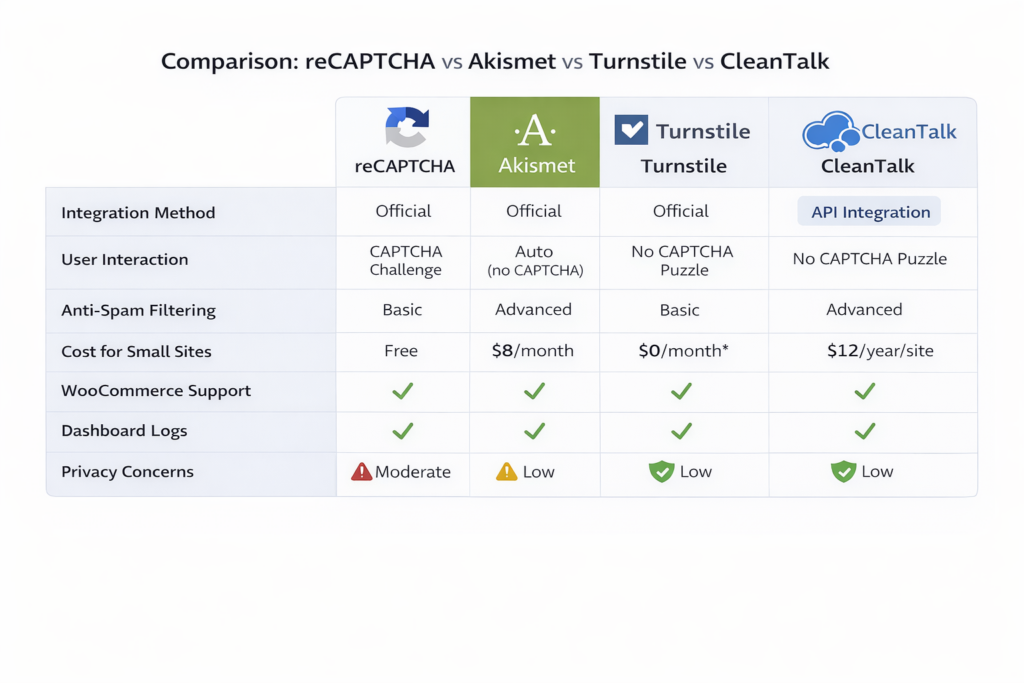
    Comparison table: reCAPTCHA vs Akismet vs Turnstile vs CleanTalk

    If you want to compare Contact Form 7’s native stack with an external service, CleanTalk is a reasonable option to include in the comparison section. WordPress.org describes it as a CAPTCHA-free anti-spam plugin that blocks contact form spam, fake users, and spam comments, and lists it at 200,000+ active installations. That makes it a valid external alternative to compare against Turnstile, Akismet, and reCAPTCHA – but in the article it should be presented as an external anti-spam service, not as one of Contact Form 7’s built-in protections.

    How to read this table: inside the official Contact Form 7 ecosystem, the strongest setup is usually Turnstile + Akismet, because CF7 explicitly recommends using multiple spam-protection modules together, calls Akismet the “centerpiece” of its spam-prevention strategy, and says, “We recommend Turnstile unless you have reasons to use reCAPTCHA.”

    reCAPTCHA v3 is still an official CF7 option, but it should be positioned carefully. Contact Form 7 says reCAPTCHA v3 is its officially supported CAPTCHA solution and that it works in the background, but the same FAQ also warns that CAPTCHA tools can be helpless against other spam types, including human spammers.

    Akismet deserves a higher position in the comparison than many WordPress articles give it. CF7 says Akismet is the centerpiece of its spam-prevention strategy and explains that it works by evaluating submission data, not just by placing a challenge in front of the visitor.

    Turnstile is the clearest current default inside Contact Form 7. CF7’s integration page says all contact forms are protected after setup, while Cloudflare positions Turnstile as a CAPTCHA replacement that works without showing visitors a traditional CAPTCHA and aims for a less intrusive experience.

    CleanTalk should be presented honestly as an external alternative, not a native Contact Form 7 feature. The WordPress.org listing describes it as a no-CAPTCHA anti-spam plugin and says it stops spam contact emails; the same listing also has a dedicated Contact Form 7 section saying the plugin extends spam protection for CF7 and can be used with other third-party spam filters.

    Bottom line: if the article is comparing the best practical options, the cleanest conclusion is this – Turnstile is the best default native entry point, Akismet is the strongest native filtering layer, reCAPTCHA v3 is still valid but weaker as a primary recommendation, and CleanTalk is the most natural external no-CAPTCHA alternative to compare against the CF7 stack.
    Anti-Spam plugin by CleanTalk for WordPress

    The next tool we’re going to use is the Anti-Spam plugin by CleanTalk.

    Here’s a short overview:

    • CleanTalk is a cloud-based spam protection service for websites, founded in 2012.
    • It automatically blocks spam without CAPTCHAs and doesn’t interrupt the user experience.
    • Protects many types of forms: contact forms, payment forms, registrations, comments, surveys and more.
    • Stops both automated bots and human spam submissions.
    • Uses advanced filtering algorithms and a global spam detection network.
    • Detects spam based on IP address, email address and user behavior.
    • Lets you create custom filtering rules for specific cases.
    • Allows blocking or filtering by IP, email and country.
    • Works quietly in the background and is very easy to install and configure.

    According to WordPress.org, Anti-Spam by CleanTalk for WordPress has over 200,000 active installations, with thousands of reviews and an average rating around 4.7 out of 5.

    Plugin Homepage at cleantalk.org | Latest release at GitHub.com | Website cleantalk.org

    According to WordPress.org, Anti-Spam by CleanTalk for WordPress has over 200,000 active installations, with 3,168 reviews and an average rating of 4.7.

    Plugin Homepage at cleantalk.org | Latest release at GitHub.com

    Install the CleanTalk Anti-Spam plugin

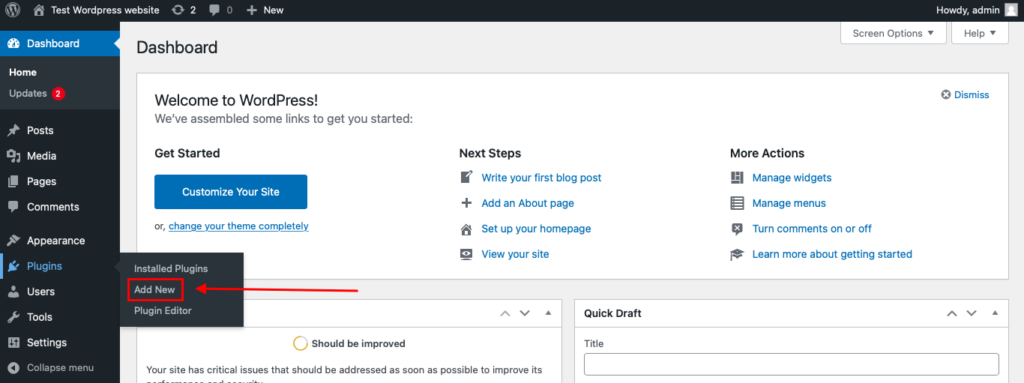
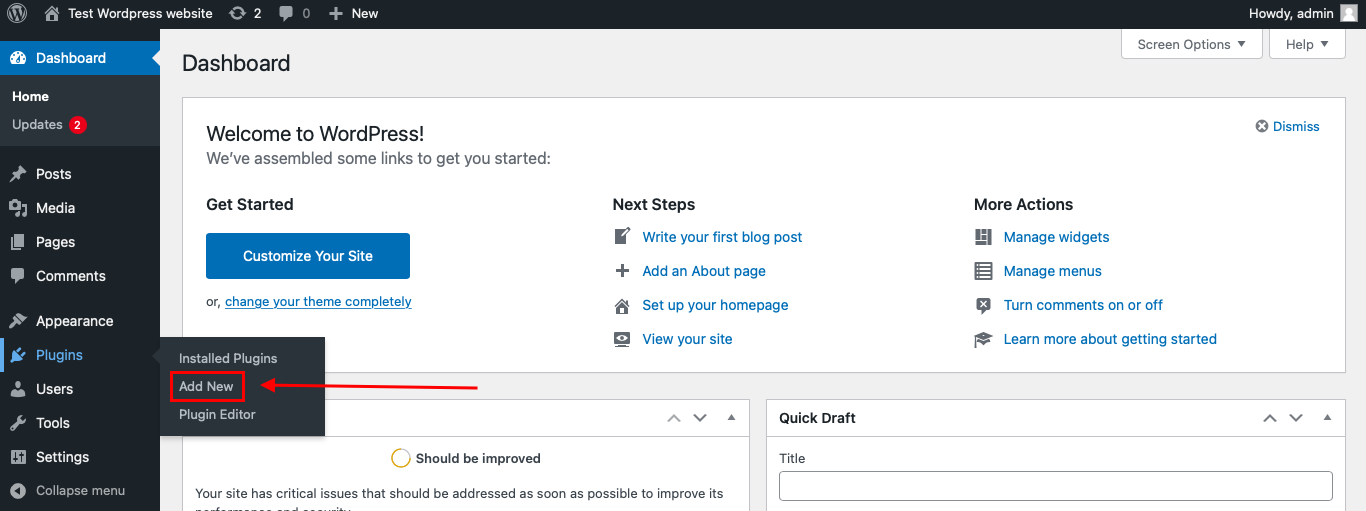
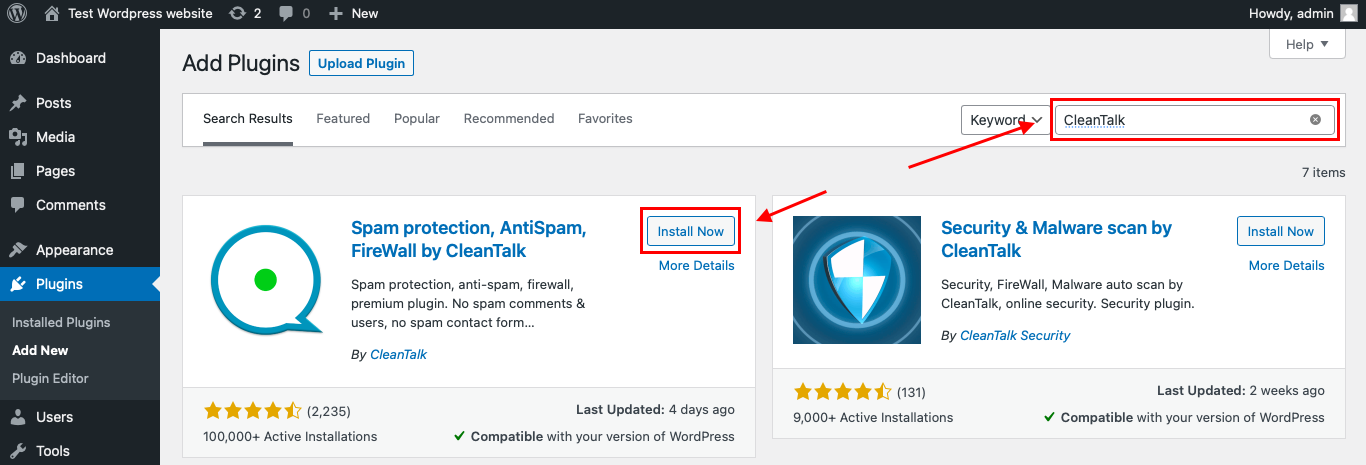
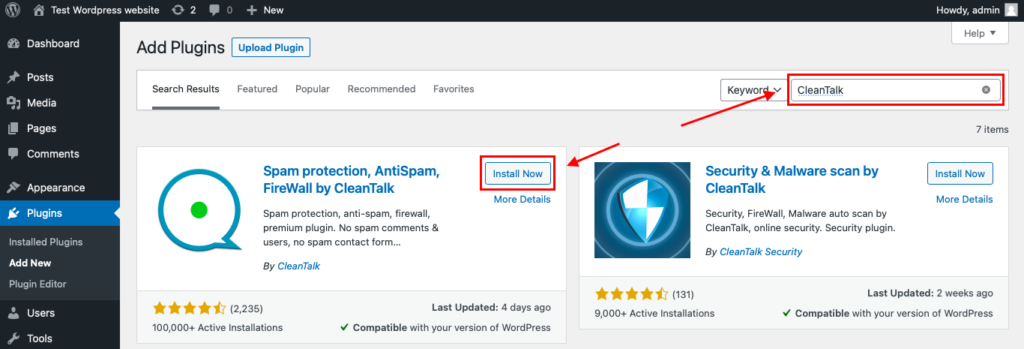
    To install the Anti-Spam plugin, go to your WordPress admin panelPluginsAdd New.

    image

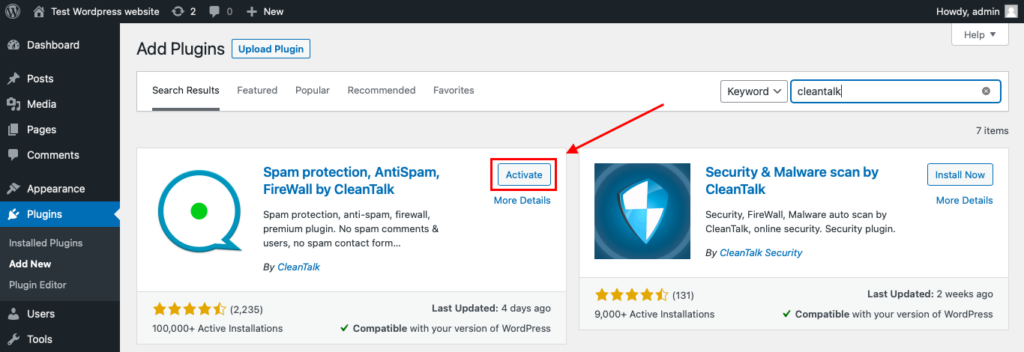
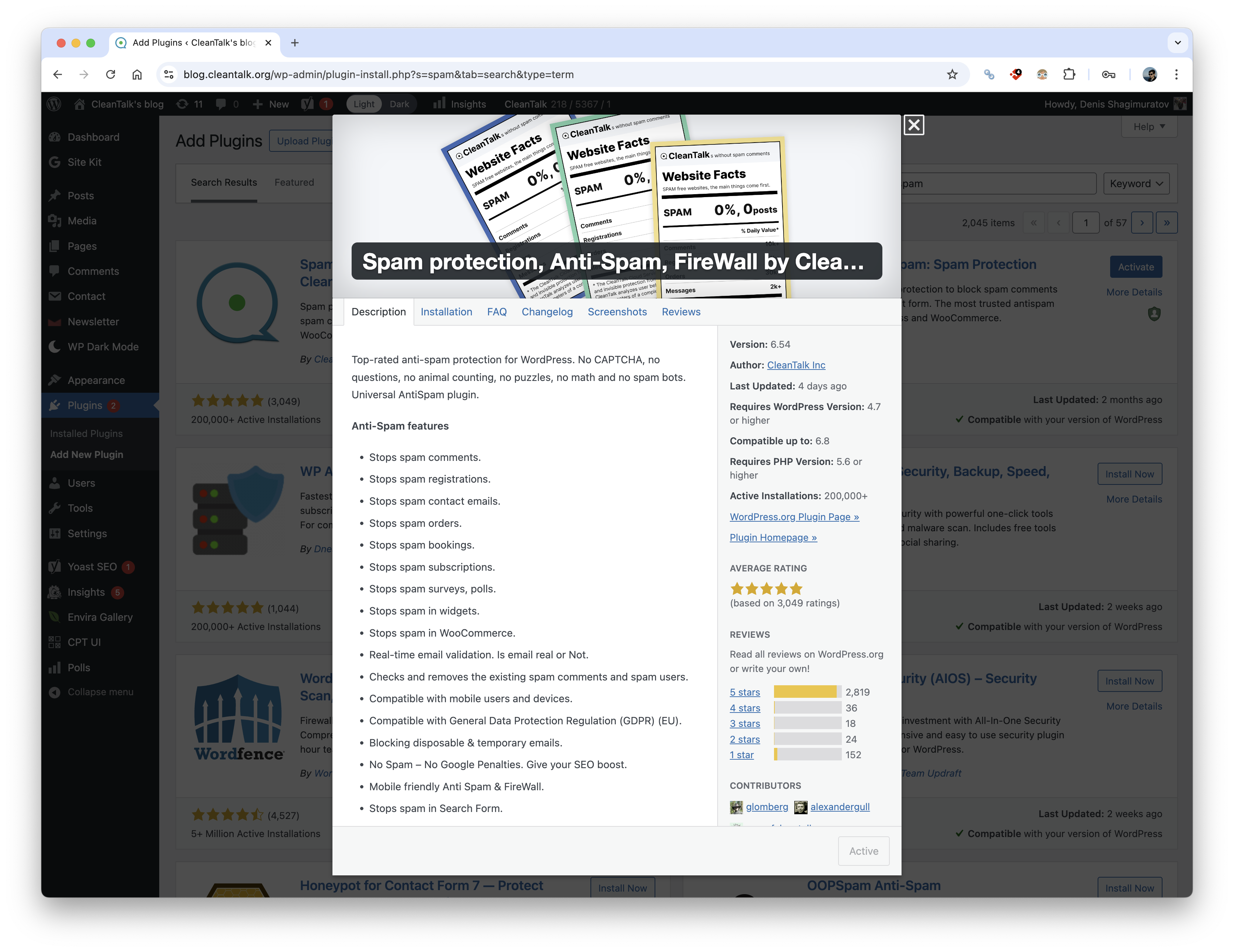
    Then enter «СleanTalk» in the search box and click the Install button for «Spam protection, Anti-Spam, FireWall by CleanTalk».
    image

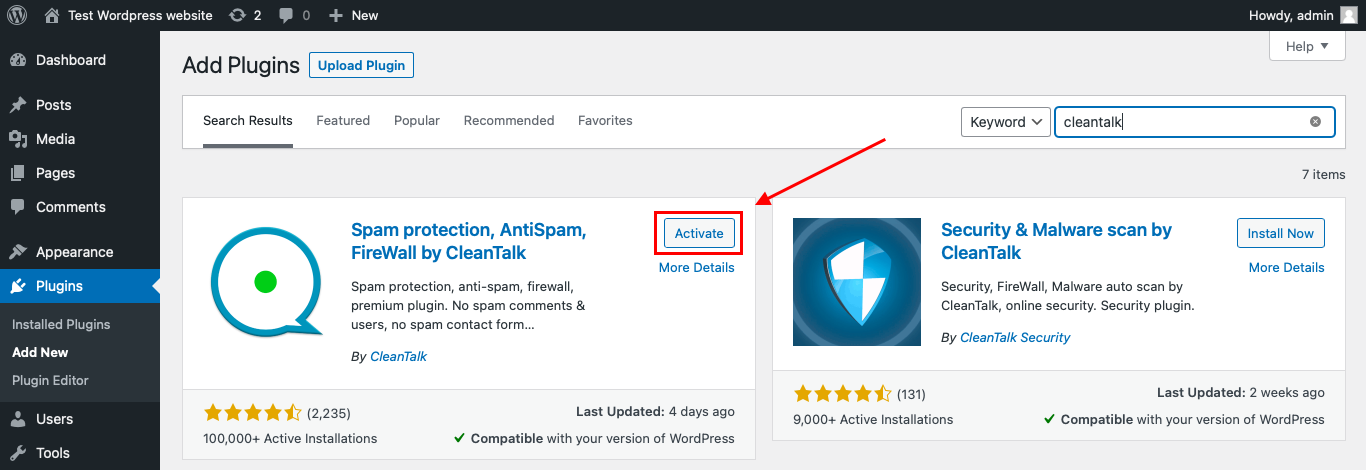
    After installing the plugin, click the «Activate»‎ button.

    image

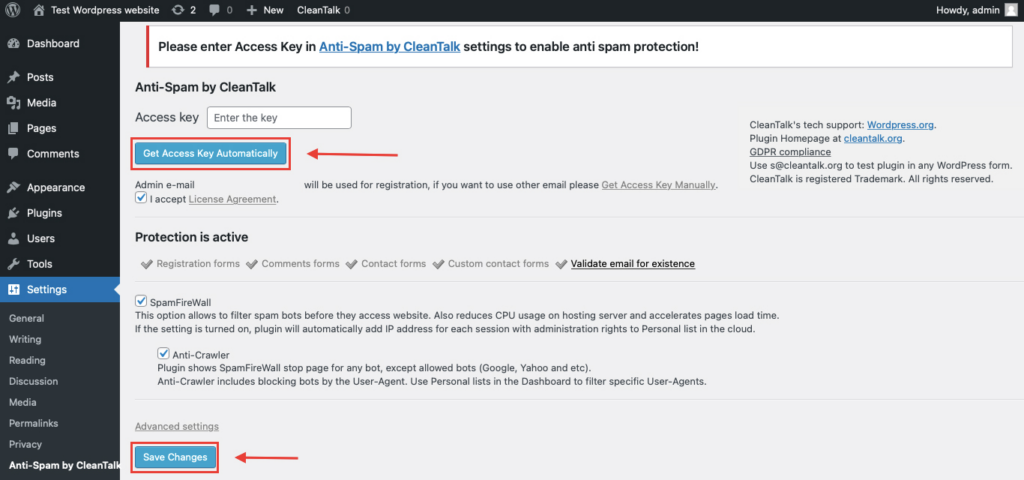
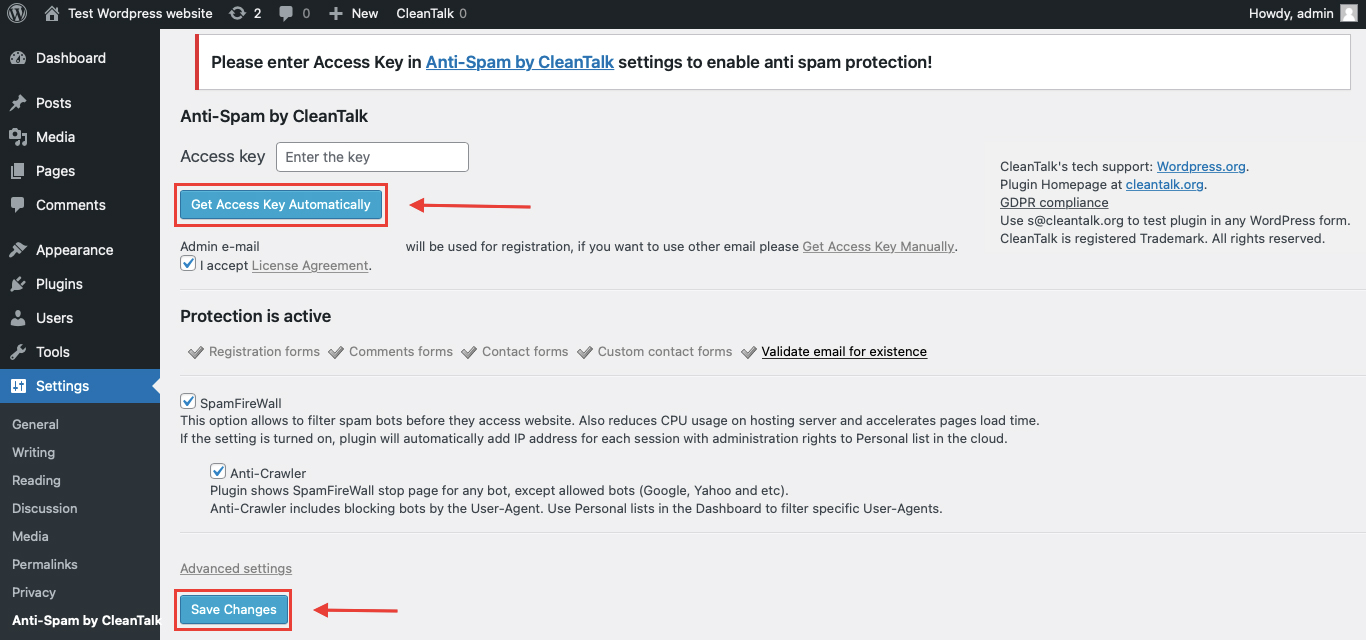
    After it is done go to the plugin settings and click the «Get Access Key Automatically» button. Then just click the «Save Settings»‎ button.

    image

    That’s all –  Contact Form 7 are now protected From this moment,CleanTalk automatically protects the  Contact Form 7 registration form (REST route /wp-json/Contact Form 7press/v1/users/), and the Add Listing form used to submit new listings.
    You don’t need to paste any shortcodes – just use  Contact Form 7 as usual, and CleanTalk will filter spam in the background.

    Check if spam protection works with Contact Form 7 (CF7)

    The best way to text the spam protection by using a test email,

    stop_email@example.com

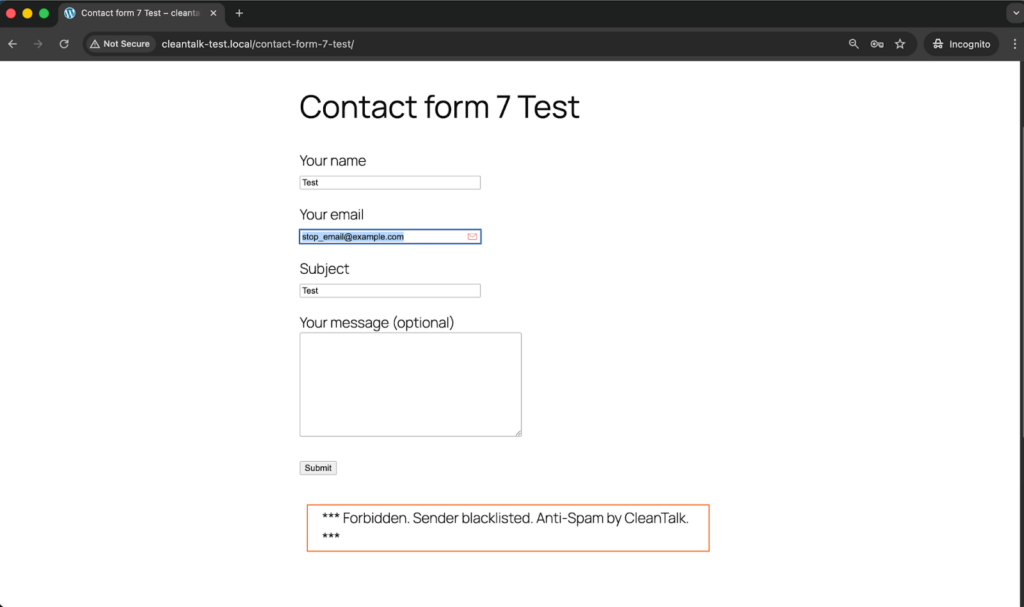
    1. Open a page with a Contact Form 7 (for example, the registration popup or the Add Listing form) in an Incognito / private browser tab.
    2. Fill out the Contact form using stop_email@example.com as sender’s email.
    3. Send the form.
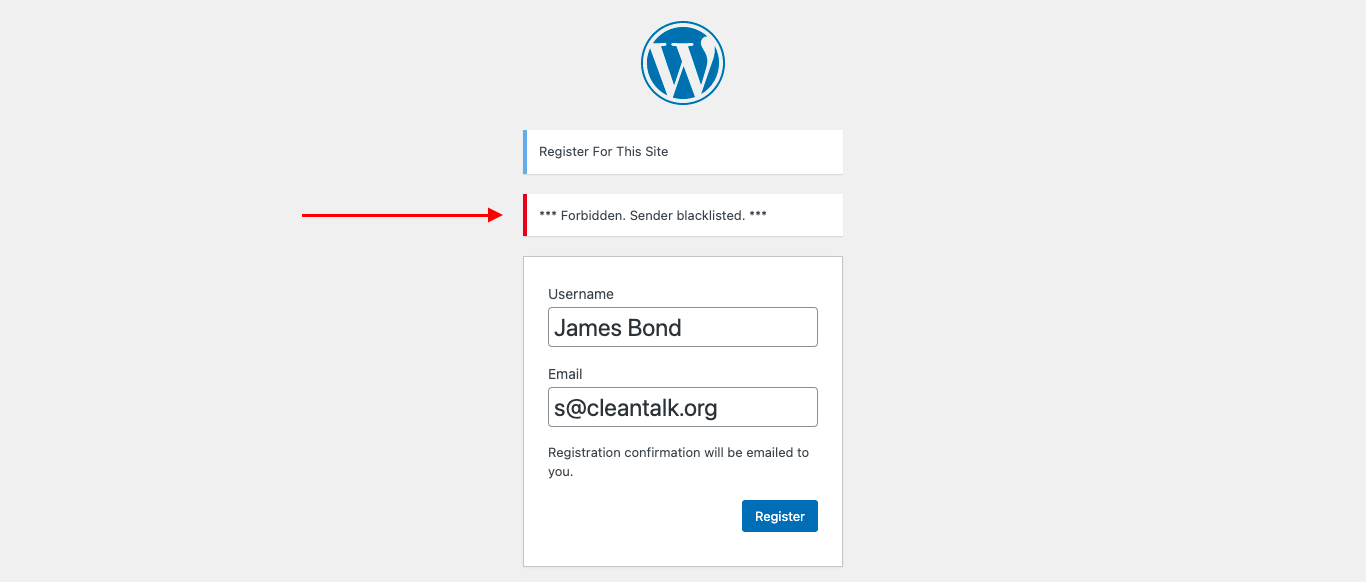
    4. You should see a message from the Anti-Spam plugin confirming that a spam submission was blocked.

    *** Forbidden. Sender blacklisted. Anti-Spam by CleanTalk. ***
    image

    If you see this message, it means CleanTalk successfully protects your Contact Form 7 (registration and Add Listing) from spam.

    Cloud Dashboard

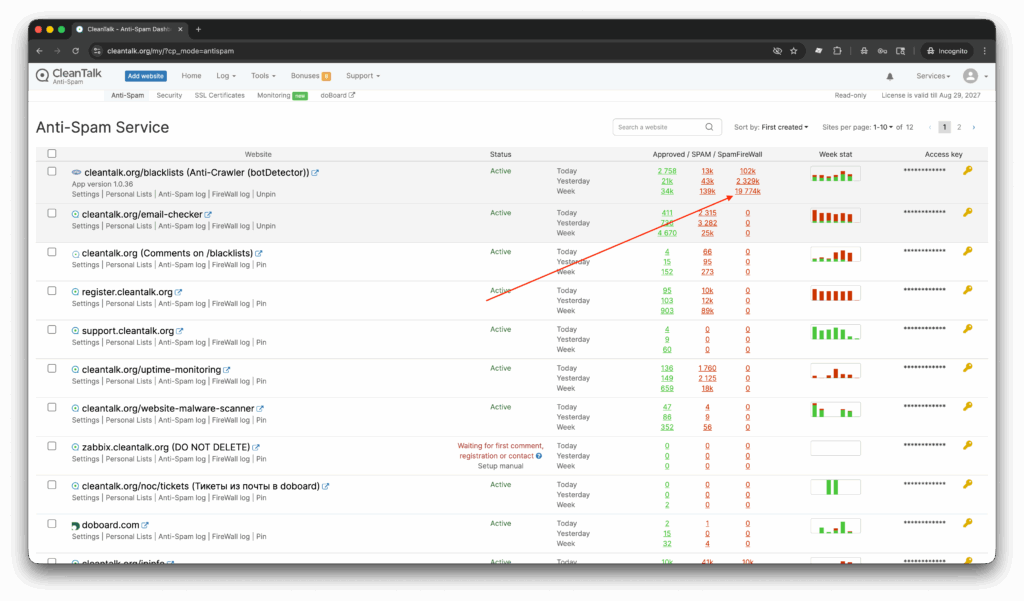
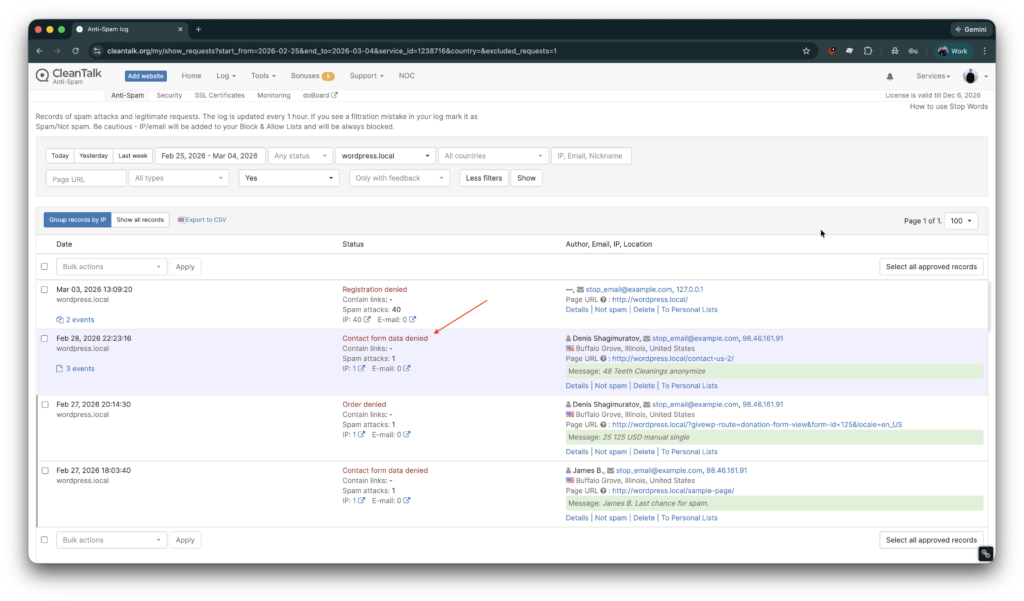
    In addition, in the Cloud Dashboard you can find extra details regarding all submissions processed by CleanTalk, including Contact Form 7 registration and Add Listing forms:

    • IP and email of the sender, as well as the sender’s activity history across other websites connected to the CleanTalk cloud.
    • Geolocation of the sender.
    • Date and time of the submission.
      Page (URL) where the form was submitted (for example, a specific listing submission page).
    • Cloud decision – Approved or Denied.
    • Cloud explanation for the decision (e.g. blacklisted email, bad IP reputation, spam text, etc.).
    • Tools to move the sender to Block or Allow lists so you can fine-tune  Contact Form 7 spam protection.

    FAQ

    I still get spam in Contact Form 7 after setting everything up. What should I do?

    If spam still gets through, the first step is to stop treating any one plugin as a complete solution. Contact Form 7 itself recommends using two or more spam-protection modules together, because different tools catch different abuse patterns. In practice, that usually means combining a bot-reduction layer such as Turnstile or reCAPTCHA with a filtering layer such as Akismet or an external service such as CleanTalk, plus simple rule-based blocking through the disallowed list when you see repeated phrases or IP-based abuse.

    Should I choose Turnstile or reCAPTCHA for Contact Form 7?

    If you want to stay within Contact Form 7’s official CAPTCHA-style options, Cloudflare Turnstile is now the clearer default choice. Contact Form 7 explicitly says, “We recommend Turnstile unless you have reasons to use reCAPTCHA.” reCAPTCHA v3 remains supported, but Contact Form 7 also warns that CAPTCHA solutions are mainly effective against spambots and can be weak against other types of spam, including human spam.

    Is Akismet enough on its own?

    Akismet is one of the strongest native filtering layers in the Contact Form 7 stack, and CF7 even calls it the “centerpiece” of its spam-prevention strategy. But Contact Form 7 does not frame Akismet as a one-plugin answer to every spam problem. The project recommends combining different protection types, which is why Akismet works best alongside another layer such as Turnstile, reCAPTCHA, or an external server-side anti-spam service.

    Contact Form 7 says the message was sent, but I never received the email. Is that a spam issue?

    Not necessarily. Contact Form 7’s FAQ explains that if you see the green success message, the PHP mail function completed successfully, but the message may still have been filtered or lost afterward. The same FAQ notes that spam filters often cause this kind of problem. That means this is usually a mail deliverability issue rather than a form-spam issue.

    How do I improve email deliverability for Contact Form 7 notifications?

    Start with Contact Form 7’s own mail best practices. The plugin recommends using a From address that belongs to the same domain as the website, setting a proper Reply-To header for the sender’s real email, and enabling email authentication methods such as SPF and DKIM. WordPress also explains that wp_mail() depends on the site’s mailing environment, so if local mail is not configured properly, routing mail through a correctly configured SMTP or mail provider setup is often more reliable.

    Final recommendation

    If your goal is to stop Contact Form 7 spam reliably without making the form harder for real users, the best approach is a layered protection stack. In 2026, inside the official Contact Form 7 ecosystem, the strongest starting point is usually Cloudflare Turnstile + Akismet, supported by the disallowed list where repeated patterns appear. That recommendation matches Contact Form 7’s own guidance: use multiple anti-spam modules together, treat Akismet as a core filtering layer, and prefer Turnstile over reCAPTCHA unless there is a specific reason to stay with Google’s solution.

    If you want broader site-wide protection without relying only on CAPTCHA-style challenges, an external server-side solution such as CleanTalk is a reasonable alternative to include in the comparison, especially for sites that want a CAPTCHA-free layer across Contact Form 7, comments, and registrations. The right choice depends on how much spam you get, how much friction you can tolerate, and whether you need protection only for Contact Form 7 or across WordPress more broadly.

    The most important takeaway is simple: in 2026, no single anti-spam method is enough for every Contact Form 7 site. CAPTCHA can reduce automated abuse, Akismet can evaluate suspicious submissions, rule-based filters can block recurring patterns, and external services can add broader server-side protection. The sites that perform best usually combine these layers instead of expecting one plugin or one checkbox to solve the entire problem.
    Stop Contact Form 7 spam without CAPTCHAs

    Create your CleanTalk account and protect Contact Form 7 from bot and human spam with server-side filtering. Keep forms easy for real visitors while extending protection across comments, registrations, and other WordPress forms.

    CleanTalk Account

    No credit card required • Setup takes less than a minute • Your temporary password will be sent by email.

  • Is zekisuquc419@gmail.com Spam Bot? How to Stop It

    Is zekisuquc419@gmail.com Spam Bot? How to Stop It

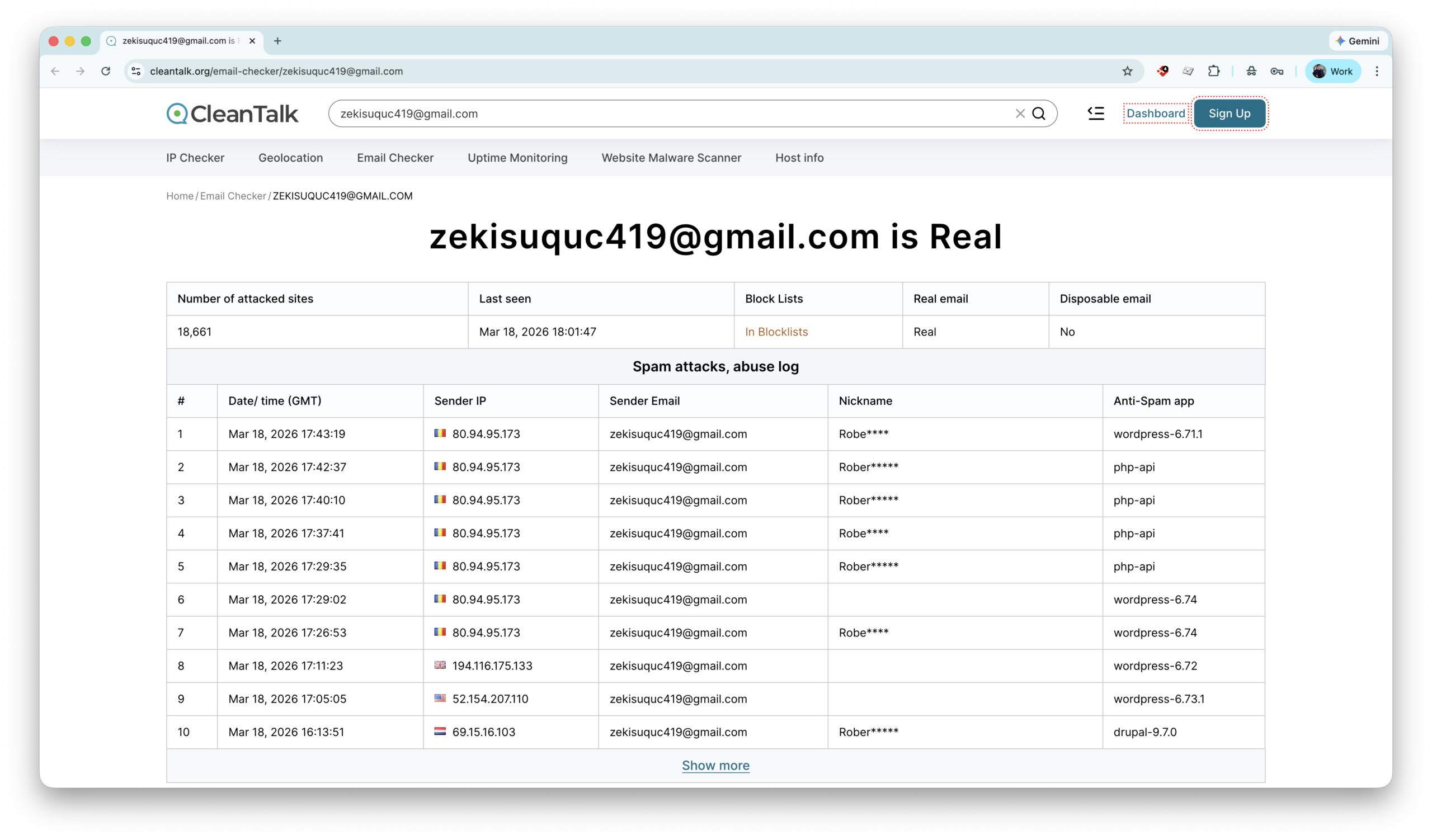
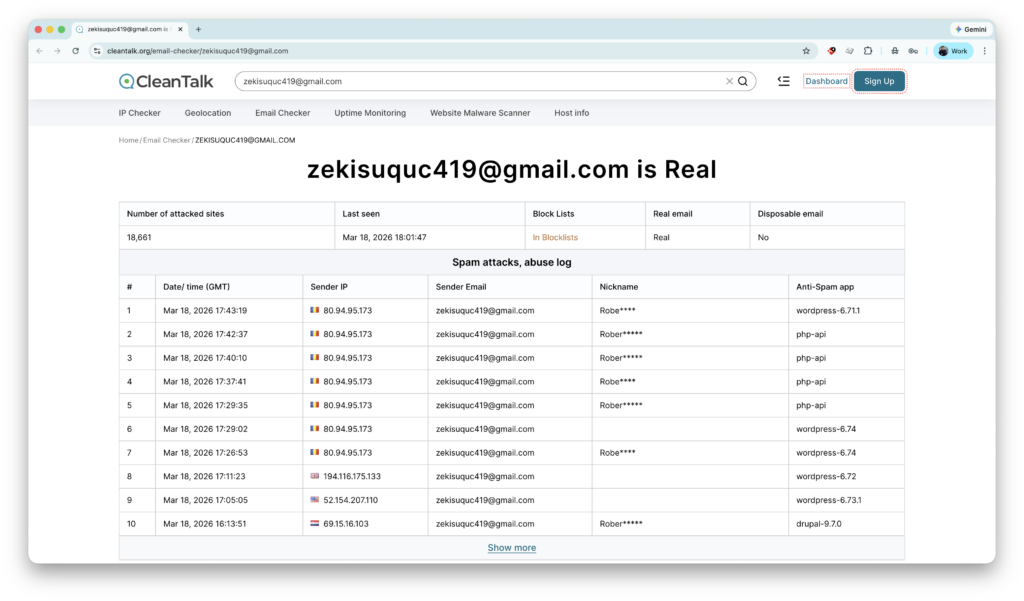
    The email address zekisuquc419@gmail.com has been reported for sending spam and launching automated malicious requests on thousands of websites. According to CleanTalk Block Lists, this address has:

    • Attacked over 10,000 websites.
    • Generated approximately 12,144 spam requests in the last 24 hours.
    • Used Russian IP addresses to send requests.
    • First detected on March 19, 2025.
    • Last activity recorded on March 18, 2026, attacked over 18,661 websites.

    What Does This Spam Bot Do?


    This bot attempts to register accounts, submit forms, and post comments on websites using the email zekisuquc419@gmail.com. The activity is fully automated and intended to spread spam or malicious links. This can:

    • Clutter your website with junk content
    • Expose your visitors to phishing or malware
    • Harm your SEO and domain reputation

    This spam bot uses multiple languages to send what look like harmless price inquiries, helping it evade standard spam detection systems. At first sight, these messages seem genuine, which makes them especially dangerous for site administrators who could easily confuse them with real customer requests.

    • Hi, I wanted to know your price.
    • Прывітанне, я хацеў даведацца Ваш прайс.
    • Salam, qiymətinizi bilmək istədim.
    • Zdravo, htio sam znati vašu cijenu.
    • Xin chào, tôi muốn biết giá của bạn.
    • Aloha, makemake wau eʻike i kāu kumukūʻai.
    • Ողջույն, ես ուզում էի իմանալ ձեր գինը.
    • Kaixo, zure prezioa jakin nahi nuen.
    • Hola, volia saber el seu preu.

    This bot uses this template to submit contact forms.

    Here is a snapshot from CleanTalk’s logs:

    “2160 requests in 24 hours detected from multiple Russian IP addresses. All actions associated with spam form submissions and bot-like behavior.”

    How to Block Spam from zekisuquc419@gmail.com

    If you’re seeing traffic or spam submissions from this email, here’s how to stop it:

    1. Use CleanTalk Anti-Spam Plugin
      Install the CleanTalk Anti-Spam plugin for your CMS (WordPress, Joomla, Drupal, etc.). It automatically filters requests by checking emails, IPs, and behavior against the global CleanTalk Spam Database. This email is already blacklisted and will be blocked automatically by the plugin.
    2. Manually Block the Email (if needed) through Personal lists in your Dashboard. If you want to block it manually in addition to using CleanTalk,
      – Add zekisuquc419@gmail.com to your site’s block list.
      – Block common IPs that were used in attacks (CleanTalk logs show many from Russian ranges).
    3. Monitor your server logs for repetitive POST requests in the Anti-Spam log at your Dashboard.

    zekisuquc419@gmail.com is a known spammer attacking thousands of sites daily. By installing proper anti-spam protection like CleanTalk and staying vigilant, you can block these threats before they reach your visitors.

    If you’re already using CleanTalk, rest assured — this spammer is on the blacklist and will be filtered automatically.

    You can check any email or check any IP for spam activity on our Block Lists page.

    🧩 Want full protection?

    ✅ Blocks fake registrations and spam submissions
    ✅ Filters bots and fake emails in real time
    ✅ No CAPTCHAs or puzzles – clean and fast

    Stay ahead of spam – let CleanTalk handle the bots so you can focus on your content. Protect your site in under 5 minutes.
    👉 Start now

    Have you come across this kind of spam? Share your experience in the comments.

  • Spam protection is available for HubSpot and Leaky Paywall

    Spam protection is available for HubSpot and Leaky Paywall

    I’m glad to announce our experienced developers added spam protection to Anti-Spam by CleanTalk for Leaky Paywall and HubSpot users!

    The protection works in this way,

    To active protection for both services, simply install Anti-Spam by CleanTalk for WordPress,
    https://cleantalk.org/help/install-wordpress

    Make sure you are using at least 6.50 version of our plugin.

    Have any questions? Drop a message in the comment form down below!

    Have fun in promoting your business online!

  • 6 reasons not to use Contact Form 7 CAPTCHA spam protection for your website

    6 reasons not to use Contact Form 7 CAPTCHA spam protection for your website

    CAPTCHA technology is a widely used tool to prevent spam and abuse on websites. This free technology uses risk analysis techniques to distinguish humans from bots. It may seem like a convenient and free solution for protecting contact forms from spam. Still, there are several reasons why using CAPTCHA with Contact Form 7 can be detrimental to user experience and website accessibility.


    1. Using CAPTCHA degrades user experience

    One of the main issues with using CAPTCHA is its impact on user experience. The traditional CAPTCHA process requires users to solve a challenge, such as identifying objects in images or solving puzzles before they can submit a form. This extra step can be frustrating for users, particularly those with visual or cognitive impairments. It creates a barrier to entry and can discourage potential visitors from engaging with the website. The use of free tools is a saving on the convenience of visitors. And they understand that.


    2. Impossible to be used by visitors with disabilities

    Moreover, CAPTCHA can be especially challenging for individuals with disabilities. Such as those who rely on screen readers or have difficulty with fine motor skills. The visual and interactive nature of CAPTCHA challenges can make it inaccessible to these users. That helps effectively exclude them from interacting with the contact form.


    3. Data Privacy

    In addition to accessibility concerns, CAPTCHA also raises privacy issues. The tool collects and processes large amounts of personal data, including user behavior and device information, to determine whether a visitor is a bot or a human. This data collection raises concerns about user privacy and data security, as it involves sharing sensitive information with a third-party service provider. So, when you use a free solution, you still pay, but only with the convenience of your visitors and the security of their data.

    For example, Google reCAPTCHA’s reliance on Google’s infrastructure means that website owners have limited control over how their users’ data is handled. This lack of transparency and control can be problematic, especially in light of increasing concerns about data privacy and online security.


    4. Slowing down your website

    Another drawback of using Contact Form 7 CAPTCHA is the potential impact on website performance. The CAPTCHA script adds additional overhead to the website, increasing load times and affecting overall performance. This can lead to a suboptimal user experience and may deter visitors from engaging with the contact form or other parts of the website.


    5. Risk of technical issues

    Moreover, CAPTCHA’s reliance on external scripts and resources means that it introduces another point of failure to the website. If the CAPTCHA service experiences downtime or technical issues, it can prevent users from submitting forms or accessing content, disrupting the normal functioning of the website.


    6. Ethical issues

    In addition to these practical concerns, there are also ethical considerations associated with using Contact Form 7 CAPTCHA spam protection. By relying on a proprietary tool developed by a tech giant like Google, website owners contribute to the consolidation of power in the hands of a few dominant players in the tech industry. This can have far-reaching implications for competition, innovation, and the open web.


    What are the alternatives?

    Fortunately, there are alternative approaches to protecting contact forms from spam that do not rely on CAPTCHA. The most effective way is to use an invisible cloud-based spam protection, that has a direct integration with Contact Form 7. One of these solutions is the Anti-Spam protection by CleanTalk.


    Join 842,000+ websites, already trusting CleanTalk

    Why CleanTalk Anti-Spam
    instead of CAPTCHA-based solutions

    CleanTalk Anti-Spam offers several advantages over traditional CAPTCHA solutions, making it a more user-friendly and effective option for protecting websites from spam. Here are some reasons why CleanTalk Anti-Spam is considered superior to CAPTCHA:

    Compatibility
    CleanTalk Anti-Spam is compatible with a wide range of platforms and content management systems, making it easy to integrate with existing websites without requiring extensive customization or development work

    Privacy and Security
    The Anti-Spam service prioritizes user privacy and data security and operates without invasive data collection practices. This approach aligns with the growing concerns about online privacy and data protection.


    User-Friendly Experience
    The Anti-Spam provides a seamless and non-intrusive experience for website visitors. It operates in the background without requiring any action from the user. This approach minimizes friction and frustration for visitors, leading to a more positive user experience.
    Performance
    CleanTalk Anti-Spam cloud protection operates efficiently in the background, minimizing the impact on website performance and ensuring a smooth user experience.
    Accessibility
    CleanTalk Anti-Spam does not rely on visual or interactive challenges, making it more accessible to a wider range of users, including those with disabilities.
    Effectiveness
    The Anti-Spam plugin employs advanced algorithms and machine learning techniques to accurately identify and effectively filter out unwanted content while reducing false positives, ensuring that legitimate form submissions are not erroneously blocked.
  • How to protect your BuddyPress Forms from spam

    How to protect your BuddyPress Forms from spam

    In case you prefer to use BuddyPress registration form be sure to use the most effective Anti-Spam plugin. Read the guide below and learn how to protect your BuddyPress Registration Forms from spam.

    Once the CleanTalk Anti-Spam plugin is installed it starts to protect all of the existing forms on your WordPress website. It may not only be registration form but also contact forms and many others.

    Download CleanTalk Anti-Spam plugin | Download BuddyPress Registration Form 

    How to install CleanTalk Anti-Spam plugin

    To install the Anti-Spam plugin, go to your WordPress admin panelPluginsAdd New.

    Then enter «СleanTalk» in the search box and click the Install button for «Spam protection, Anti-Spam, FireWall by CleanTalk».

    After installing the plugin, click the «Activate»‎ button.

    After it is done go to the plugin settings and click the «Get Access Key Automatically» button. Then just click the «Save Settings»‎ button.

    That’s it! From now you How to completely protect your BuddyPress Registration Form from spam.

    Check the result to save your BuddyPress Registration Form from spam

    You can test the work of Anti-Spam protection for your BuddyPress Registration Form by using a test email s @ cleantalk.org (without spaces). First, open the form in an Incognito browser tab. Fill in all the required form fields and send a form. After submitting the form, you will see a block message about the block on the form submission.

    If you have any questions, add a comment and we will be happy to help you.

    Create your CleanTalk account – Register now and protect your BuddyPress Registration Form from spam in 5 minutes

    Update

    The protection works only for website visitors, not for website admins. Be sure to test the form protection using Incognito mode.

    Additional features

    • CleanTalk protects all forms at once: comments, registrations, feedbacks, contacts, reviews.
    • Installation takes about 1-2 minutes.
    • Smart 99% protection against spambots.
    • Always online – 24/7 technical support.
    • Logs, SpamFireWall, personal lists, country filters, stop-words, and many others.

    Discover the complete list of CleanTalk Anti-Spam plugin features here.

  • How to Disable all WordPress Comments

    How to Disable all WordPress Comments

    If you get spam through your comments forms you can always use our Anti-Spam plugin for complete spam protection. But if you decided to disable all WordPress Comments on your website we also have a simple decision for you.

    Follow our guide to disable all the Comments fields you don’t need in less than 5 minutes.

    How to install CleanTalk Anti-Spam plugin

    To install the Anti-Spam plugin, go to your WordPress admin panelPluginsAdd New.

    Then enter «СleanTalk» in the search box and click the Install button for «Spam protection, Anti-Spam, FireWall by CleanTalk».

    After installing the plugin, click the «Activate»‎ button.

    After it is done go to the plugin settings and click the «Get Access Key Automatically» button. Then just click the «Save Changes»‎ button.

    Disable all WordPress Comments in 3 steps

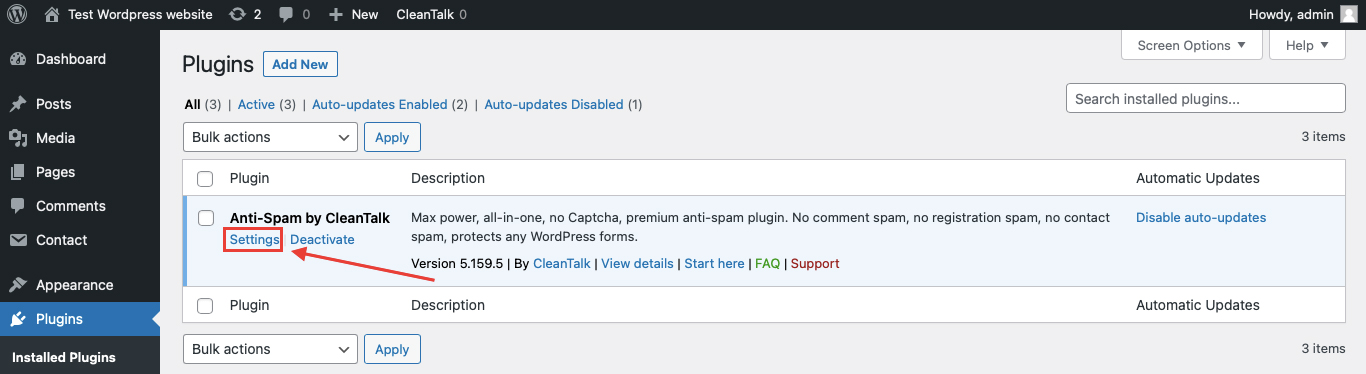
    Step 1: Go to Plugins Installed Plugins.

    Then go to Settings link next to CleanTalk Anti-Spam plugin.

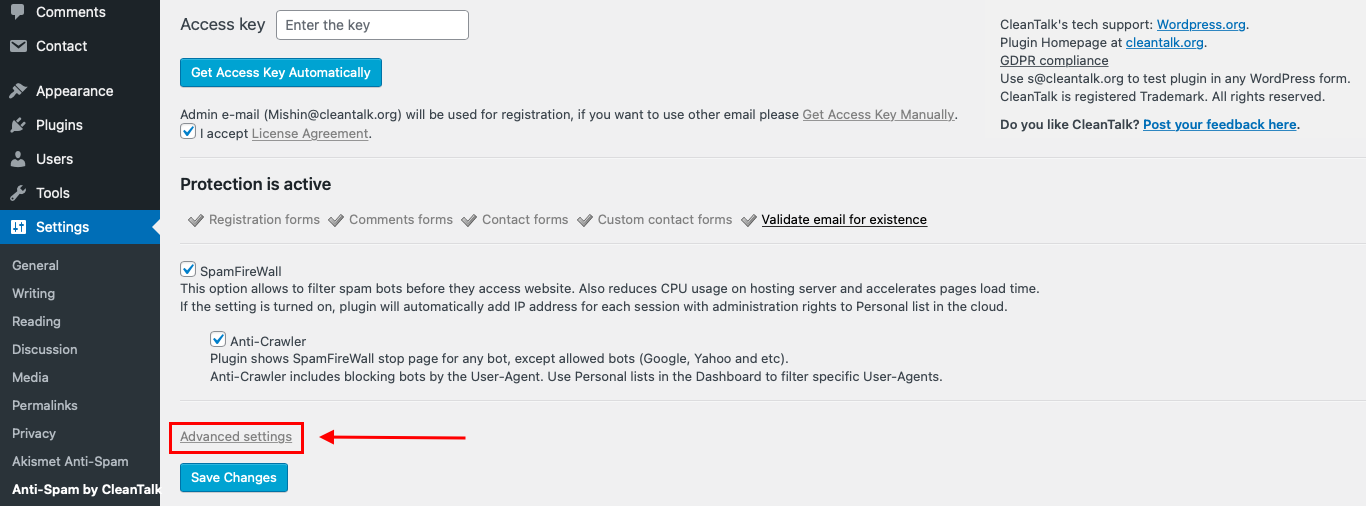
    Step 2: Click on «Advanced settings» button at the bottom of the screen. More setting will appear.

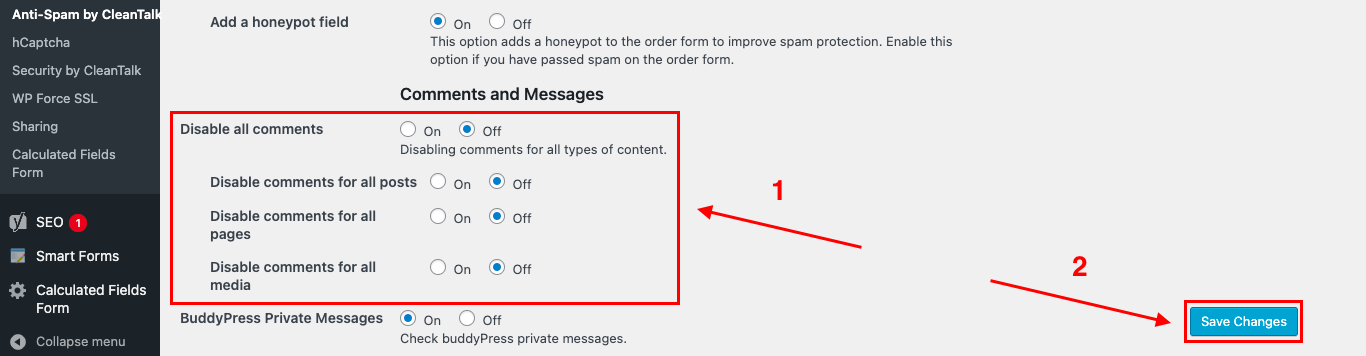
    Then find Disable all comments in Comments and Messanges section.

    Step 3: Choose wherever you want to disable comments (1) and then press the Save Changes button (2).

    Done! It really is that simple.

    If you have any questions, add a comment and we will be happy to help you.

    Create your CleanTalk account – Register now.

    Additional features

    • CleanTalk protects all forms at once: comments, registrations, feedbacks, contacts, reviews.
    • Installation takes about 1-2 minutes.
    • Smart 99% protection against spambots.
    • Always online – 24/7 technical support.
    • Logs, SpamFireWall, personal lists, country filters, stop-words, and many others.

    Discover the complete list of CleanTalk Anti-Spam plugin features here.

  • How to protect your Clean and Simple Forms using CleanTalk Anti-Spam plugin

    How to protect your Clean and Simple Forms using CleanTalk Anti-Spam plugin

    After you created your Clean and Simple Contact Form you may get spam through this form. CleanTalk Anti-Spam plugin protects your Clean and Simple Contact Forms from spam and save your visitors time.

    Once CleanTalk Anti-Spam plugin is installed it starts to protect all of the existing forms on your WordPress website. It may not only be Clean and Simple Contact Forms but many others.

    How to install CleanTalk Anti-Spam plugin

    To install the Anti-Spam plugin, go to your WordPress admin panel → Plugins → Add New.

    Then enter «СleanTalk» in the search box and click the Install button for «Spam protection, Anti-Spam, FireWall by CleanTalk».

    After installing the plugin, click the «Activate»‎ button.

    After it is done go to the plugin settings, click the «Get Access Key Automatically» button. Then click the «Save Settings»‎ button.

    That’s it! From now your WordPress website and Clean and Simple Contact Forms are protected from spam.

    You can always use our detailed installation instructions.

    Download CleanTalk Anti-Spam plugin | Download Contact Form by Clean and Simple Contact Forms 

    How to check that CleanTalk already protects your Clean and Simple Contact Forms from spam

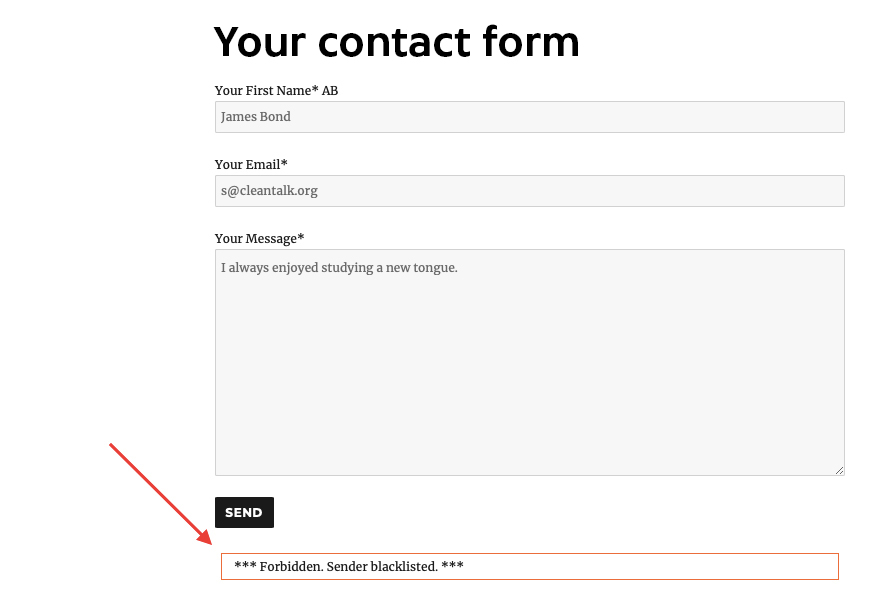
    You can test the work of Anti-Spam protection for your Clean and Simple Contact Forms by using a test email s @ cleantalk.org (without spaces). First, open the form in an Incognito browser tab. Fill in all the required form fields and send a form. After submitting the form, you will see a block message about the block on the form submission.

    If you have any questions, add a comment and we will be happy to help you.

    Create your Cleantalk account – Register now and enjoy while CleanTalk Anti-Spam plugin protects your Clean and Simple Contact Forms from spam.

    Update

    The protection works only for website visitors, not for website admins. Be sure to test the form protection using Incognito mode.

    Additional features

    • CleanTalk protects all forms at once: comments, registrations, feedbacks, contacts, reviews.
    • Installation takes about 1-2 minutes.
    • Smart 100% protection against spambots.
    • Always online – 24/7 technical support.
    • Logs, personal lists, country filters, stop-words and many another.

    A complete list of CleanTalk Anti-Spam plugin features can be viewed here https://cleantalk.org/help/introduction 

  • Access key rotation for Anti-Spam and Security

    Access key rotation for Anti-Spam and Security

    In case your website is connected to CleanTalk it uses a special Access key to exchange information. We have improved its functionality to guarantee you the safest user experience.

    Connect your website to CleanTalk in 5 minutes and forget about spam.

    Improved Access key safety

    Your Anti-Spam and Security Access keys don’t have any expiration date. So don’t worry, you don’t have to do anything about it.

    Access key doesn’t need to be manually renewed except several cases:

    • In case you gave your website access to web developer or a freelancer and it may be compromised.
    • When your website had been hacked.
    • When you expect your CleanTalk access being given or copied to a third party.
    • In case you have any other issues and risks with CleanTalk account access.

    Also you can always change your password or email in CleanTalk dashboard.

    How to update your Access key

    Step 1: Add your website to dashboard using the button below. If your site is already connected to CleanTalk pass to Step 3.

    Step 2: Input your website URL in “Site URL” field.

    Step 3: Click on “Settings” button under your website name.

    Step 4: Go to “Change the Access key”.

    Step 5: Click on “Generate key” to create new safe Access key.

    Step 6: Then Apply the key by pressing the button below.

    Step 7: And just close the window after you are finished.

    Well done! Your new Access key is successfully generated and applied to your website. From now it will be active and if needed, you may change it again to guarantee its safety.

  • Spam attack on the CleanTalk Service

    Good day!

    We must inform you that some days ago we have been attacked by spam on our service. Spammers used species emails xxxx@cleantalk.org to send spam comments/registrations / subscriptions. At the moment, the attack affected about 4,000 websites. This is not the first such attack on our service, just a couple of weeks ago we faced with a DDoS attack, which we are pretty well blocked.

    PS

    A little add the message to avoid misunderstandings.

    It was not a spam via SMTP and the substitution of the sender’s address. This spam is caused by the fact that spammers use your public email for subscriptions to news and stuff on other websites.

    The problem is actually much wider, we are a small company and we have not caused any difficulties. But for large companies, which business is tied to e-mail, receiving orders for example?

    Let’s say John Doe took for the example online shop, took them the email address for type orders order@example.com and signed up with this address on 10,000 newsletters at different sites. Every day, this address will be sent news and other mailings, the work of the sales department in this store can be significantly slowed down and cause losses for business, including reputation ones.

    There are several problems here:

    1. Websites are poorly protected from spam.
    2. The company may have problems because it starts receiving a lot of messages.
    3. Reputation losses. Site owners see spam from you, the visitors of websites can see spam from you.

    What do you think, how we can avoid it?

  • New anti-spam checks for WordPress, XenForo, phpBB 3.1, SMF, Bitrix

    We are pleased to announce that we have released new versions of plugins for WordPress, XenForo, phpBB 3.1, SMF, Bitrix.

    In the new version, we have added some new checks for spam to improve anti-spam service.

    Mouse tracking and Time zone monitoring give good results against spam bots which simulate the behavior of real visitors.

    These checks for other CMS will be added soon.

    Please, update your anti-spam plugins for latest version:

    WordPress
    XenForo
    phpBB 3.1
    Simple Machines Forum
    Bitrix