

If you use Quform on a WordPress website, spam will eventually become a real problem. Fake messages, bot submissions, junk inquiries, and low-quality entries can quickly fill your inbox and make genuine submissions harder to manage.
This guide explains how to set up Quform spam protection using CleanTalk as the main filtering layer on your website, together with additional tools already available inside Quform, such as honeypot, image CAPTCHA, reCAPTCHA, validators, and time-based spam prevention. Quform’s official features page explicitly lists honeypot, image CAPTCHA, and reCAPTCHA as built-in spam-prevention options, while its blog documents time-based spam prevention as an added passive layer.
This protection approach can be applied to contact forms, quote requests, lead forms, booking forms, surveys, upload forms, and other public-facing forms created in Quform. Quform also supports saving form data to a custom database table, which makes clean submissions even more important over time.

Quform for WordPress
Before looking at protection methods, it helps to understand how Quform is used on WordPress sites.
Quform is a premium WordPress form builder by ThemeCatcher. On its official site, it is positioned as a professional drag-and-drop form builder for WordPress, and its features page highlights custom autoreplies, import/export, validators, filters, database saving, and built-in anti-spam tools.
In practice, Quform can help website owners:
- create contact and inquiry forms
- collect leads and quote requests
- save submissions to the database
- build more advanced multi-field and conditional forms
That flexibility is exactly why spam becomes an issue. Once a form is public, it can attract bots, fake submissions, repeated junk messages, and low-quality lead traffic.
Quform’s official homepage describes it as CodeCanyon’s favorite or best-selling form builder for WordPress. Because Envato search snippets do not consistently expose a stable per-item sales count in every view, this is the safest current way to describe its market footprint without overstating a number from an outdated snapshot.
As Quform shows on its official website, the plugin has been on the market for over 10 years, has 30,000+ downloads, and is presented as a 5 star rated form builder for WordPress.
Plugin Homepage at Quform | Product Page at CodeCanyon.
Why Quform Attracts Spam
Quform is built to make make both form building and form submission smooth. That is good for real visitors, but it also makes forms attractive to bad traffic.
In real-world use, the most common issues usually include:
- automated bot messages
- repeated junk submissions
- low-quality or fake leads
- form abuse on highly visible public pages
This matters even more in Quform because the plugin can save form data to a custom database table. If spam is not filtered well enough, it can affect not only inboxes, but also stored submission data and internal workflows.
Anti-Spam by CleanTalk
The main tool we’re going to use here is CleanTalk Anti-Spam.
CleanTalk is a cloud-based anti-spam service for WordPress sites. Its official WordPress plugin page describes it as CAPTCHA-free spam protection for forms, comments, registrations, subscriptions, and many other submission types, and the current WordPress.org listing shows more than 200,000 active installations.
In practical terms, CleanTalk helps by:
- filtering suspicious submissions before they are processed
- checking sender reputation and email quality
- detecting automated and repeated abuse patterns
- reducing junk entries before they reach Quform inboxes or stored submissions
That matters because the real cost of Quform spam is not only inbox clutter. It also means wasted time, weaker lead quality, and noisier data inside form workflows.
According to WordPress.org, Anti-Spam by CleanTalk for WordPress has over 200,000 active installations, with 3,168 reviews and an average rating of 4.7.
Plugin Homepage at cleantalk.org | Latest release at GitHub.com | Website cleantalk.org
Install the CleanTalk Anti-Spam plugin
Show Instructions
To install the Anti-Spam plugin, go to your WordPress admin panel → Plugins → Add New.
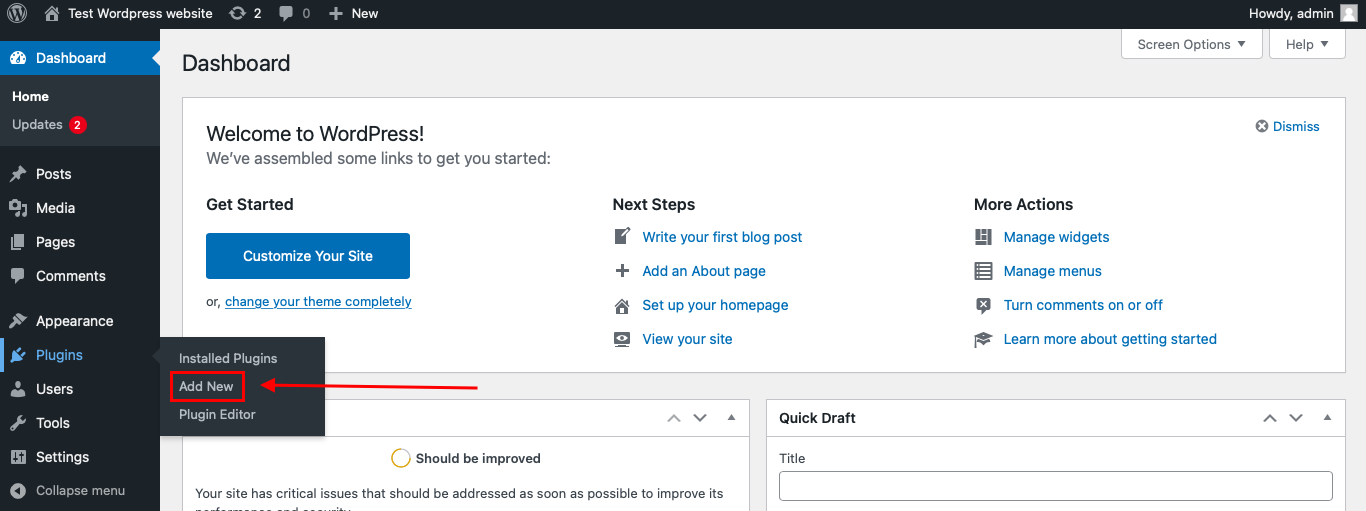
Then enter «СleanTalk» in the search box and click the Install button for «Spam protection, Anti-Spam, FireWall by CleanTalk».
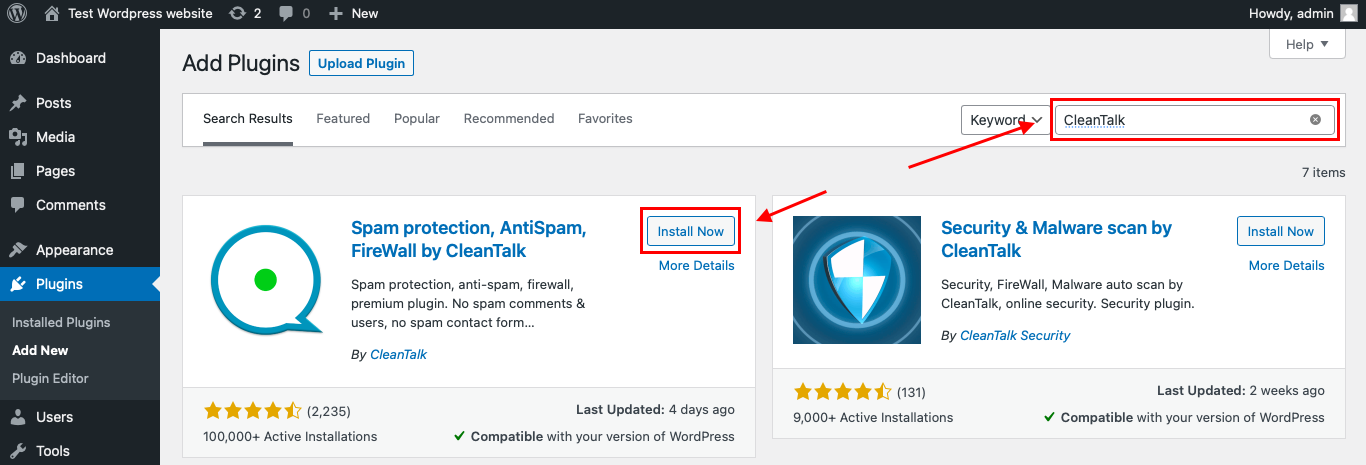
After installing the plugin, click the «Activate» button.
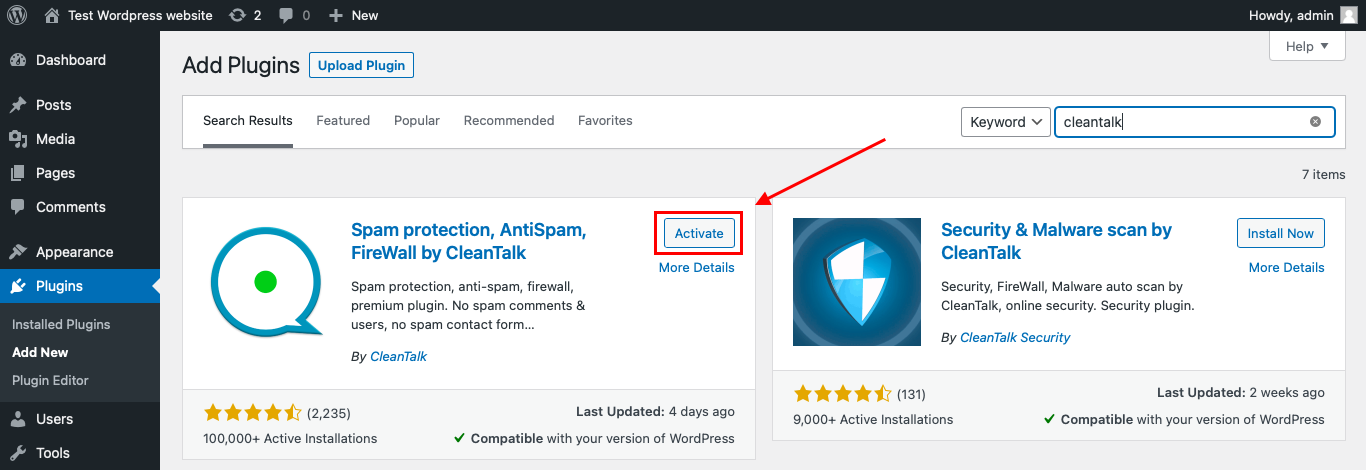
After it is done go to the plugin settings and click the «Get Access Key Automatically» button. Then just click the «Save Settings» button.
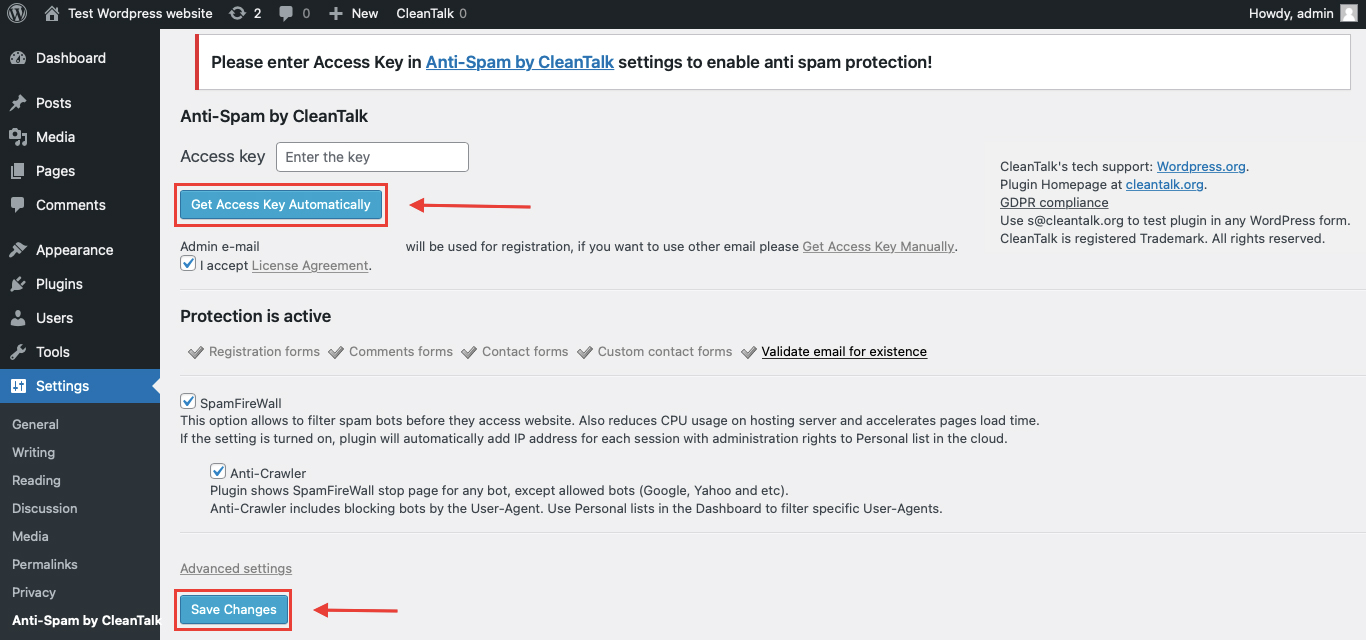
That’s it! From now you know how to completely protect your HivePress from spam.
Once that is done, your website has a background anti-spam layer that can help reduce suspicious Quform activity before unwanted messages reach their destination.
How CleanTalk Fits into the Quform Workflow
Quform runs inside WordPress, so the strongest place to apply protection is before a submission is treated as a normal message.
That means the focus should not be only on what the form looks like on the frontend. The more important point is what happens when the submission reaches WordPress.
If a site uses Quform for contact requests or lead capture, a site-level anti-spam layer can help stop suspicious submissions before they become normal entries.
If the website uses custom handlers, automations, autoresponders, or database saving after submission, the filtering layer should still be placed before the message is accepted into the workflow.
That is the key principle: do not wait until junk has already reached your inbox or stored data. Stop it earlier in the process.
How to Check Whether Spam Protection Works
A simple way to test the setup is to use the following test address:
stop_email@example.com
Open the page with your Quform form in an Incognito or private browser window.
Submit the form using that email address.
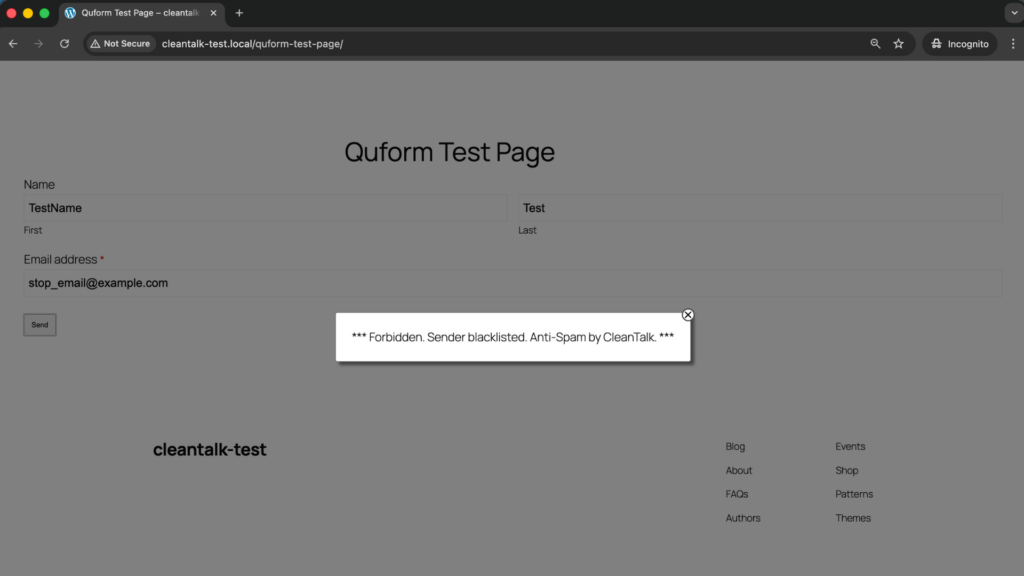
When testing, check both sides of the process:
- the frontend, to see whether the form accepts the submission
- the form entries, database records, or email destination, to verify that the message was not processed as a normal inquiry
This matters because a form may appear to submit on the surface while the real question is whether the message actually made it into your workflow.
Cloud Dashboard and Monitoring
Blocking spam is only one part of the job. Good protection also gives you visibility into what is happening.
In the anti-spam dashboard, it is useful to review:
- sender IP and email
- submission time
- source page
- approval or denial status
- the likely reason a message was flagged
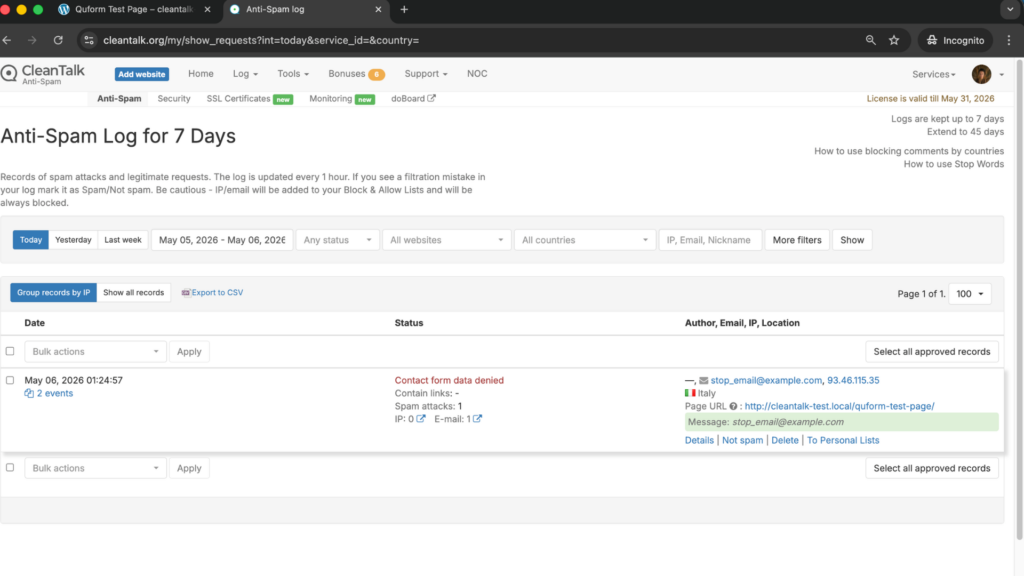
This makes it easier to spot recurring spam waves, identify weak pages, and understand which forms attract the most junk traffic.
That visibility helps you fine-tune the setup over time instead of guessing.
Honeypot, CAPTCHA, reCAPTCHA, and Additional Anti-Spam Options
Besides CleanTalk, Quform already includes several useful anti-spam controls.
Honeypot
Quform’s official features page lists honeypot as one of its built-in spam-prevention options. Its blog also explains that the honeypot field was improved so that it is randomly placed through the form and made to look more like normal fields to bots, which increases its usefulness against simple automation.
Honeypot is especially useful when:
- you want an invisible anti-spam measure
- you do not want to interrupt the user experience
- you need a lightweight first barrier against simple bots
Its limitation is that it works best against simpler automation, not every type of spam.
Image CAPTCHA
Quform also includes a built-in image CAPTCHA option. The official features page lists image CAPTCHA as one of Quform’s three built-in CAPTCHA methods.
Image CAPTCHA can be useful when:
- you want a visible challenge inside the form
- you are dealing with repeated automated submissions
- you need an extra checkpoint on high-risk forms
The tradeoff is friction: visible CAPTCHA fields can reduce completion rates on some forms.
Google reCAPTCHA
Quform’s features page also lists reCAPTCHA as a built-in spam-prevention option, and release notes mention fixes and support work related to the reCAPTCHA field.
reCAPTCHA can be helpful when:
- you want a familiar anti-bot checkpoint
- your site is seeing repeated automated submissions
- you need an extra verification layer alongside broader filtering
At the same time, reCAPTCHA should not be treated as the only line of defense.
Time-Based Spam Prevention
Quform’s blog documents a time-based spam prevention option. By default, submissions made too quickly after the form is displayed can be rejected, which helps catch automated behavior that moves faster than real users.
This is especially useful as a passive layer because it adds protection without introducing a visible challenge.
Why Quform Spam Becomes a Bigger Problem Over Time
Spam in Quform is not just a temporary annoyance. It tends to become an operational problem.
Once junk submissions start slipping through, they can:
- clutter inboxes and notifications
- reduce the quality of collected leads
- waste time on manual review
- fill saved form data with low-value entries
This is especially important if the site uses Quform not only for simple contact forms, but also for quote requests, support flows, surveys, or other business-critical form workflows.
Comparison of Anti-Spam Approaches for Quform
| Solution | Main role | Strengths | Limitations | Best use case |
| Quform honeypot | Built-in invisible anti-bot layer | Native to Quform, invisible to users, improved by random placement | Limited against more advanced spam patterns | Sites that want a lightweight first layer inside Quform |
| Quform image CAPTCHA | Built-in visible challenge | Native option, useful on higher-risk forms | Adds friction and may reduce completion | Forms that need an extra visible anti-bot step |
| Quform reCAPTCHA | Built-in anti-bot verification | Familiar, supported inside Quform, useful as an extra checkpoint | Should not be the only protection method | Sites that want a built-in additional anti-bot layer |
| Quform time-based protection | Passive speed-based filtering | Helps catch automated fast submissions without visible friction | Works best as a supporting layer | Sites that want low-friction passive filtering |
| CleanTalk | Core site-level anti-spam filtering | Filters suspicious submissions before they become normal entries, reduces junk leads, works without classic CAPTCHA friction | Usually strongest when combined with Quform’s native controls | Sites that want the main filtering layer to protect Quform submissions |
In practice, the strongest starting point is to use one reliable primary anti-spam layer and then enable Quform’s built-in anti-spam options only where they add real value.
Frequently Asked Questions
Why is my Quform getting spam even though I already enabled CAPTCHA?
Because one visible challenge does not solve every type of abuse. CAPTCHA can reduce some automated traffic, but it does not always stop repeated junk submissions, low-quality manual spam, or more advanced automated behavior. Sites with heavier spam pressure usually need a stronger filtering layer behind the form as well.
Is Quform honeypot enough on its own?
For lower-risk forms, it may reduce a lot of basic bot traffic. But on its own, it is usually better treated as a first layer rather than a complete anti-spam strategy, especially if the form is highly visible or tied to lead generation.
What is the best anti-spam setup for Quform in 2026?
For most websites, the best setup is to use CleanTalk as the main filtering layer, keep Quform’s built-in honeypot enabled, and add reCAPTCHA, image CAPTCHA, or time-based protection only where they improve protection without creating too much friction.
Can Quform save spam submissions to the database?
Yes. Quform can save submitted form data to a custom database table, so if spam is not filtered properly, junk entries can affect not only inboxes but also stored submission data.
How can I test whether Quform spam protection is actually working?
Open the form page in an Incognito or private browser tab and submit it with the test email stop_email@example.com. Then check both whether the form accepts the submission on the frontend and whether the message appears in Quform entries, stored data, or your email destination. If protection is working properly, the submission should be blocked or should not be processed as a normal entry.
Why are real submissions being blocked together with spam?
That usually means one of the protection layers is too aggressive. Review your CAPTCHA settings, honeypot behavior, time-based filtering, and site-level spam filtering one by one. In most cases, the goal is not to remove protection entirely, but to tune it more carefully.
Recommended Anti-Spam Stack for Quform (2026)
| Use case | Recommended setup | Why it works |
| Standard contact website | CleanTalk as the main anti-spam filtering layer + Quform honeypot | Helps block obvious spam while keeping the form experience smoother |
| Business website with valuable inquiries | CleanTalk as the main anti-spam filtering layer + honeypot + reCAPTCHA | Reduces bot submissions while improving lead quality |
| High-traffic public forms | CleanTalk as the main anti-spam filtering layer + honeypot + time-based protection + optional reCAPTCHA | Balances strong filtering with practical low-friction protection |
| Higher-risk lead or quote forms | CleanTalk as the main filtering layer + honeypot + image CAPTCHA or reCAPTCHA | Adds extra protection where form abuse has a higher business cost |
| Sites focused on low friction | CleanTalk as the main anti-spam filtering layer + honeypot + time-based protection | Adds protection while keeping the form experience as smooth as possible |
Final Thoughts
No single anti-spam tool can stop every kind of unwanted Quform submission.
Some controls are better at catching simple bots. Others add visible or invisible verification at the form level. The most reliable approach is to combine one strong primary filtering layer with Quform’s built-in anti-spam options in a way that matches the risk level of each form.
For most WordPress websites using Quform, the strongest setup is to use CleanTalk as the main site-level anti-spam layer, keep Quform’s built-in honeypot enabled, and add reCAPTCHA, image CAPTCHA, or time-based protection only where extra verification is needed. Quform’s own documentation confirms that these anti-spam tools are built into the product, while CleanTalk provides broader WordPress-level spam filtering.
This combination helps keep bad submissions out of your workflow, reduces noise in your inbox and stored entries, and makes it easier to focus on real inquiries.
CleanTalk protects every form on the site the same way. More on the approach: anti-spam without CAPTCHA and reCAPTCHA alternatives for WordPress.

Comments
2 responses to “Quform Spam Protection in 2026: How to Stop Fake Messages, Bot Submissions, and Junk Entries”
[…] You do not need to be a developer to move off CAPTCHA. There are two practical routes, and you can start with whichever fits your stack.For a plugin-level example, see how to stop form spam without CAPTCHA in Quform. […]
[…] need to be protected not least then the others. Not on this list? We have separate guides for Protect Quform forms from spam and Protect AWeber forms from spam. The right anti-spam solution for your forms not only protects […]