

TL;DR: To stop spam in Sender forms, combine the platform’s own controls with a cloud anti-spam filter. CleanTalk Anti-Spam checks every Sender submission in the background and blocks spam bots invisibly – no CAPTCHA, no puzzles, no checkboxes – while protecting registrations, comments and WooCommerce on the same site. reCAPTCHA, hCaptcha and Turnstile add a visible challenge layer for high-risk forms. For most WordPress sites, an invisible cloud filter blocks more spam with less friction than CAPTCHA alone. Plans start at $12 per site/year with a free 7-day trial. Protection for Sender’s embedded forms is included in CleanTalk Anti-Spam 6.84 and newer.
A fake subscriber costs more than a fake comment
Sender is an email marketing platform: newsletters, automations, SMS and WooCommerce campaigns, with signup forms and popups you embed on your site in a couple of clicks. In 2026 popularity also means exposure, and a subscription form is a softer target than a contact form, because nobody reads what a bot submits – it just lands in the list and stays there.
That is what makes Sender form spam expensive in a quiet way. Fake and disposable addresses never open anything, so your open rate falls. Some of them are spam traps, and hitting those damages the sending reputation of the whole domain. Double opt-in confirmations bounce, automations fire for addresses that do not exist, and your subscriber count stops meaning anything. You pay for volume, and part of that volume is bots.
As WordPress.org shows, the official Sender plugin is currently used on over 5,000 active installations and has 76 reviews with an average rating of 4.8.
Plugin Homepage at wordpress.org | Website sender.net
Why Sender forms are harder to protect than a normal WordPress form
This part is worth understanding, because it explains why a spam filter that works everywhere else on your site can still miss these signups.
A Sender form is not rendered by WordPress. Their script draws the form inside an iframe, and when a visitor subscribes, the data is sent with a fetch request straight to Sender’s API – /forms/{form_id}/subscribe. Nothing is posted to your own site, and the form fields live in a separate document that page scripts do not normally touch.
For most anti-spam tools that means there is simply nothing to hook into: no WordPress form submission, no POST to your server, no fields to inspect. The submission leaves the browser and goes straight to the platform.
This is the case CleanTalk added support for in version 6.84: the plugin now catches that fetch request, so forms rendered inside an iframe are checked like any other form on the site.
Common types of spam in Sender forms
- Bulk bot subscriptions. Scripted signups in bursts, usually with generated addresses on disposable domains.
- Spam traps. Recycled addresses that exist only to catch senders who do not validate their lists. Hitting them hurts your domain reputation, not just one campaign.
- List bombing. Your form is used to subscribe someone else’s address, repeatedly, as part of an attack on that person’s mailbox.
- Fake names and junk in custom fields. Any extra field you added for personalisation becomes a place to paste links.
- Manual spam signups. Low volume, entered by people who are paid to do it. Rate limits and CAPTCHA do not stop them, because a person really is filling the form.
Official anti-spam options in Sender
Sender gives you tools, and they are worth switching on – just be clear about what each one actually does.
- Double opt-in. The subscriber has to confirm the address before joining the list. It keeps most junk out of your active audience, but the signup still happens, the confirmation email is still sent, and your bounce statistics still take the hit.
- reCAPTCHA on forms. Sender’s form script supports Google reCAPTCHA. It judges the session, not the address, and it adds a challenge exactly where you want the least friction – at the point of subscribing.
- Manual list cleaning. Removing suspicious subscribers after the fact. It works, and it is the most expensive option in terms of your time.
If your main goal is to protect Sender forms without adding CAPTCHA challenges, CleanTalk can be used as a Google reCAPTCHA alternative that filters spam submissions in the background.
Best ways to stop spam in Sender forms
- Filter the submission before it leaves the browser. The address is checked against the reputation of the sender’s IP and email and against the behaviour of the session, so a blocked signup never becomes a subscriber.
- Keep double opt-in on. It is a good second layer once the volume of junk is already gone.
- Do not put a CAPTCHA on a subscribe form unless you have a specific attack to stop. Every extra step costs you real subscribers.
- Protect the rest of the site too. Comments, registrations, contact forms and WooCommerce checkout are entry points on the same site.
- Use CleanTalk Anti-Spam 6.84 or newer and enable Protect external forms – that is the option that covers forms embedded in an iframe.
Comparison table: anti-spam options for Sender forms vs CleanTalk
Here is how the main anti-spam options for Sender forms compare:
| Solution | Best for | Pricing | Main limitation |
| CleanTalk Anti-Spam | Invisible, site-wide protection across forms, signups and WooCommerce | From $12/site/year; free 7-day trial | Cloud service; paid after trial |
| Double opt-in | Keeping unconfirmed junk out of the active list | Included in Sender | The signup still happens; bounces and traps still hit you |
| Google reCAPTCHA | High-risk forms where a challenge is acceptable | Free | Adds friction on a subscribe form; bots bypass it |
| Manual list cleaning | Small lists, occasional cleanup | Your time | Reactive, never finishes |
In short: use CleanTalk as the invisible baseline filter, and add reCAPTCHA, hCaptcha or Turnstile only on your highest-risk forms.
Anti-Spam plugin by CleanTalk for WordPress
The next tool we’re going to use is the Anti-Spam plugin by CleanTalk.
CleanTalk is a cloud-based anti-spam service for WordPress and other platforms. Instead of showing visitors a puzzle, it analyzes each submission server-side against a constantly updated database of known spammers, spam patterns, and behavioral signals, then silently blocks the bad ones.
Here’s a short overview:
- CleanTalk is a cloud-based spam protection service for websites, founded in 2012.
- It automatically blocks spam without CAPTCHAs and doesn’t interrupt the user experience.
- Protects many types of forms: contact forms, payment forms, registrations, comments, surveys and more.
- Stops both automated bots and human spam submissions.
- Uses advanced filtering algorithms and a global spam detection network.
- Detects spam based on IP address, email address and user behavior.
- Lets you create custom filtering rules for specific cases.
- Allows blocking or filtering by IP, email and country.
- Works quietly in the background and is very easy to install and configure.
According to WordPress.org, Anti-Spam by CleanTalk for WordPress has over 200,000 active installations, with 3,168 reviews and an average rating of 4.7.
Plugin Homepage at cleantalk.org | Latest release at GitHub.com
Install the CleanTalk Anti-Spam plugin
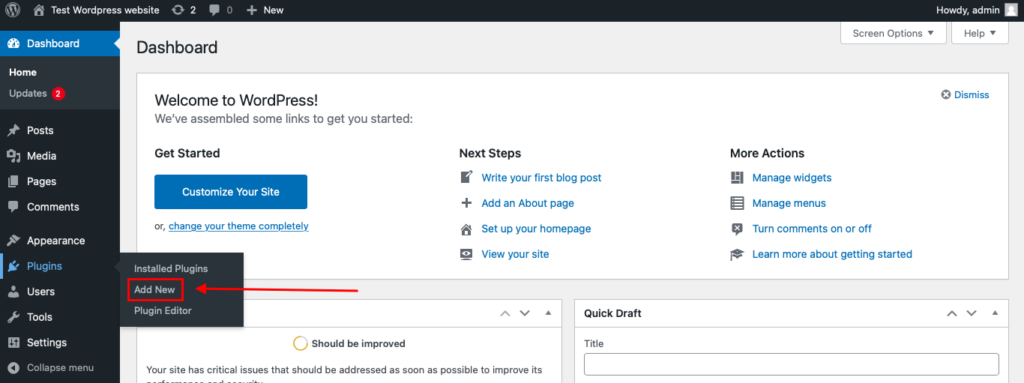
To install the Anti-Spam plugin, go to your WordPress admin panel→ Plugins→ Add New.
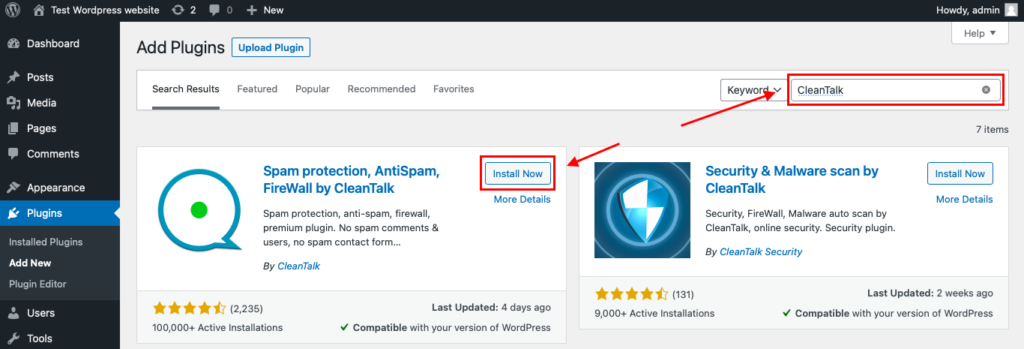
Then enter «СleanTalk» in the search box and click the Install button for «Spam protection, Anti-Spam, FireWall by CleanTalk».
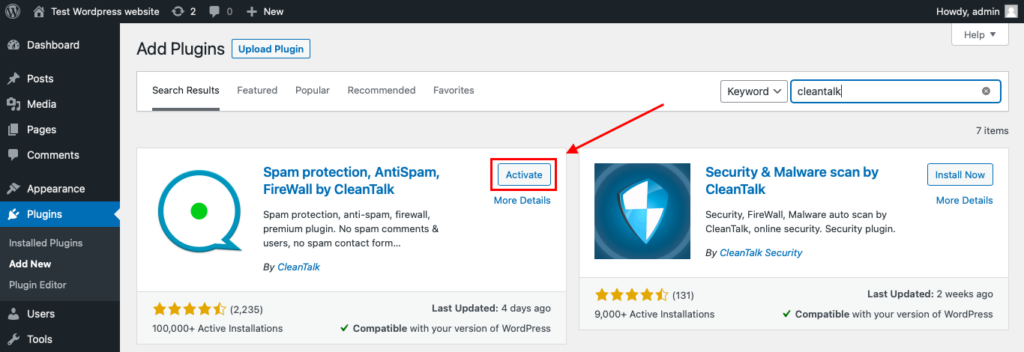
After installing the plugin, click the «Activate» button.
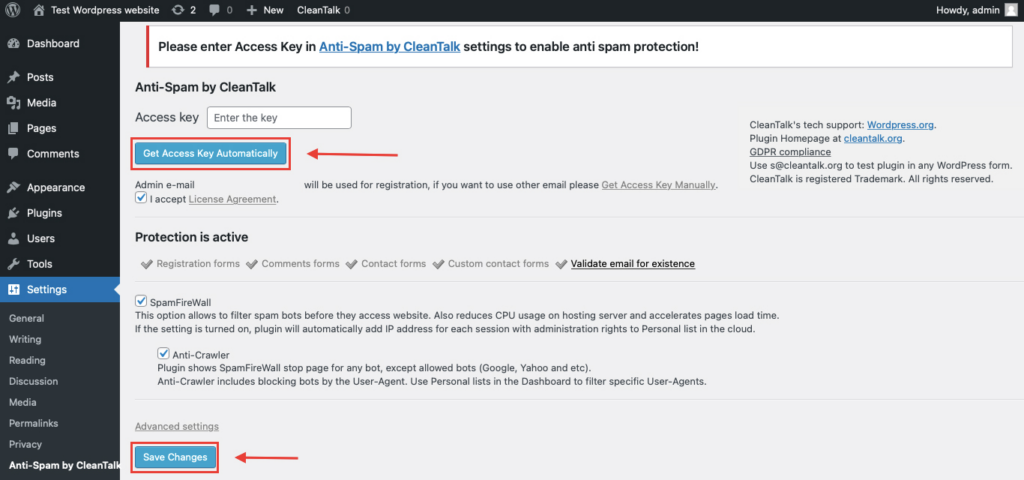
After it is done go to the plugin settings and click the «Get Access Key Automatically» button. Then just click the «Save Settings» button.
Turn on protection for embedded forms
One extra step is needed for Sender, because its forms are loaded from an external service:
Go to WordPress admin panel -> Settings -> Anti-Spam by CleanTalk -> Advanced settings and turn on Protect external forms. Make sure you are running CleanTalk Anti-Spam 6.84 or newer – support for Sender’s iframe forms was added in that release.
That’s it! From now you know how to completely protect your Sender forms from spam. You don’t need to paste any shortcodes – just use Sender as usual, and CleanTalk will filter spam in the background.
Check if spam protection works with Sender forms
The best way to test the spam protection is by using a test email,
stop_email@example.com
- Open a page with your Sender form in an Incognito / private browser tab.
- Fill out the form using stop_email@example.com as the sender’s email.
- Send the form.
- You should see a message from the Anti-Spam plugin confirming that a spam submission was blocked.
\*\*\* Forbidden. Sender blacklisted. Anti-Spam by CleanTalk. \*\*\
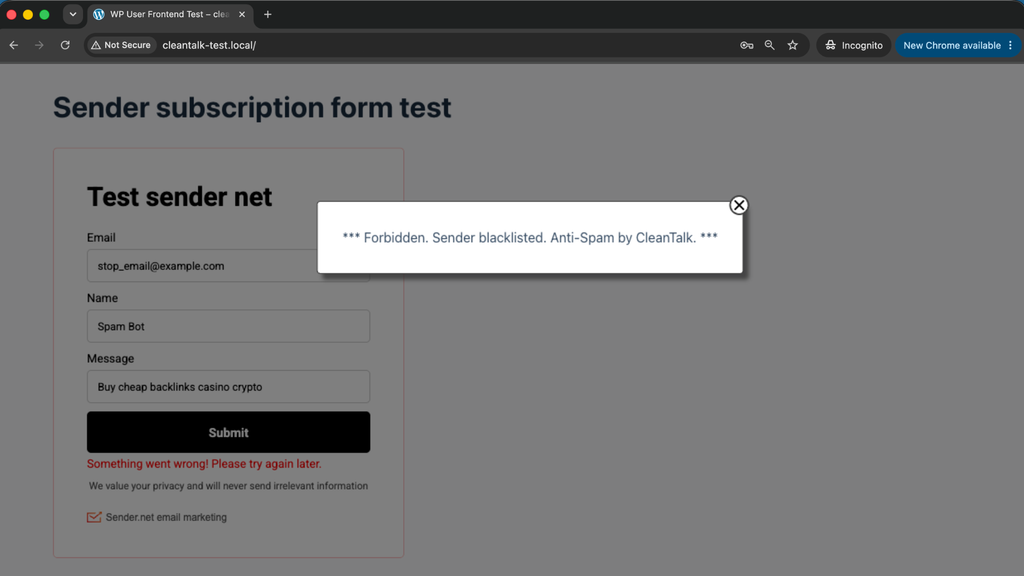
If you see this message, it means CleanTalk successfully protects your Sender forms from spam.
We ran this test on a WordPress site with an embedded form that submits over fetch, exactly the way Sender forms do. The spam submission was stopped with the message above and the request never left the browser – the address was never delivered to the mailing platform. A normal subscription with a real email address went through as usual and reached the endpoint without any extra step.
Cloud Dashboard
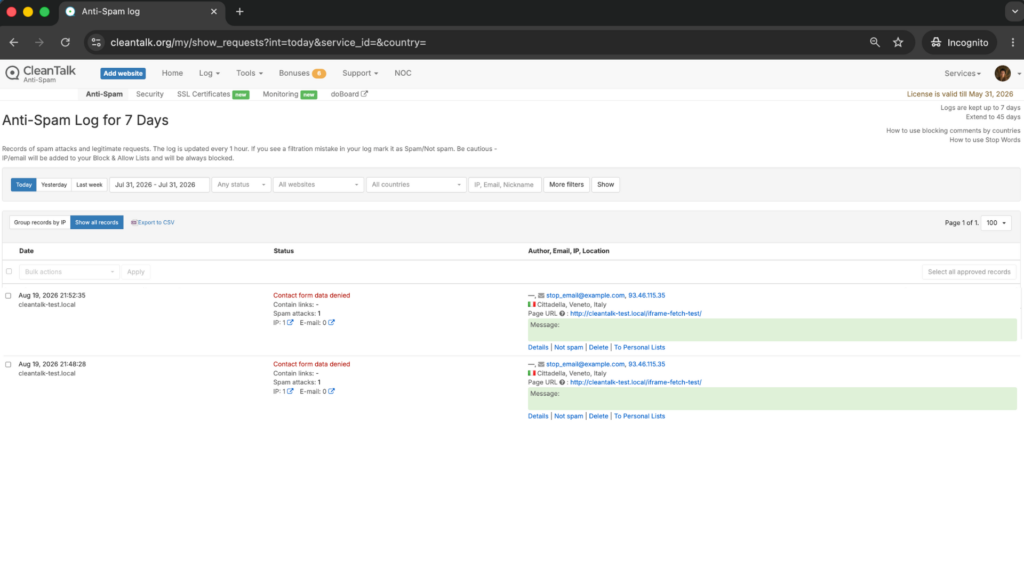
In addition, in the Cloud Dashboard you can find extra details regarding all submissions processed by CleanTalk, including Sender forms:
- IP and email of the sender, as well as the sender’s activity history across other websites connected to the CleanTalk cloud.
- Geolocation of the sender.
- Date and time of the submission.
- Page (URL) where the form was submitted.
- Cloud decision – Approved or Denied.
- Cloud explanation for the decision (e.g. blacklisted email, bad IP reputation, spam text, etc.).
- Tools to move the sender to Block or Allow lists so you can fine-tune Sender form spam protection.
FAQ
Do I need the Sender WordPress plugin for this to work?
No. Protection works with any Sender form embedded on your site, whether you place it through their WordPress plugin or with their embed script.
Does it cover popups as well as inline forms?
Yes. The check happens when the subscription request is sent, so it does not matter how the form is displayed on the page.
Will a blocked signup still appear in my Sender account?
No. The submission is stopped before the request reaches the platform, so the address never enters your list and no confirmation email is sent.
I already use double opt-in. Is that not enough?
Double opt-in keeps unconfirmed addresses out of your active list, but the signup, the bounce and the trap hit still happen. Filtering at the form removes the cause instead of the symptom.
Which version do I need?
CleanTalk Anti-Spam 6.84 or newer, with Protect external forms enabled in the advanced settings.
Will real subscribers be blocked?
Legitimate signups pass through without any extra step. If a valid submission is ever stopped, it is visible in the Cloud Dashboard with the reason, and you can move that sender to the Allow list.
Final recommendation
For a site that collects subscribers, the cheapest place to stop spam is the form itself, before an address enters the list and starts costing you deliverability. Keep double opt-in as a policy control, skip the CAPTCHA on your subscribe form, and let an invisible cloud filter handle the volume.
For broader website protection, CleanTalk also provides anti-spam protection for websites, helping block spam in forms, comments, registrations, and orders without CAPTCHA.
