Automated crawlers and scraping bots are a growing problem for modern websites. While search engine bots are useful, many other crawlers generate excessive traffic, scrape content, or overload servers.
To help website owners control this type of traffic, we recently released the Anti-Crawler PHP Library by CleanTalk, an open-source tool designed to detect and limit aggressive crawlers before they cause performance problems.
The library analyzes incoming requests and applies rate-limiting logic to detect crawler-like behavior. Once a bot exceeds defined limits, the system blocks or restricts further requests.
In the first version of the library we chose SQLite as the storage backend. SQLite allowed the library to work immediately after installation without requiring additional infrastructure such as Redis or Memcached.
However, after deploying the library on our own high-traffic website cleantalk.org, we encountered an unexpected performance issue: disk load increased significantly.
The result was a simple architectural change that completely removed the disk load increase while improving scalability.
The First Version of the Anti-Crawler Library
The goal of the library was to provide a simple crawler protection mechanism for PHP applications. Typical anti-crawler logic requires storing temporary request data. Each request updates this data so the system can determine whether a visitor behaves like a normal user or an automated crawler. Because the data must be updated frequently, the storage backend plays a critical role in overall performance.
Why SQLite Was Chosen
For the initial release we selected SQLite for several reasons:
Zero configuration. SQLite is included in most PHP environments and does not require running an additional service.
Single-file storage. All data is stored in a single database file, making installation extremely simple.
Good performance for moderate workloads. SQLite performs very well for many typical web applications.
Easy deployment. Users could install the library without modifying their infrastructure.
This approach allowed the library to work immediately after installation and made it suitable for shared hosting environments. For many websites this configuration works perfectly. However, high-traffic environments behave differently.
Deploying the Library on a High-Traffic Website
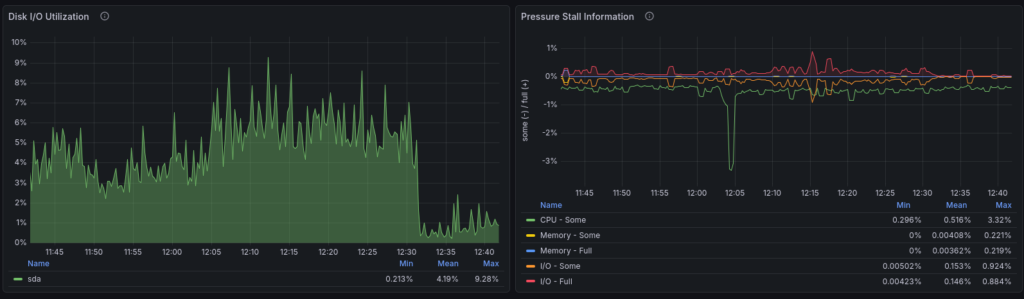
After releasing the first version of the library, we deployed it on our own website https://cleantalk.org Our infrastructure handles a large volume of traffic, including both legitimate users and automated bots. Shortly after enabling the library, our monitoring systems detected something unusual. Disk Activity Increased. Server monitoring showed a noticeable increase in disk activity. After analyzing the metrics we observed: Disk load increased by approximately 30%.
This was unexpected because the library itself performs only lightweight operations. The problem was not CPU usage or memory consumption. Instead, the issue was directly related to disk I/O. Further investigation showed that the additional disk operations were coming from the SQLite database used by the anti-crawler system.
Why SQLite Became a Bottleneck
SQLite is a reliable and efficient embedded database, but its design has limitations under certain workloads. The anti-crawler system generates a very specific traffic pattern. For each HTTP request the library needs to:
read crawler counters
update request statistics
write the updated data back to storage
This means the database receives frequent write operations.
Because SQLite stores data on disk, every update results in disk activity. Under high traffic this leads to a large number of disk writes. SQLite also uses file-level locking to ensure consistency. When many requests attempt to update the database simultaneously, additional locking overhead appears.
As a result, frequent writes combined with locking increased disk activity on our production servers.
Moving the Storage Layer to Redis / KeyDB
To eliminate disk operations we needed a storage system optimized for frequent updates. The natural solution was an in-memory data store, so we added support for: Redis and KeyDB. Both systems keep data in memory and provide extremely fast read and write operations. This approach removes disk I/O and allows the crawler detection logic to update counters much more efficiently.
The Anti-Crawler PHP Library was updated to support multiple storage backends. Users can now choose between:
SQLite (default)
Redis
KeyDB
SQLite remains useful for simple deployments, while Redis or KeyDB can be enabled for high-traffic environments. The crawler detection logic itself remains unchanged — only the storage backend is replaced.
Results After Switching to Redis
After switching the storage backend to Redis on our production servers we immediately saw improvements. Disk activity returned to normal because the crawler counters were now stored in memory instead of on disk. The previous 30% increase in disk load disappeared, and request processing became faster. The Redis-based architecture also scales better under heavy traffic and avoids locking issues associated with file-based databases.
disk io
When to Use SQLite vs Redis
Both storage options remain available because they fit different environments.
SQLite works well for:
small and medium websites
environments without Redis
simple installations
Redis or KeyDB is recommended for:
high-traffic websites
infrastructure already using Redis
environments with heavy bot traffic
How to Use the Anti-Crawler PHP Library
The library is open source and available on GitHub: https://github.com/CleanTalk/php-anticrawler It can be integrated into any PHP application to detect aggressive crawlers and limit automated traffic.
Switching the storage backend of our Anti-Crawler PHP Library from SQLite to Redis/KeyDB allowed us to eliminate the disk I/O overhead that appeared under high traffic. This small architectural change removed the 30% disk load increase and made the crawler detection system faster and more scalable for busy websites.
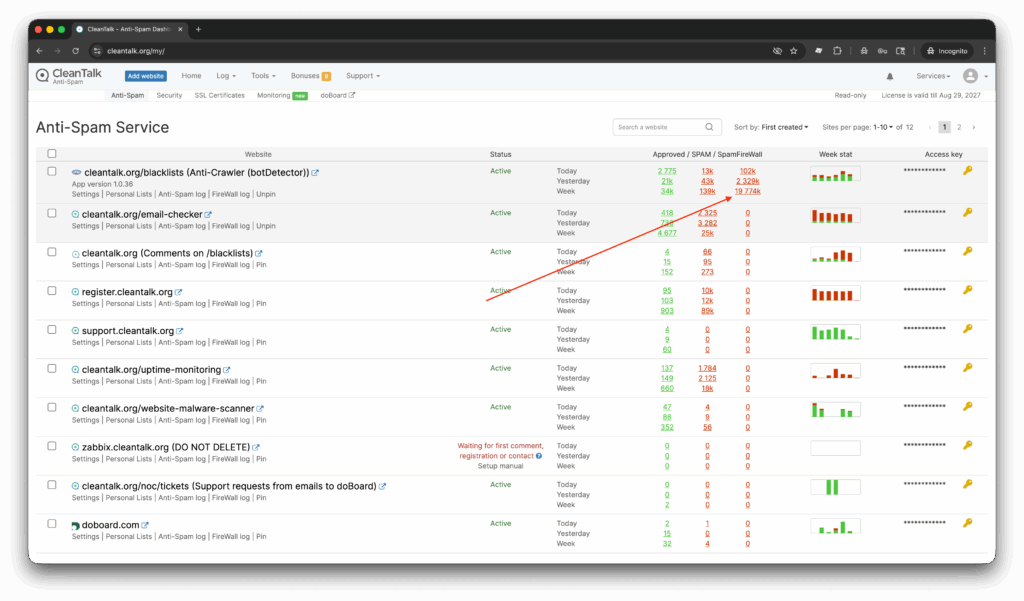
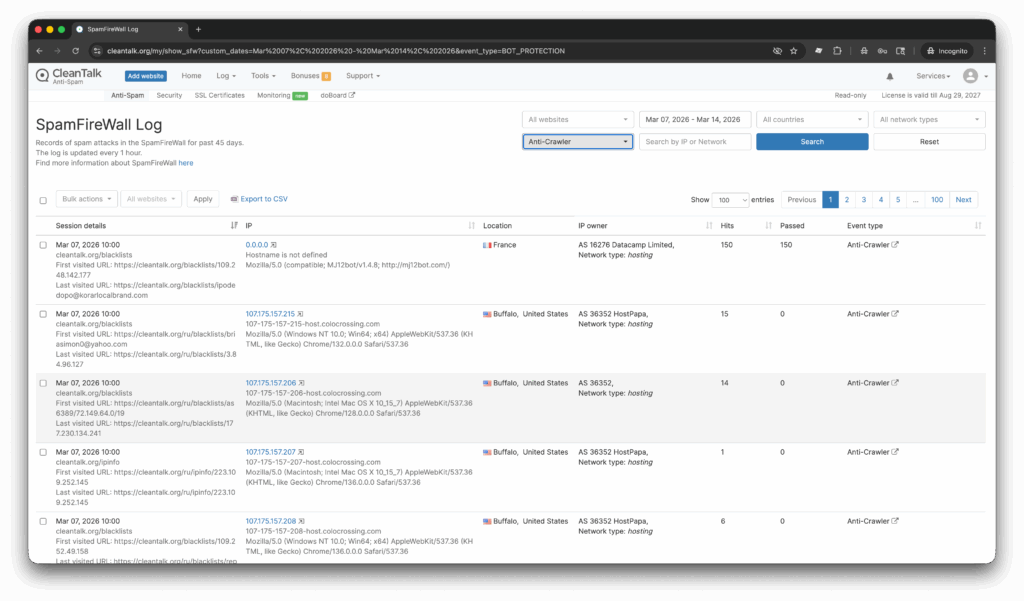
Anti-Spam Dashboard with results for Anti-Crawler PHP LibrarySpamFireWall log and Anti-Crawler sessions
On cleantalk.org Anti-Crawler PHP Library serves about 20k sessions weekly, wich gives roughly 500k hits weekl.
Anti-Crawler PHP Library by CleanTalk
Protect your website from aggressive crawlers, automated scraping,
and unwanted bot traffic using the CleanTalk Anti-Crawler PHP library.
If you use Forminator Forms, you may occasionally experience spam submissions. In the guide below, you’ll learn about several tools that help achieve complete spam protection for Forminator. In this post we will look at as built-in (in the plugin core) anti-spam tools like Honeypot, Google reCAPTCHA, hCaptcha, Cloudflare Turnstile. As well as, spam protection via third party plugins like Akismet, CleanTalk and OOPSpam.
Forminator Forms – Contact Form, Payment Form & Custom Form Builder
First of all, let’s figure out what Forminator Forms are.
Forminator Forms is a powerful and user-friendly form builder plugin for WordPress that allows you to create contact forms, registrations, payment forms, quizzes, and polls without coding. Developed by WPMU DEV, the plugin has gained popularity for its flexibility and reliable spam protection designed to reduce spam submissions across websites. Since its release in 2018, Forminator has continued to evolve, introducing new integrations, improving usability, and strengthening tools that help website owners fight spam more effectively. The plugin supports payment providers such as Stripe and PayPal, enabling secure transactions while maintaining strong spam protection for payment and contact forms. Regular updates keep the plugin compatible with modern WordPress versions and current security standards, helping prevent spam attacks and automated bot activity.
As WordPress.org shows, Forminator is currently used on over 600,000 websites and has 2,034 user reviews with an average rating of 4.8.
Install Forminator Forms, Surveys, Quizzes, Polls, Calculations and More…
Installation is as easy as following these steps.
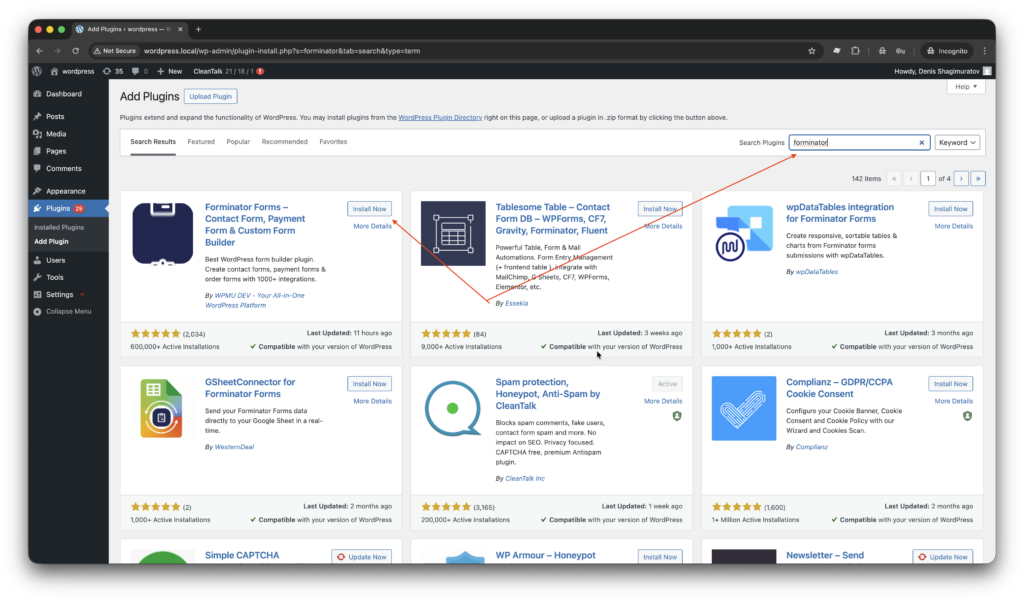
1. Search for the plugin in WordPress console -> Plugins -> Add plugin -> Search -> Type ‘forminator‘
Forminator search, install and activation.
2. Install and Activate the plugin.
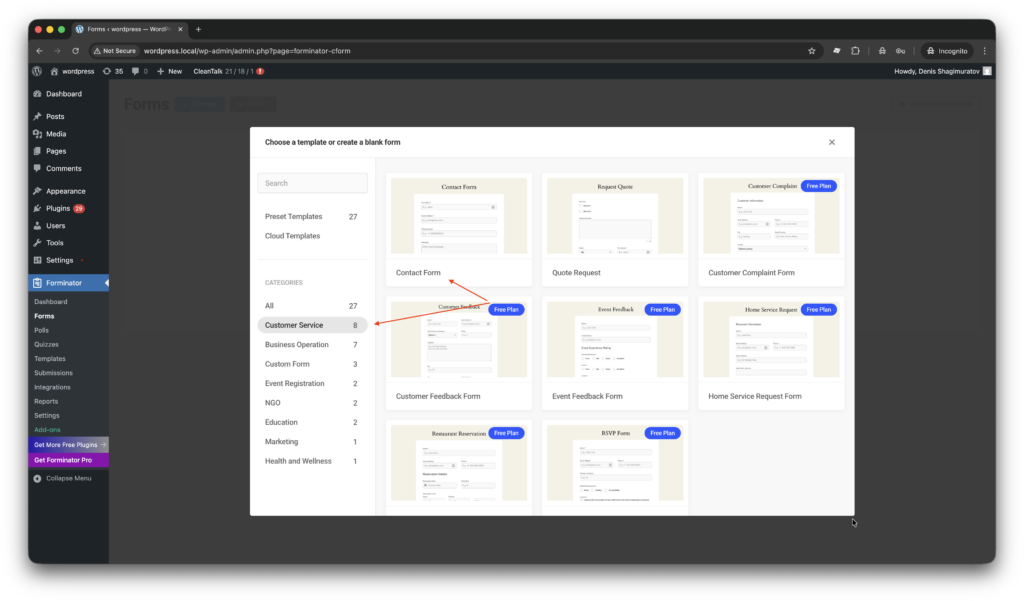
3. Add the very first contact form in WordPress console -> Forminator > Forms -> +ADD NEW -> Customer service -> Contact form.
WordPress console -> Forminator > Forms -> +ADD NEW -> Customer service -> Contact form.
4. Click Publish in top-left corner.
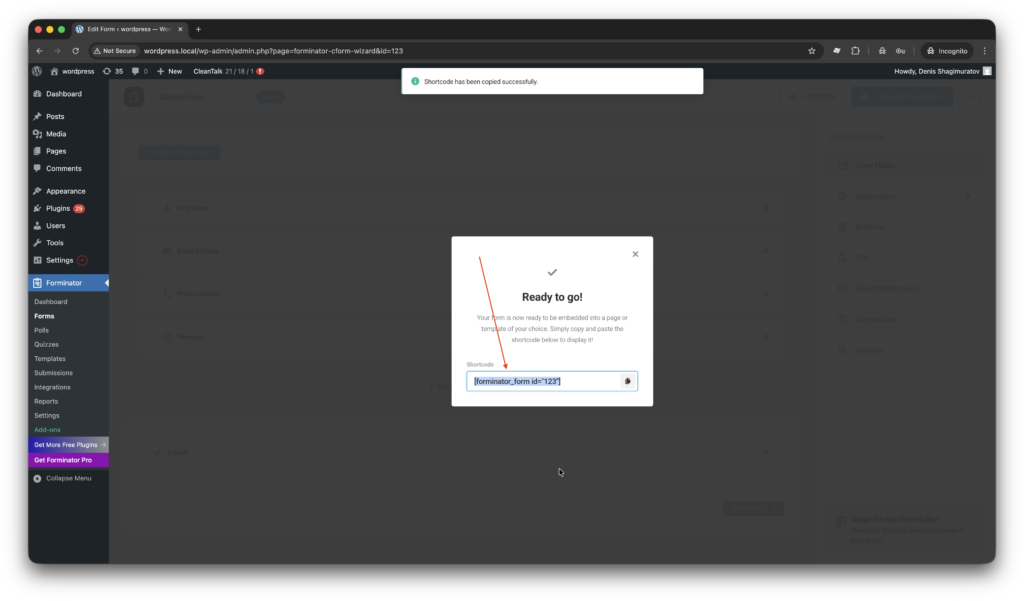
5. That’s all! Your form is ready to go, just use a short code like this on any page or post of your site.
[forminator_form id="123"]
Form is ready to go, use shortcode.
Anti-Spam plugin by CleanTalk for WordPress
The next plugin we are going to use is the Anti-Spam plugin by CleanTalk. Here is a short description of it,
CleanTalk is a cloud-based spam protection for websites, founded in 2012.
It automatically blocks spam without CAPTCHAs or disrupting user experience.
Protects multiple form types: contact forms, payment forms, registrations, comments, and surveys.
Stops both automated bots and manual spam submissions.
Uses advanced filtering algorithms and a global spam detection network.
Detects spam activity based on IP addresses, email addresses, and behavioral patterns.
Users can apply custom filtering rules.
Allows filtering or blocking by IP, email, and country.
Works automatically in the background with easy installation.
According to WordPress.org, Anti-Spam by CleanTalk for WordPress has over 200,000 active installations, with 3,165 reviews and an average rating of 4.8.
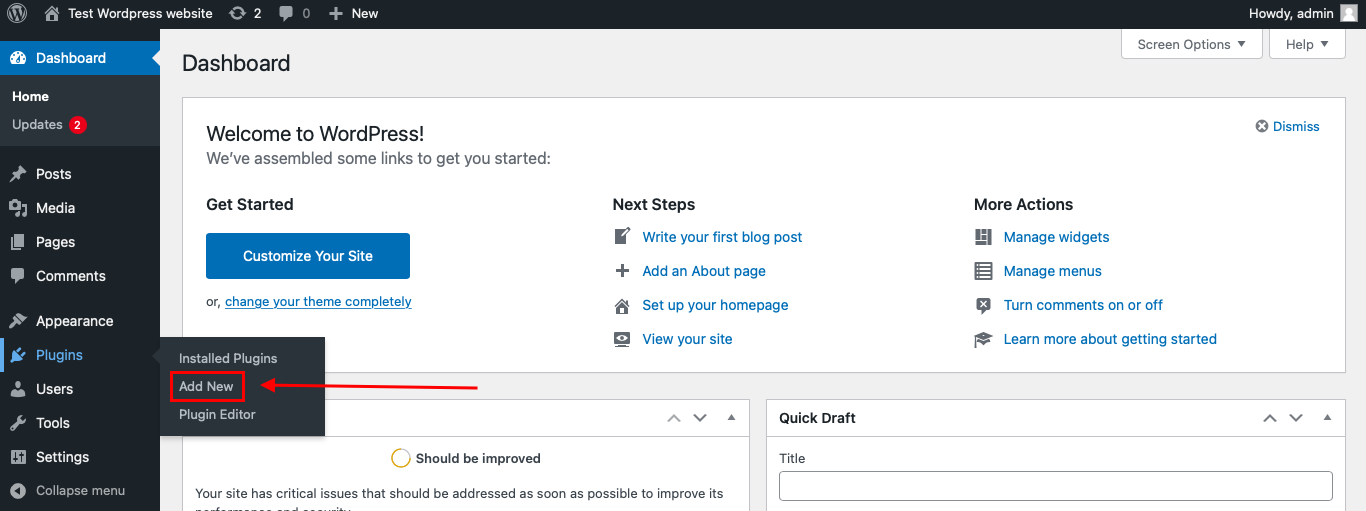
To install the Anti-Spam plugin, go to your WordPress admin panel → Plugins → Add New.
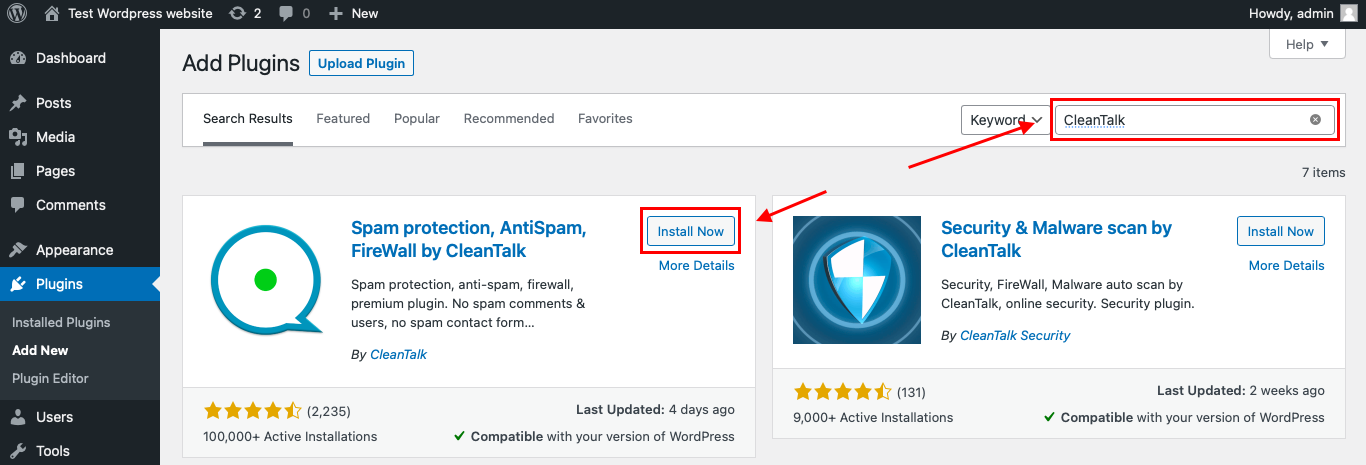
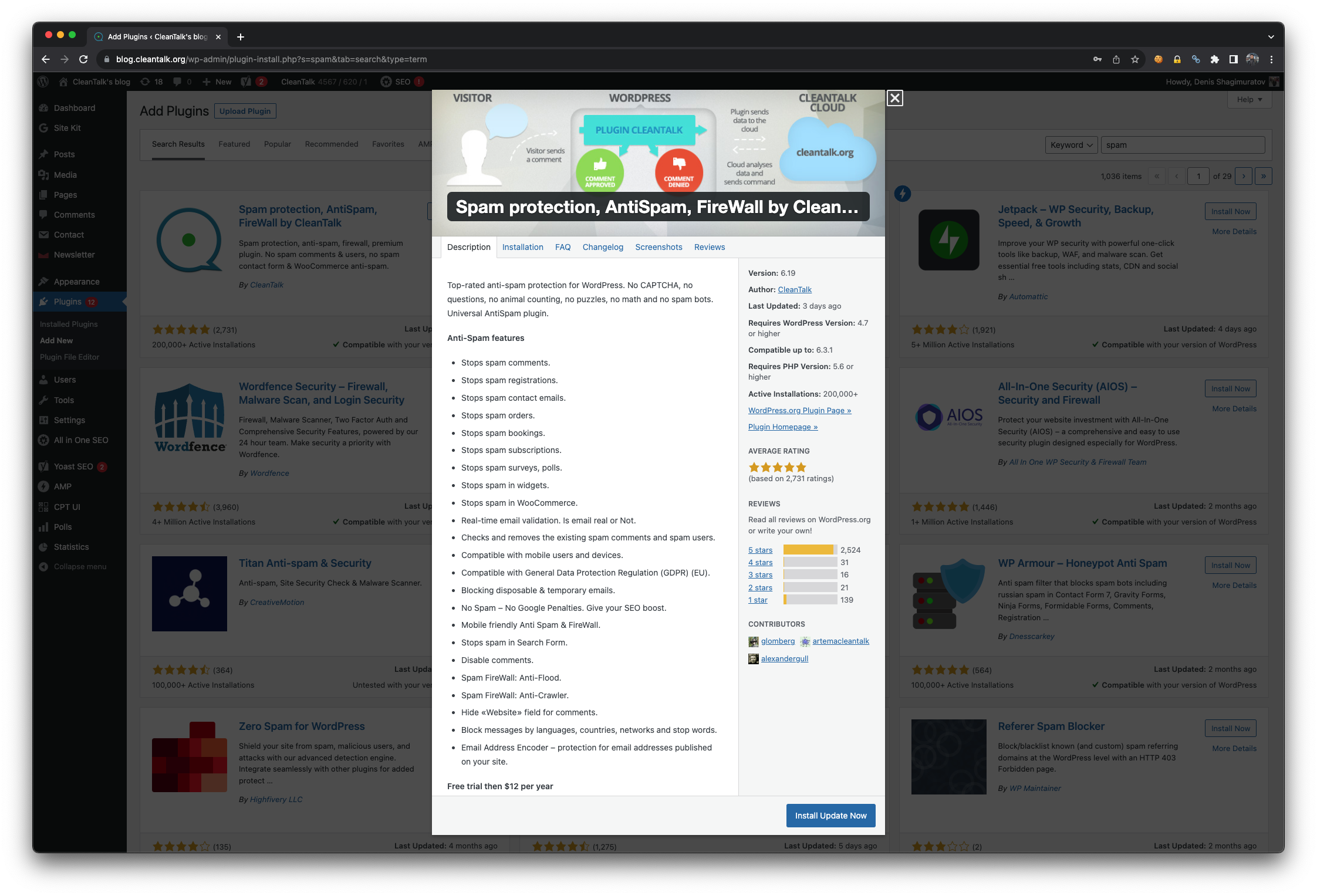
Then enter «СleanTalk» in the search box and click the Install button for «Spam protection, Anti-Spam, FireWall by CleanTalk».
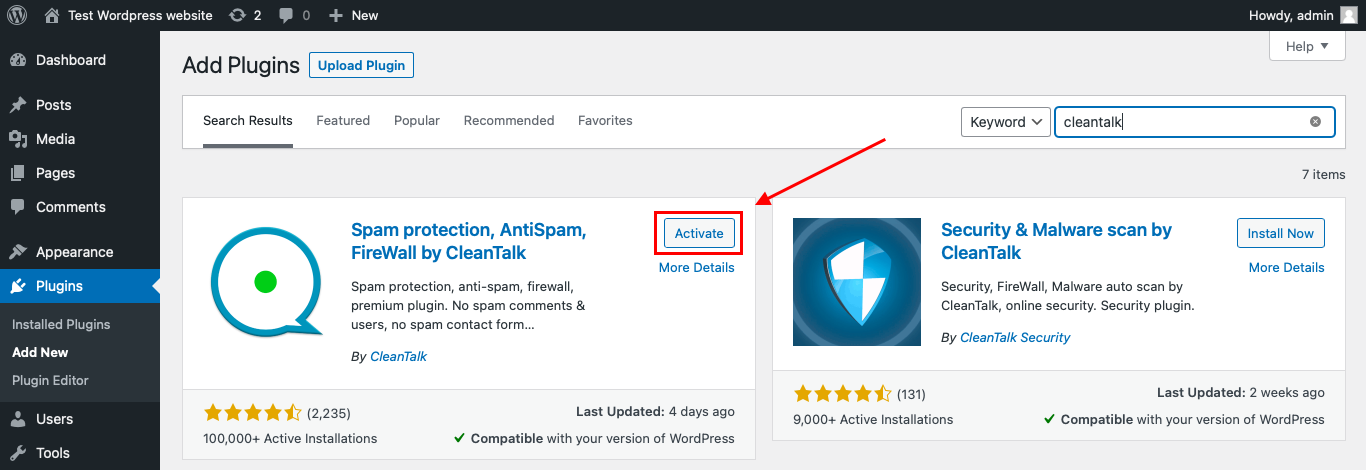
After installing the plugin, click the «Activate» button.
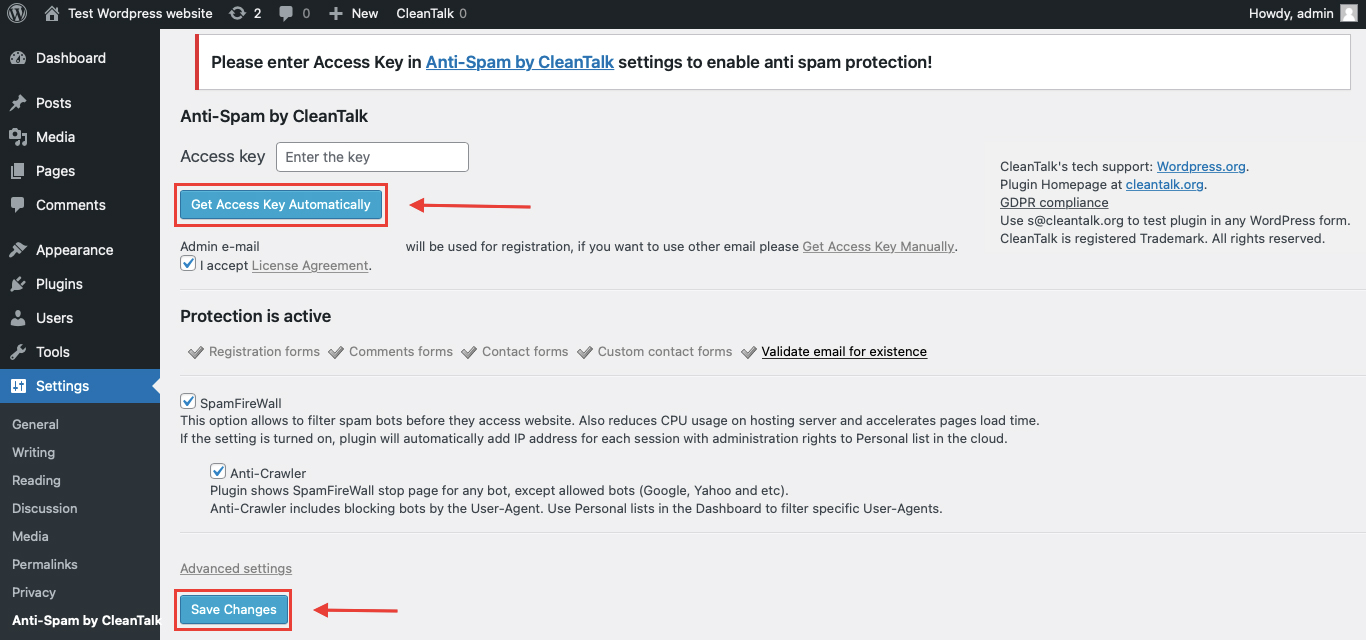
After it is done go to the plugin settings and click the «Get Access Key Automatically» button. Then just click the «Save Settings» button.
That’s it! From now you know how to completely protect your Forminator Forms from spam.
Check if spam protection works with Forminator Forms
The best way to text the spam protection by using a test email,
stop_email@example.com
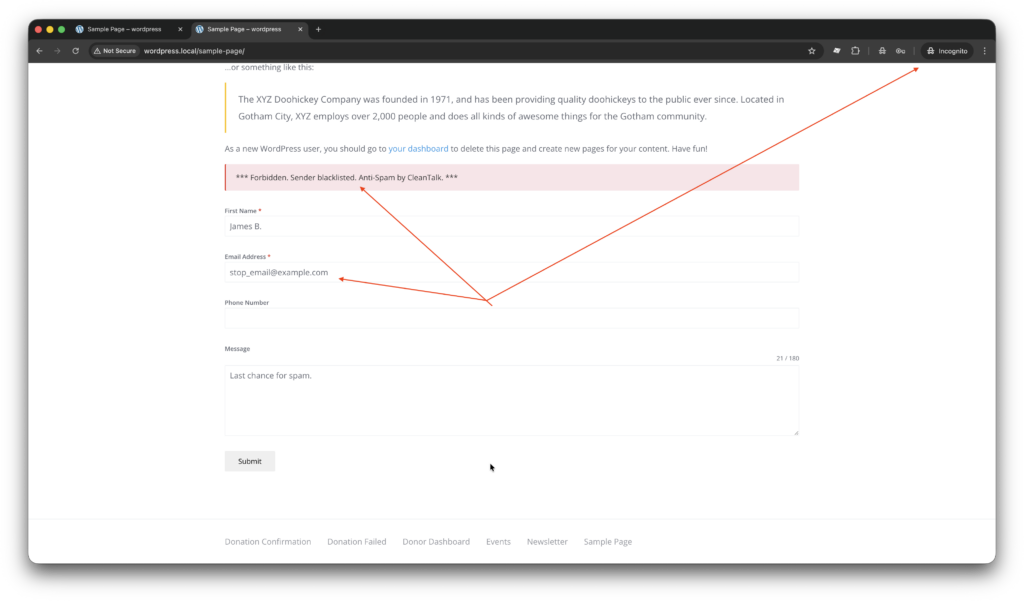
Open page with your form (don’t forget to add the shortcode in the page content) in Incognito browser tab.
Fill out the Contact form using stop_email@example.com as sender’s email.
Send the form.
You should see a message from the Anti-Spam plugin confirming that a spam submission was blocked.
*** Forbidden. Sender blacklisted. Anti-Spam by CleanTalk. ***
Spam submission was blocked in contact form by Forminator.
Cloud Dashboard
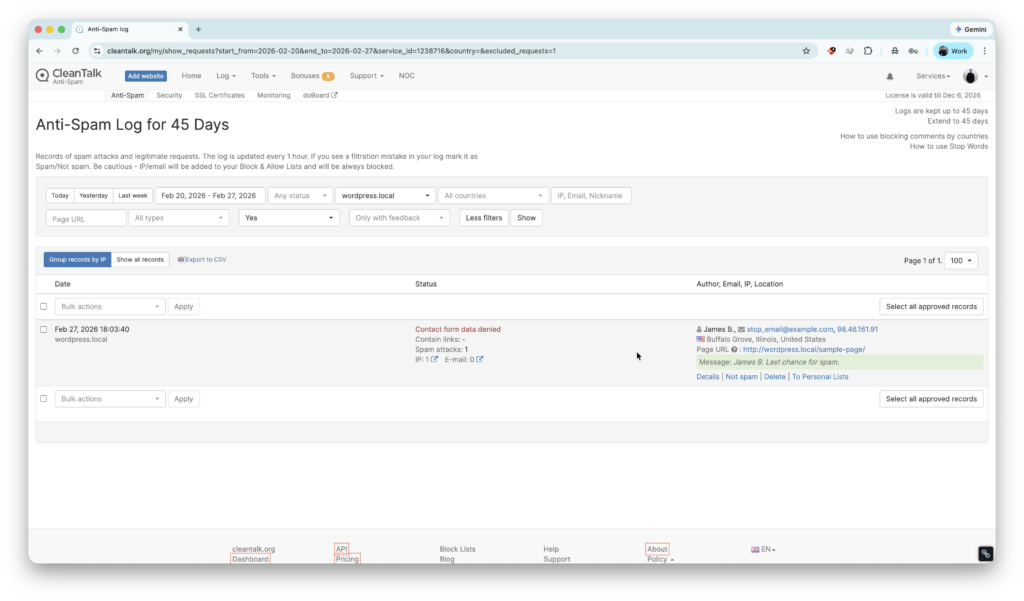
In addition, in the Cloud Dashboard you can find extra details regarding all submissions made via form,
IP, Email of the sender. As well as history of activity a sender among other sites connected to CleanTalk’s cloud.
Geolocation of the sender.
Date and time of submission.
Page (URL) of the submission.
Cloud decision – Approved, Denied.
Cloud explanation for the decision.
Tools to move the sender to Block or Allow lists.
Anti-Spam Cloud Dashboard, Forminator form.
Google reCAPTCHA, hCaptcha, and Cloudflare Turnstile
Also, let’s have a look at cloud, anti-spam services that we have for Forminator forms,
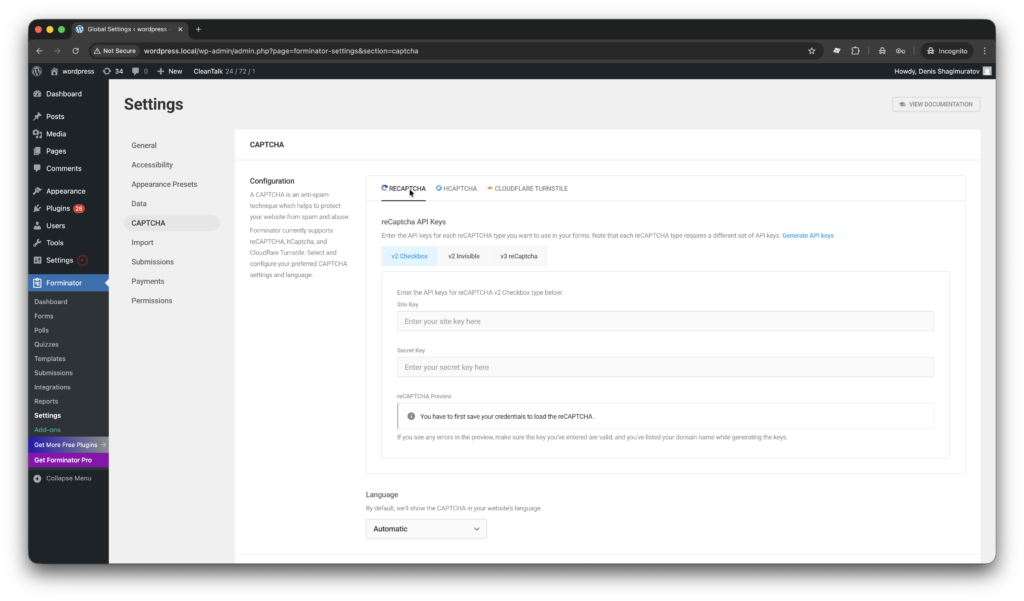
The plugin has core integration with many CAPTCHA services,
Forminator integrates with Google reCAPTCHA, helping users reduce spam submissions while adding an extra layer of security to contact forms, registrations, and surveys. This allows website owners to protect their forms automatically without complex configuration. To activate this service obtain Site key and Secret key on the site. If your priority is protecting forms without visible CAPTCHA challenges, see this reCAPTCHA alternative for forms guide.
hCaptcha support. Forminator users can reduce spam submissions while maintaining better privacy for visitors and improving overall form security.
Key benefits of hCaptcha over reCAPTCHA,
Better privacy for visitors. hCaptcha collects less user tracking data compared to Google reCAPTCHA, which is important for privacy-focused websites and GDPR-sensitive regions.
Reduced dependence on Google services. Using hCaptcha allows Forminator users to avoid relying on Google infrastructure, which some organizations prefer for compliance or branding reasons.
Potential monetization option. hCaptcha offers a program where site owners can earn small rewards for solving challenges, something reCAPTCHA does not provide.
hCaptcha requires Site Key and Secret key as well, which can be obtained on site.
Cloudflare Turnstile. By integrating with Cloudflare Turnstile, Forminator users can protect their forms from spam and bots without showing traditional CAPTCHA challenges. Turnstile works invisibly in the background, helping improve user experience while maintaining strong spam protection for contact forms, registrations, payments, and surveys. This reduces friction for real visitors, increases form completion rates, and keeps submissions clean without interrupting the workflow.
Main benefits of Cloudflare Turnstile over Google reCAPTCHA,
Invisible verification. Turnstile works mostly in the background without puzzles or image challenges, so visitors can submit Forminator forms faster and with less frustration compared to reCAPTCHA.
Higher form conversion rates. Because users are not interrupted by CAPTCHA challenges, contact forms, surveys, and payment forms typically see fewer abandoned submissions.
Strong privacy approach. Turnstile is designed to minimize user tracking and does not rely on extensive behavioral profiling, which makes it more privacy-friendly than reCAPTCHA.
All CAPTCHA services are aviable under settings Settings are under path WordPress console -> Forminator > Forms -> Settings -> CAPTCHA -> reCAPTCHA | hCaptcha | Turnstile.
Honeypot, Akismet and third-party Anti-Spam Plugins
Additionally, let’s consider standalone plugins and anti-spam mechanics that also works for Forminator forms,
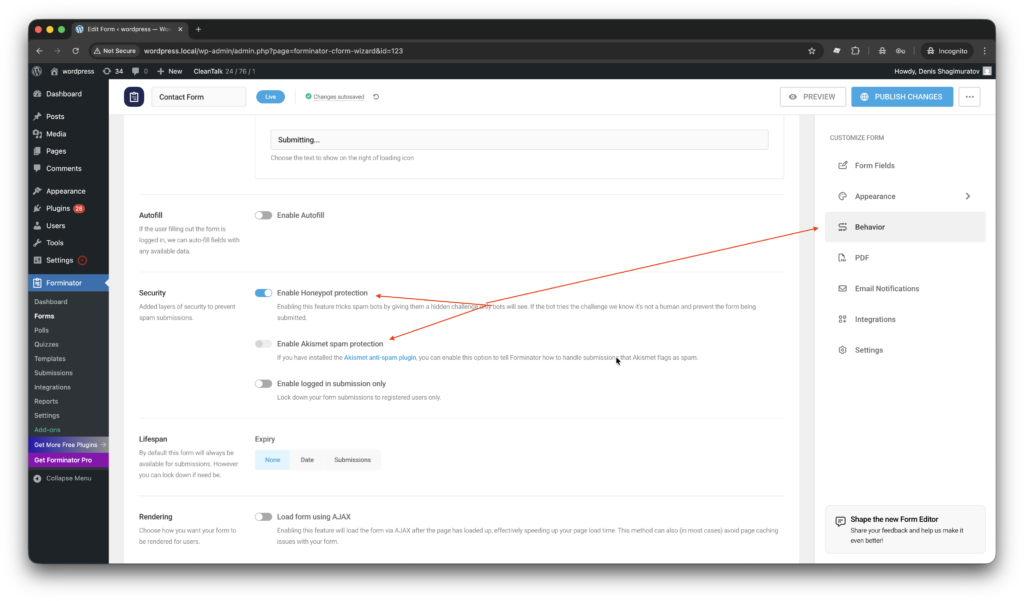
Honeypot. Which is most simple anti-spam mechanic against primitive spam bots. It works by adding hidden fields that are only detected and filled by bots, allowing spam to be blocked automatically while legitimate users never see additional challenges. Because no CAPTCHA or interaction is required, honeypots help maintain a smooth user experience and improve form completion rates. This lightweight method is easy to enable and adds an extra layer of protection for contact forms, surveys, and registrations.
Settings are available per each individual form, the path is WordPress console -> Forminator > Forms -> FORM -> Settings -> Behavior -> Security. Please look at screenshots down below.
Third-party Anti-Spam plugins.
Akismet. Akismet helps Forminator users automatically filter spam submissions by analyzing form data against its global spam detection network. It works in the background to identify suspicious content and prevent unwanted messages from reaching your inbox or database. This reduces manual moderation and helps keep contact forms, surveys, and registrations clean. As a widely used WordPress anti-spam solution, Akismet is easy to enable and integrates naturally into existing WordPress workflows.
In order to activate protection user must install, activate and get API key for third-party plugin Akismet and then turn integration under the settings WordPress console -> Forminator > Forms -> FORM -> Settings -> Behavior -> Security. Please look at screenshots down below.
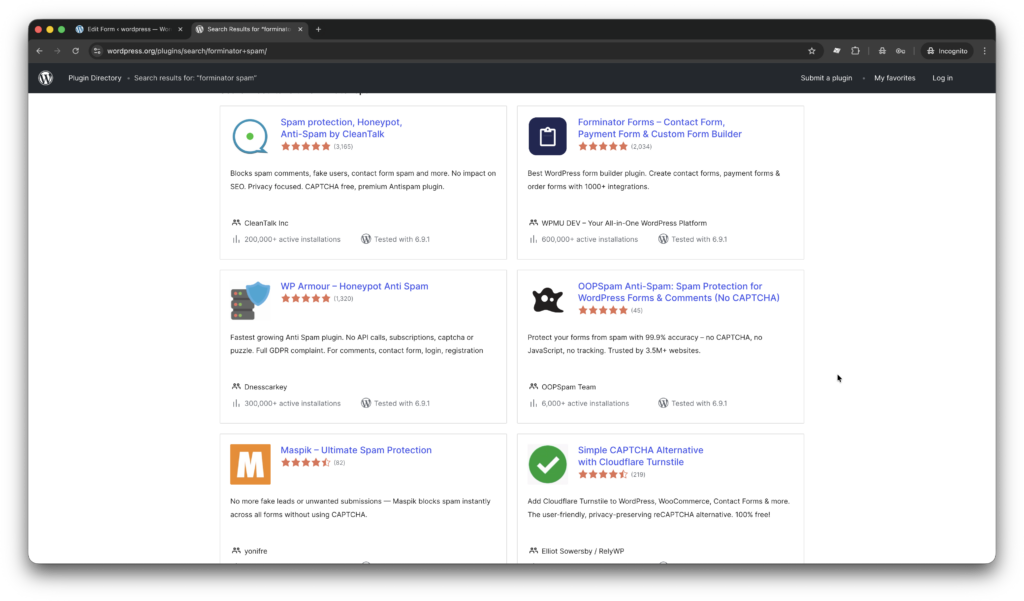
WP Armour, OOPSpam, Maspik, and Simple CAPTCHA Alternative are universal anti-spam plugins for WordPress that provide reliable spam protection for Forminator users. All of these solutions can be found in the search results at wordress.org.
CAPTCHA services at Forminator settings. Google reCAPTCHA, hCaptcha, Cloudflare Turnstile.Honeypot and Akismet in Forminator.WP Armour, OOPSpam, Maspik, and Simple CAPTCHA Alternative.
Here is a guide by WPMU DEV. It tells how to protect Forminator with additional cloud services such as Honeypot (not as service), Google reCAPTCHA, hCaptcha, Cloudflare Turnstile. Third party plugins like Akismet, and OOPSpam. If you want a broader option for registration and form protection, see our Akismet alternative for Forminator.
Frequently Asked Questions (FAQ)
Cannot stop spam from coming through forms no matter what…
If nothing works in this guide, try a few more things,
Block spammers by particular IPs, Countries via Personal lists under your CleanTalk’s account.
Submit a support request, we will do our best to tune spam protection for your specific case.
v3 reCAPTCHA not saving in Forminator Settings. V2 shows ‘ERROR for site owner: Invalid key type’
Forminator’s team doesn’t have a solution for this error, but advices to switching to hCaptcha, read more.
Forminator x hCaptcha does not prevent spam
The main recommendation is to avoid relying on hCaptcha alone, enable Forminator’s honeypot protection, prevent plugin conflicts, and use layered anti-spam methods for better results. WordPress.org.
Emails from website contact form going to spam.
The recommended solution is to check SMTP configuration using a real email account so the website sends messages through authenticated mail servers instead of the default PHP mail system. Installing and configuring an SMTP plugin ensures proper email delivery and improves sender reputation, preventing form notifications from being marked as spam. WordPress.org.
Recommended Anti-Spam Stack for Forminator (2026)
Finally, no single anti-spam tool can stop every type of spam submission. The most reliable approach for Forminator users is a layered protection stack, where each tool blocks a different category of bots and spam behavior.
Membership / registration sites: CleanTalk + Turnstile or hCaptcha.
By now, all spam issues in your Forminator contact, survey, poll, or quiz forms should be resolved. If not, Sign Up for an account and our support team will be happy to help you.
Stop spam without frustrating your visitors
Create your CleanTalk account and start blocking spam forms, surveys, polls and quiz answers — no CAPTCHA challenges and no impact on visitors.
CleanTalk has added spam protection for GiveWP using direct form integration. This makes it a good opportunity to explore how to protect GiveWP against spam submissions using both built-in anti-spam tools integrated into the plugin core and third-party solutions. We will start with CleanTalk and then move on to Akismet, Google reCAPTCHA, Cloudflare Turnstile, honeypot techniques, and universal anti-spam plugins available on WordPress.org.
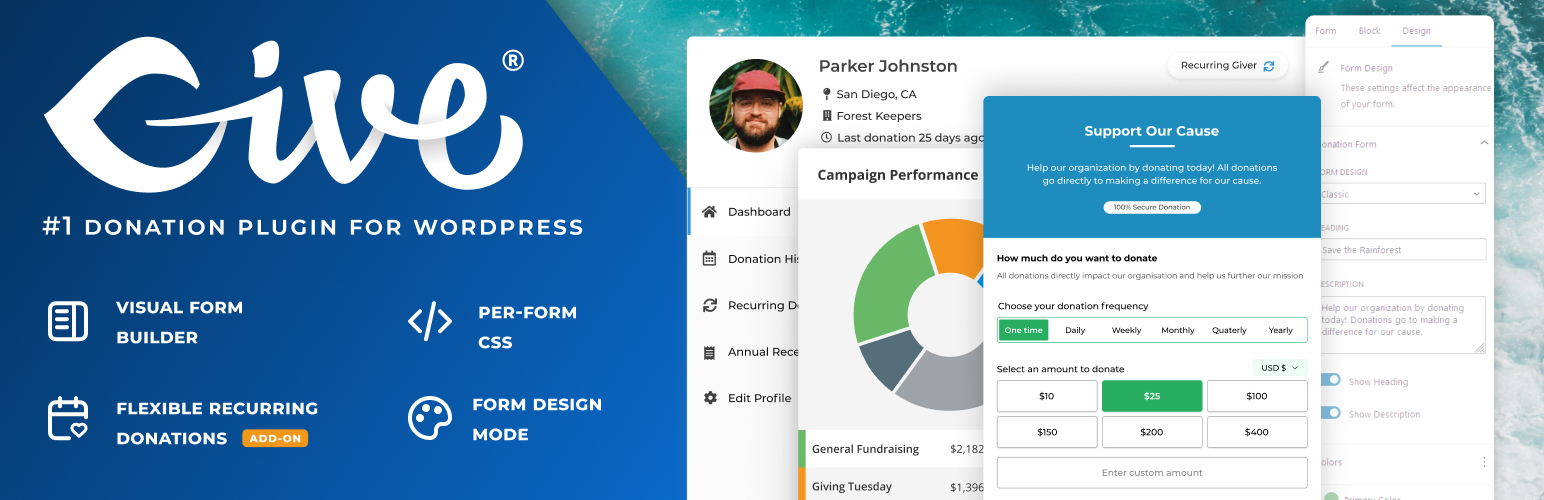
GiveWP banner at https://wordpress.org/plugins/give/
GiveWP – Donation & Fundraising Plugin for WordPress
In case of any misunderstanding or misinterpretation about which plugin we are referring to, allow me to provide a brief overview of GiveWP
GiveWP is a powerful WordPress donation plugin that helps nonprofits, charities, and organizations accept online donations directly on their websites. It allows you to create fully customizable donation forms and securely collect one-time or recurring donations without relying on third-party fundraising platforms. To maintain secure fundraising, GiveWP can be combined with spam protection solutions that help prevent fake donations, bot submissions, and fraudulent registrations. The plugin supports popular payment gateways such as PayPal and Stripe, making it easy for donors to contribute using their preferred payment method. Built-in reporting, donor management tools, and fundraising goal tracking help organizations monitor performance and grow contributions. With a wide range of add-ons and integrations, GiveWP scales from small campaigns to large nonprofit organizations while following WordPress best practices for reliability and security.
According to WordPress.org, over 100,000 websites use this plugin.
Install GiveWP – Donation Plugin and Fundraising Platform
Show Instructions
To have the plugin installed follow this steps,
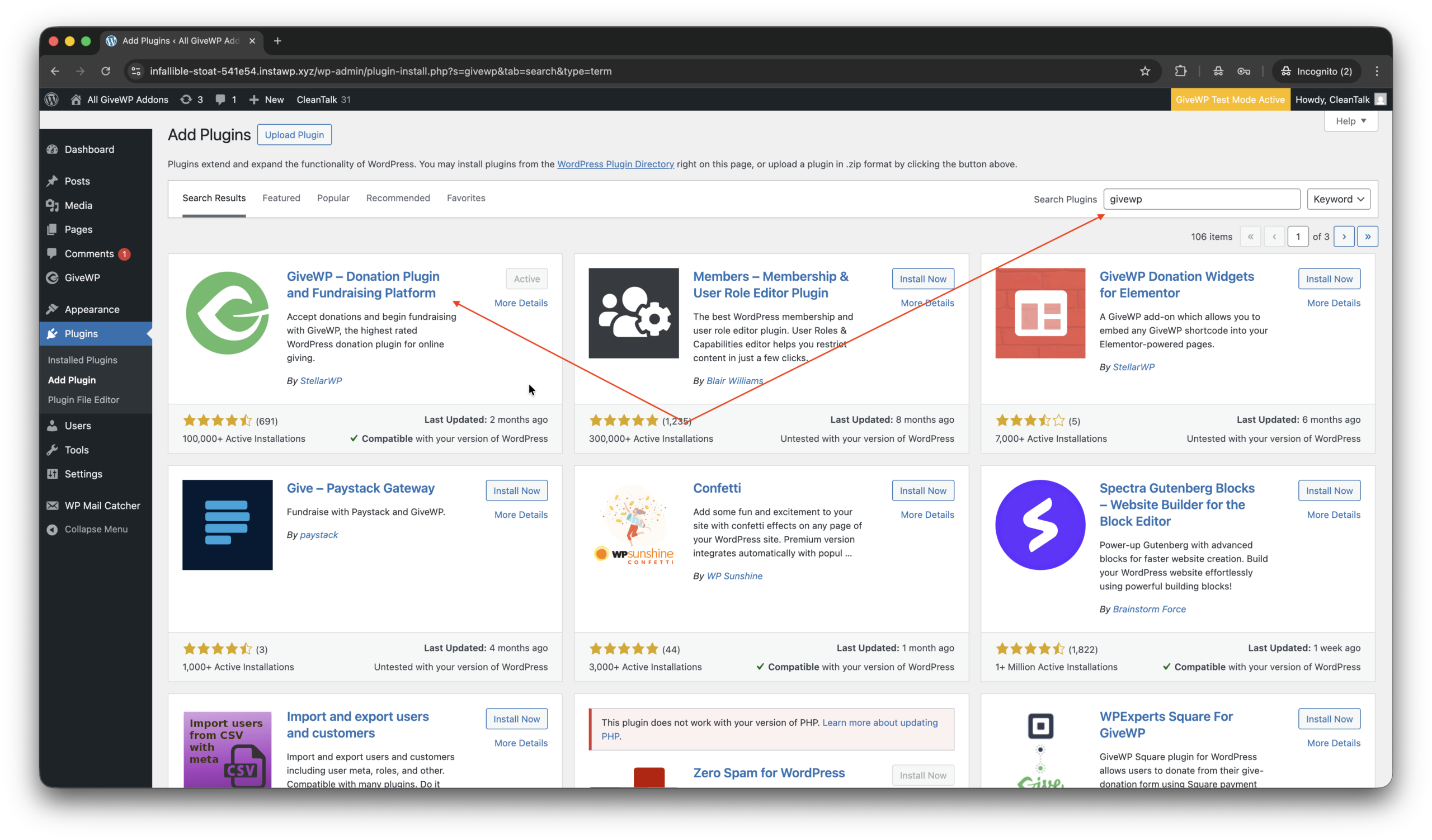
1. Search for the plugin in WordPress console -> Plugins -> Add plugin -> Search -> givewp
2. Install and Activate the plugin.
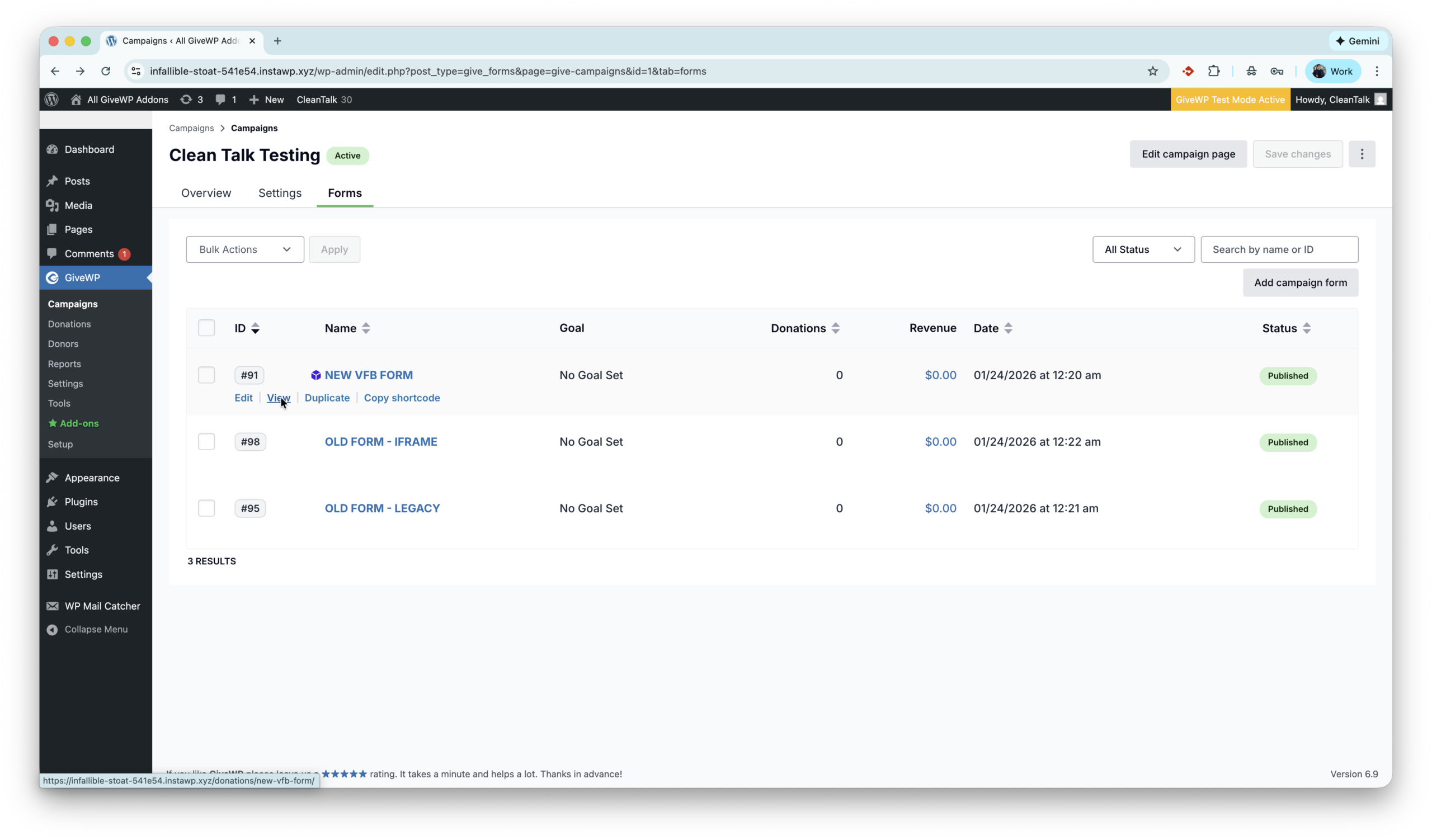
3. Add a campaign and forms in WordPress console -> GiveWP -> Campaigns -> Forms.
That’s all! GiveWP is installed.
Anti-Spam plugin by CleanTalk for WordPress
The next plugin we are going to use is the Anti-Spam plugin by CleanTalk. Here is a short description of it,
CleanTalk Anti-Spam plugin for WordPress protects your site from spam comments, contact forms, registrations, and fake donations without CAPTCHA. It uses cloud-based spam detection and real-time databases to block bots automatically while keeping the experience smooth for real users. CleanTalk works in the background and requires minimal setup, making it a reliable hands-off anti-spam solution.
CleanTalk has additional features like Block and Allow lists to manage specific Emails, IPs, Countries, custom frontend message to blocked donations and Emails obfuscation which might be helpful during fundraising events.
To install the Anti-Spam plugin, go to your WordPress admin panel → Plugins → Add New.
Then enter «СleanTalk» in the search box and click the Install button for «Spam protection, Anti-Spam, FireWall by CleanTalk».
After installing the plugin, click the «Activate» button.
After it is done go to the plugin settings and click the «Get Access Key Automatically» button. Then just click the «Save Settings» button.
That’s it! GiveWP is completely protected, let’s see how to test the protection.
How to check spam protection for GiveWP Forms
You can test the work of Anti-Spam protection for GiveWP by using a test email,
stop_email@example.com
First, open the form in an Incognito browser tab.
Choose amount to donate.
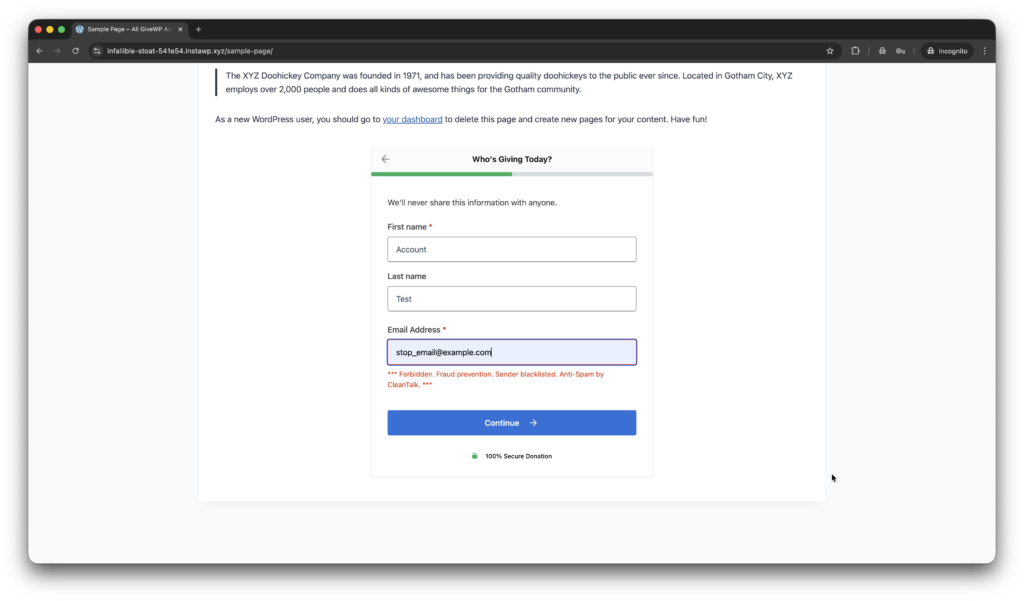
In the next step fill out the account name data and the stop_email@example.com.
You must see a message as below and in the screenshot.
*** Forbidden. Fraud prevention. Sender blacklisted. Anti-Spam by CleanTalk. ***
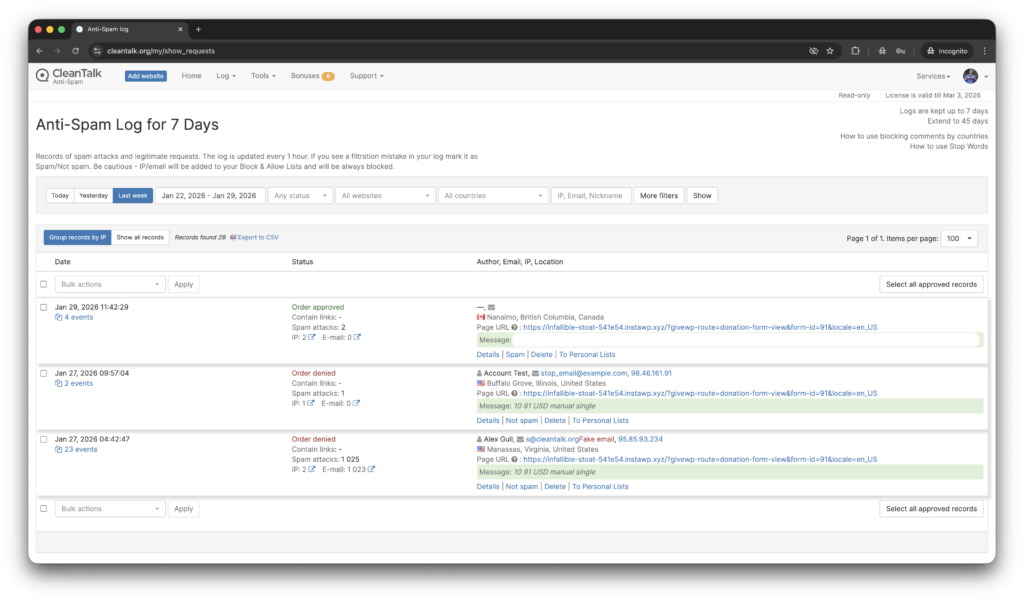
In addition, in the Cloud Dashboard you can find extra details regarding all submissions for the donation form,
IP, Email of the donator. As well as history of activity a sender among other sites connected to CleanTalk’s cloud.
Geolocation of the sender.
Date and time of submission.
Page (URL) of the submission.
Cloud decision – Approved, Denied.
Cloud explanation for the decision.
Tools to move the sender to Block or Allow lists.
What additional anti-spam tools are available for GiveWP?
Here are a few more tools on the market,
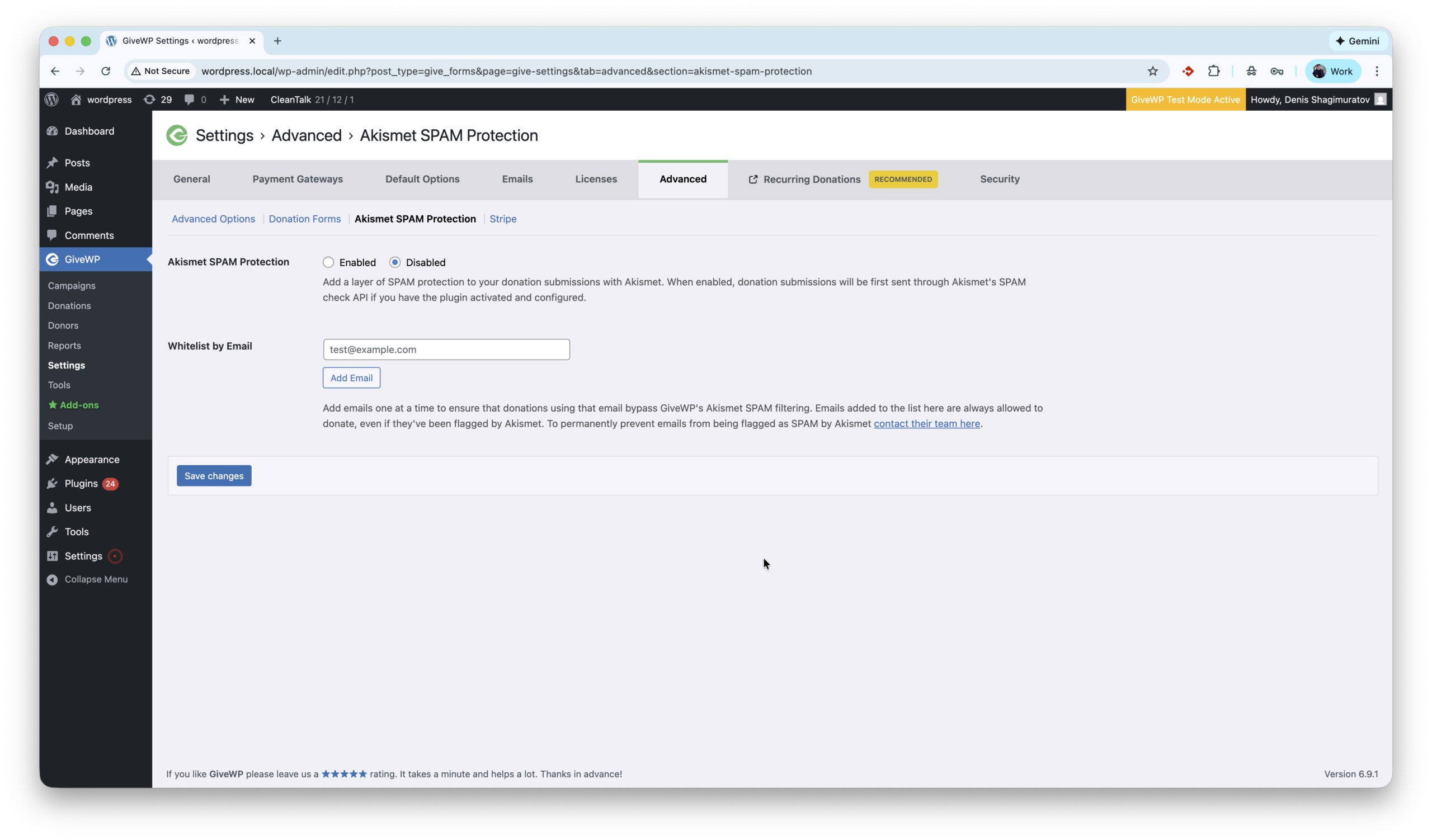
Akismet is a cloud-based anti-spam service that works in the background and has excellent compatibility with WordPress. Most importantly, the GiveWP team has included Akismet integration directly in the core of the plugin, providing a seamless user experience for those who choose Akismet as their anti-spam solution. Akismet settings are located under WordPress console -> GiveWP -> Settings -> Advanced -> Akismet SPAM Protection. Here is full guide how to setup protection.
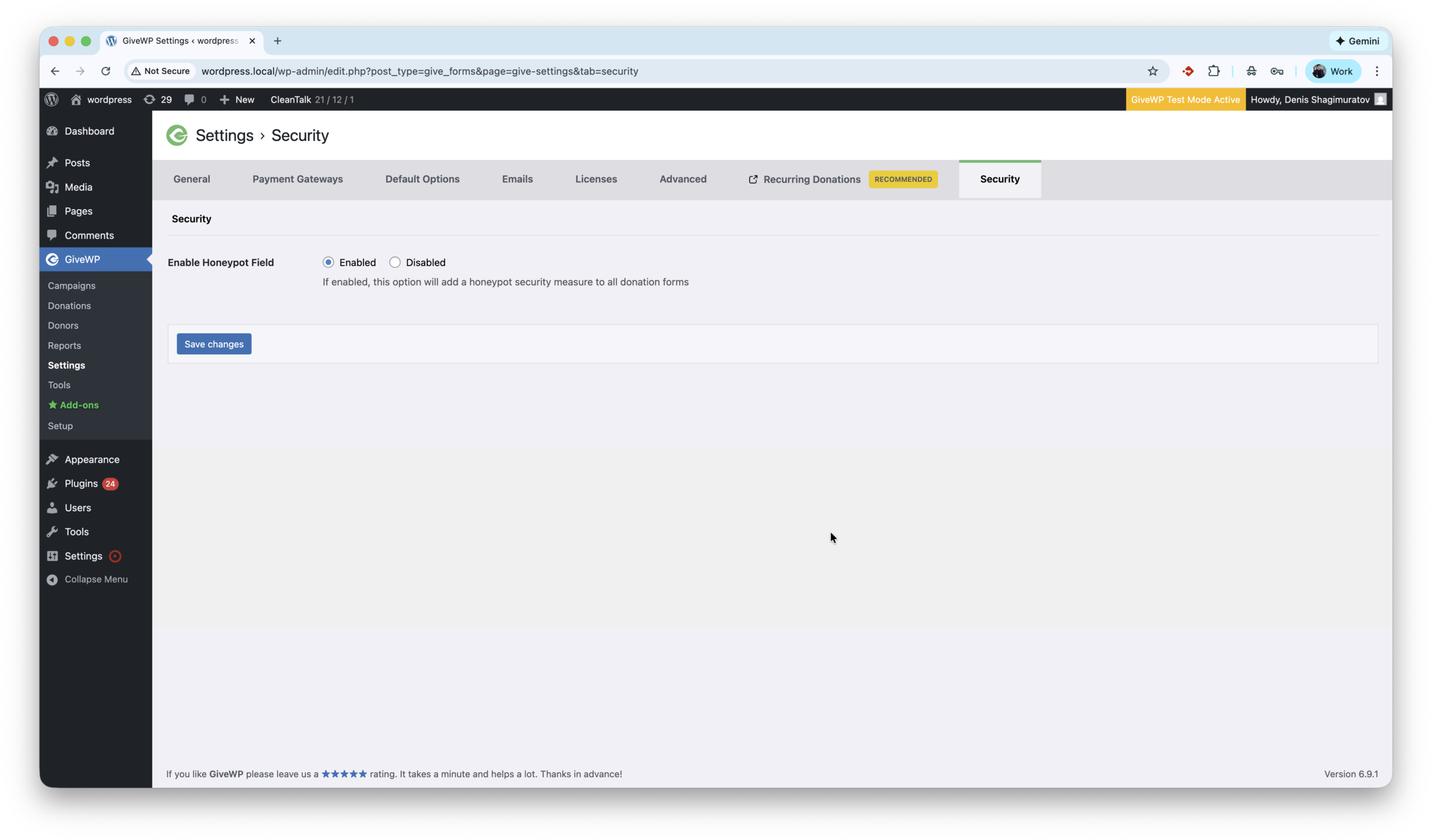
Honeypot anti-spam techniques protect websites by adding invisible form fields that real users never see but spambots automatically fill in. When these hidden fields are completed, the submission is flagged and blocked, stopping spam without CAPTCHAs or user interaction. GiveWP has built-in honeypot which is located under settings WordPress console -> GiveWP -> Settings -> Security -> Enable Honeypot Field. This option is On in default setting, so should filter some primitive spam bots out of the box.
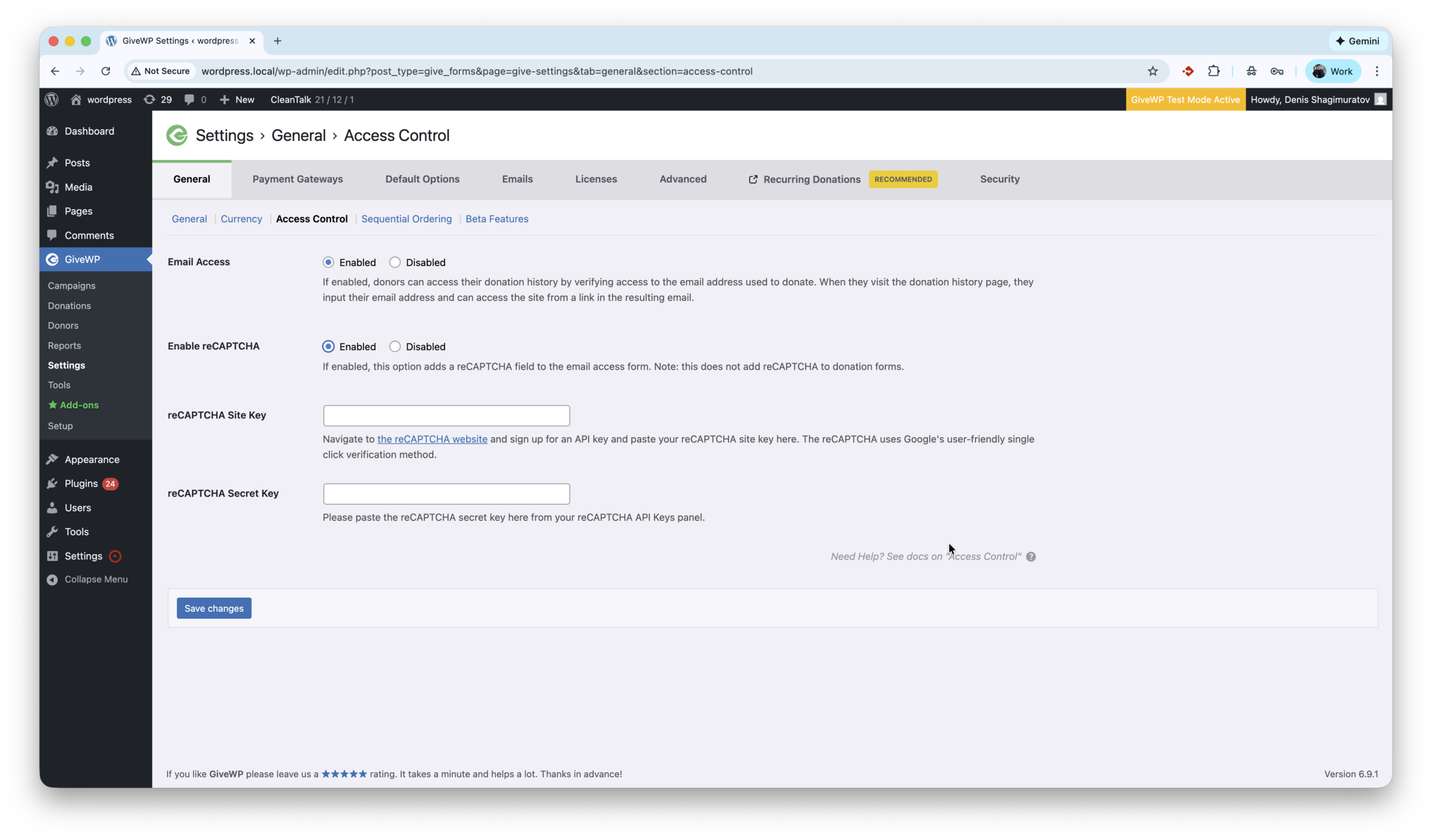
reCAPTCHA is a spam protection technology by Google that helps protect WordPress websites by distinguishing real users from bots using challenges or behavioral analysis. It reduces automated spam submissions but may require user interaction, such as clicking a checkbox or solving a challenge. GiveWP supports reCaptcha in the core and settings are located by path WordPress console -> GiveWP -> Settings -> General -> Access Control -> reCaptcha. The first step to activate this protection is getting Site and Secret keys, which are available on website.
Turnstile by Cloudflare is another great anti-spam tool which is available for GiveWP. Protects WordPress websites by verifying visitors automatically without CAPTCHAs or puzzles. It blocks bots using browser and behavioral signals while keeping the experience seamless for real users. One drawback is to use Turnstile user must install extra plugin – ‘Give – Cloudflare Turnstile’. The full guide is here.
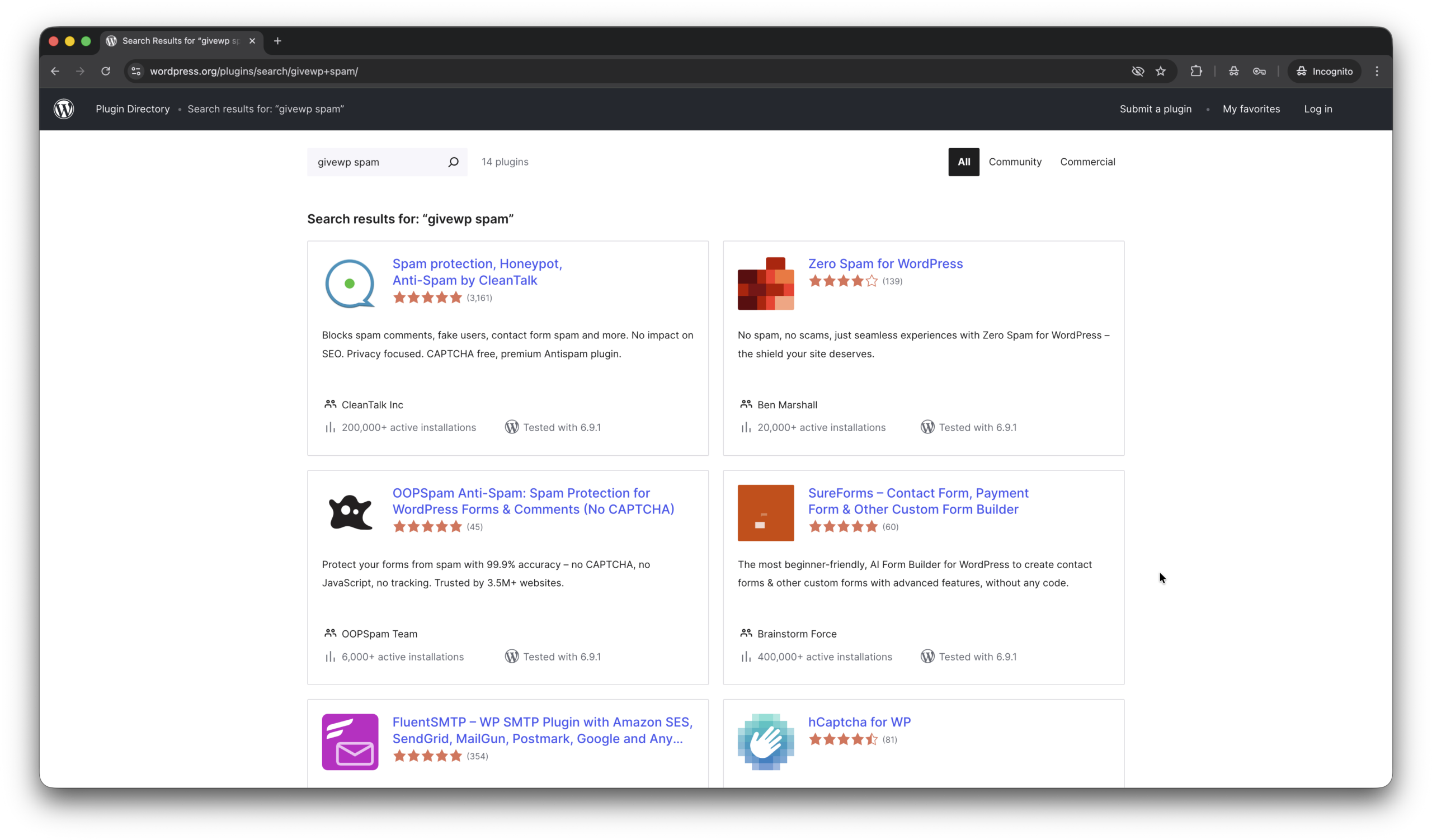
And we have bunch of standalone, universal, all-in-one plugins like Zero Spam, OOPSpam, hCaptcha for WP which provide anti-spam protection for GiveWP as well. Here is a link to download one of them.
Here are screenshots for tools above.
I have questions… (FAQ)
Does CleanTalk protect against donors emails leak?
In July 2025, a vulnerability in GiveWP led to an email data leak of Pihole donators. Yes, Anti-Spam by CleanTalk helps protect against such issues. In this case, email addresses were exposed in the HTML code, even though they were invisible on public pages. The plugin prevents this by obfuscating email addresses by default.
We received hundreds of spam donations immediately after installing GiveWP plugin. How to fix it?
If you do not have specific anti-spam tool installed. Increasing the minimum donation amount can help stop spam, as bots usually test forms with small payments like $1–$5. Setting a $10+ minimum helps filter out these low-effort automated attacks.
A donor is trying to submit recurring donations but the transaction isn’t being processed because the donor’s email is considered spam.
False/positives sometimes happen. In this case just post a support ticket or put this donor in Allow list.
Final thoughts
I hope this guide helped resolve all spam issues on your donation form. If not, Sign Up for an account and our CleanTalk team will be happy to help.
Stop spam without frustrating your visitors
Create your CleanTalk account and start blocking spam donations — no CAPTCHA challenges and no impact on visitors.
If you use WPForms for contact forms, lead generation, surveys, or payment forms, you will eventually face spam – fake submissions, junk leads, and bot activity.
This guide explains how to set up WPForms spam protection using:
the Anti-Spam plugin by CleanTalk with a direct integration for WPForms, and
additional tools like Google reCAPTCHA, hCaptcha, Cloudflare Turnstile, honeypots and third-party anti-spam plugins.
The integration protects WPForms forms such as:
simple contact forms,
marketing and lead forms,
“Request a quote” and booking forms,
registration / login / newsletter forms (where used with WPForms).
WPForms continues to handle the form UI and workflow, while CleanTalk filters spam in the background without adding CAPTCHAs to every form.
WPForms – Easy Form Builder for WordPress
First, let’s quickly look at WPForms itself and the types of sites that rely on it.
WPForms is a popular drag-and-drop form builder plugin for WordPress that lets you create:
contact and feedback forms,
quote and booking forms,
newsletter and marketing forms,
payment / donation forms (Stripe, PayPal, etc.),
surveys, polls, and custom calculators,
login, registration, and other application-style forms.
Out of the box WPForms provides:
a visual drag-and-drop builder and 2000+ pre-built form templates,
responsive, mobile-friendly layouts,
built-in spam protection (anti-spam token and optional honeypot),
integrations with major email marketing services and CRMs,
payment integrations with Stripe, PayPal, Square, and others.
Because WPForms forms are often publicly accessible (contact pages, landing pages, sign-up forms), they become an easy target for spam bots and human spammers. That’s why it’s important to have a reliable WPForms spam protection setup from the beginning.
As WordPress.org shows, WPForms Lite is currently active on over 6 million websites and has 14,274 user reviews with an average rating of 4.8 out of 5.
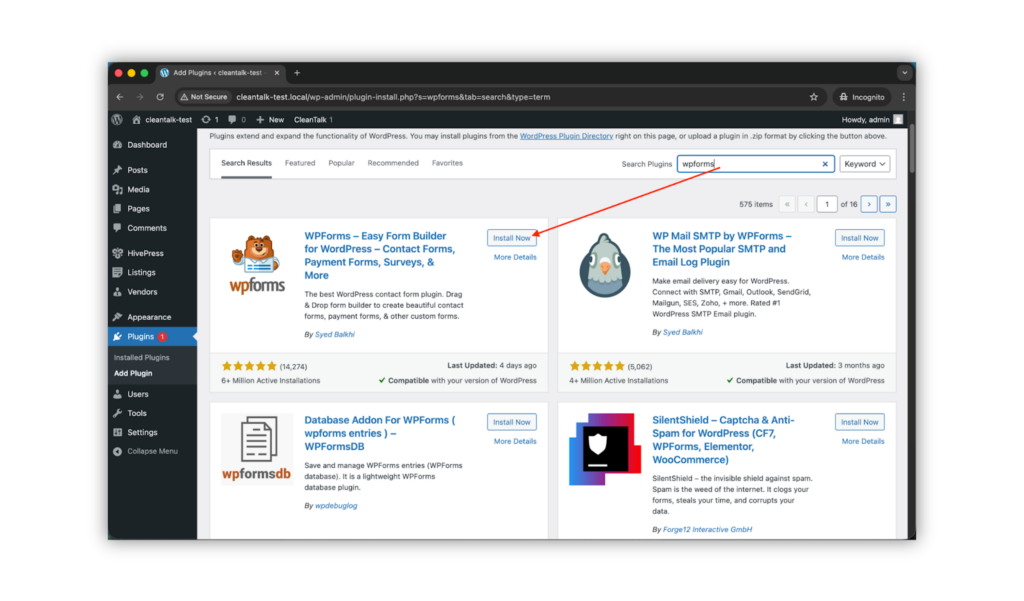
In your WordPress admin go to Plugins → Add New and search for “WPForms”.
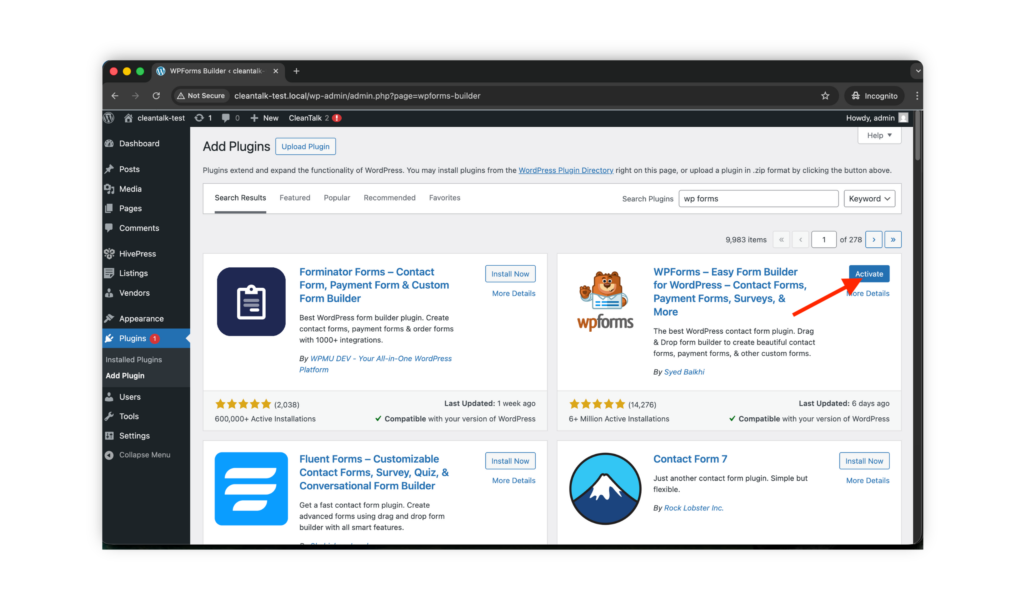
Click Install and then Activate the plugin.
Customize the fields as needed and click Save.
Embed the form on a page using the WPForms block in the editor or the form shortcode.
After that, your first WPForms form is live and ready to accept submissions.
Anti-Spam plugin by CleanTalk for WordPress
The next tool we’re going to use is the Anti-Spam plugin by CleanTalk. Here’s a brief overview:
CleanTalk is a cloud-based spam protection platform for websites, operating since 2012.
It filters spam without CAPTCHAs, challenge questions or image puzzles, so visitors don’t have to solve anything extra.
It protects many kinds of forms: comments, user registrations, contact forms, orders, subscriptions, surveys, and more.
It blocks both automated bots and human spammers using advanced filtering algorithms and data from a global spam database.
It detects spam based on IP reputation, email reputation and behavioral patterns.
It allows you to set custom rules and block by IP, email address, country or language when needed.
It runs quietly in the background, and the plugin is straightforward to install and configure.
According to WordPress.org, Anti-Spam by CleanTalk for WordPress has over 200,000 active installations, with 3,168 reviews and an average rating of 4.7.
To install the Anti-Spam plugin, go to your WordPress admin panel → Plugins → Add New.
Then enter «СleanTalk» in the search box and click the Install button for «Spam protection, Anti-Spam, FireWall by CleanTalk».
After installing the plugin, click the «Activate» button.
After it is done go to the plugin settings and click the «Get Access Key Automatically» button. Then just click the «Save Settings» button.
That’s all – WPForms are now protected From this moment,CleanTalk automatically protects the WPForms registration form (REST route /wp-json/wpformspress/v1/users/), and the Add Listing form used to submit new listings.
You don’t need to paste any shortcodes – just use WPForms as usual, and CleanTalk will filter spam in the background.
Check if spam protection works with WPforms.
The best way to text the spam protection by using a test email,
stop_email@example.com
Open a page with a WPForms (for example, the registration popup or the Add Listing form) in an Incognito / private browser tab.
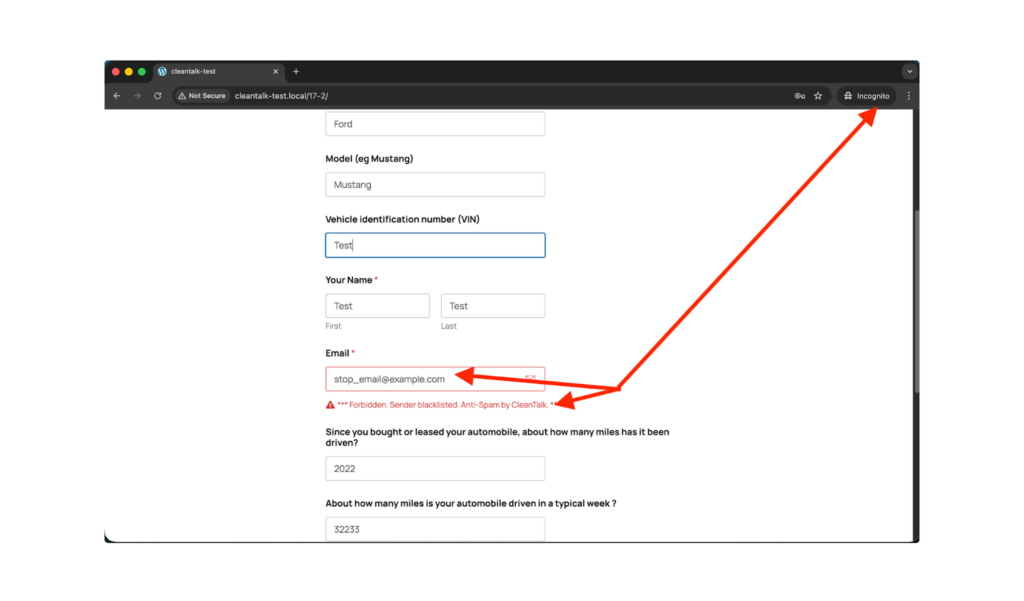
Fill out the Contact form using stop_email@example.com as sender’s email.
Send the form.
You should see a message from the Anti-Spam plugin confirming that a spam submission was blocked.
*** Forbidden. Sender blacklisted. Anti-Spam by CleanTalk. ***
If you see this message, it means CleanTalk successfully protects your WPForms (registration and Add Listing) from spam.
Cloud Dashboard
In addition, in the Cloud Dashboard you can find extra details regarding all submissions processed by CleanTalk, including WPForms registration and Add Listing forms:
IP and email of the sender, as well as the sender’s activity history across other websites connected to the CleanTalk cloud.
Geolocation of the sender.
Date and time of the submission. Page (URL) where the form was submitted (for example, a specific listing submission page).
Cloud decision – Approved or Denied.
Cloud explanation for the decision (e.g. blacklisted email, bad IP reputation, spam text, etc.).
Tools to move the sender to Block or Allow lists so you can fine-tune WPForms spam protection.
Google reCAPTCHA, hCaptcha, and Cloudflare Turnstile in WPForms
In addition to CleanTalk, WPForms itself supports several CAPTCHA and anti-bot services:
Google reCAPTCHA,
hCaptcha,
Cloudflare Turnstile.
These services act as a visible or invisible verification layer on top of your forms, while CleanTalk continues to filter spam submissions in the background.
Google reCAPTCHA (WPForms integration)
WPForms has built-in support for Google reCAPTCHA (v2 Checkbox, v2 Invisible, and v3):
Register your website in the Google reCAPTCHA admin console and generate a Site Key and Secret Key.
In WordPress go to WPForms → Settings → CAPTCHA.
Choose reCAPTCHA as the provider and paste your keys.
Select which reCAPTCHA type you want to use (checkbox, invisible, or v3 score-based).
Edit your forms and enable reCAPTCHA where needed (WPForms shows a toggle or field depending on the type).
reCAPTCHA helps block obvious automated submissions by requiring users to solve a challenge or by scoring their behavior, while CleanTalk still checks the content and sender reputation.
If you want a Google reCAPTCHA alternative that works without visible CAPTCHA friction, review this comparison page.
hCaptcha
WPForms also supports hCaptcha as a privacy-focused alternative to Google reCAPTCHA:
Key benefits of hCaptcha compared to reCAPTCHA:
Stronger focus on privacy – hCaptcha collects less user tracking data, which is important for privacy-oriented and GDPR-sensitive projects.
Less dependence on Google – useful for brands that prefer to minimize their reliance on Google infrastructure.
Optional monetization options for some hCaptcha plans, which reCAPTCHA doesn’t provide.
To use hCaptcha with WPForms:
Obtain Site Key and Secret Key from the hCaptcha dashboard.
Go to WPForms → Settings → CAPTCHA, choose hCaptcha and paste the keys.
Enable hCaptcha for the forms you want to protect.
Cloudflare Turnstile
Cloudflare Turnstile is a quite modern CAPTCHA alternative that often works invisibly in the background, without classic image puzzles. Several WPForms guides cover how to enable Turnstile as a built-in CAPTCHA provider.
Benefits of Cloudflare Turnstile:
Invisible verification – most visitors don’t see any challenge; Turnstile works in the background.
Higher completion rates – fewer puzzles means less friction and fewer abandoned forms.
Privacy-friendly design – Turnstile is built to minimize user tracking and profiling compared to traditional CAPTCHAs.
To connect Turnstile:
Get Site Key and Secret Key from your Cloudflare Turnstile dashboard.
In WPForms → Settings → CAPTCHA, select Cloudflare Turnstile and enter your keys.
Enable Turnstile on the forms (contact, registration, checkout, etc.) where you need extra bot protection.
All three CAPTCHA providers can work alongside CleanTalk Anti-Spam, giving you both:
a front-end bot check (CAPTCHA / Turnstile), and
deep cloud-based spam filtering in the background.
Honeypot, WPForms Built-In Anti-Spam, Akismet and Third-Party Plugins
Alongside CleanTalk and CAPTCHAs, WPForms and WordPress offer several additional anti-spam layers.
WPForms Anti-Spam Token and Honeypot
By default, WPForms includes:
an anti-spam token that helps block automated form submissions, and
an optional honeypot field – a hidden field that humans never see, but bots often fill in.
When a bot fills the honeypot field or fails the token check, WPForms treats the submission as spam and blocks it.
You can control these options in each form’s Settings → Spam Protection and Security section inside WPForms.
Honeypot protection is:
invisible for normal visitors,
easy to enable,
a lightweight extra defense against primitive bots.
Akismet
Akismet Anti-Spam is another popular plugin that filters spam by checking submissions against a global spam database. It is especially useful for blog comments and simple contact forms outside WPForms. If you are looking for a broader option for form protection, see our Akismet alternative for WPForms.
On a site that uses WPForms + CleanTalk you can still use Akismet to:
keep comment sections clean,
filter spam from default WordPress forms or other plugins.
To activate Akismet:
Install and activate Akismet Anti-Spam from Plugins → Add New.
Obtain an API key from Akismet and enter it in the plugin settings.
Enable spam checking for the content types you need (comments, possibly other forms).
Other universal anti-spam plugins
Plugins like WP Armour, OOPSpam, Maspik, and Simple CAPTCHA Alternative provide generic honeypot or anti-spam protection for various forms and comment areas across WordPress.
They can be used alongside CleanTalk if you want additional defense for:
Install, activate, and configure each plugin according to its documentation.
Frequently Asked Questions (FAQ)
I already use WPForms’ built-in anti-spam. Do I really need CleanTalk?
WPForms includes an anti-spam token and optional honeypot, which is great for stopping very basic bots. However, they don’t:
check global spam activity across thousands of sites,
analyze IP and email reputation,
or block known spam networks at the cloud level.
CleanTalk adds an extra layer on top of WPForms’ native tools. It filters submissions using a global spam database and the SpamFireWall, so most spam is blocked before it reaches your entries, inbox or CRM.
Will CleanTalk slow down my WPForms submissions?
No. CleanTalk is designed to work in the background and the request to the cloud is lightweight.
From the visitor’s point of view:
they fill out the WPForms form as usual,
click submit,
and either see a normal success message or an anti-spam message if they are blocked.
For normal users, there are no extra steps, pop-ups or CAPTCHAs to solve.
Can CleanTalk protect all my WPForms forms or only the main contact form?
Once the Anti-Spam plugin is installed and connected to the CleanTalk cloud, it can protect any WPForms form that uses the standard WPForms processing flow:
simple contact forms,
quote / booking / consultation forms,
lead generation and newsletter sign-up forms,
surveys, polls and feedback forms.
You don’t need to add a special field to each form – protection works on the server side.
What happens to blocked WPForms submissions? Are they lost forever?
When CleanTalk blocks a submission, the user is shown an anti-spam message and the entry is not stored as a normal form submission.
However, the attempt is:
logged in your CleanTalk dashboard with IP, email, date, URL and the reason,
available for review if you suspect a false positive,
easy to whitelist (by IP, email, country, etc.) if you decide that a sender is legitimate.
So you still have visibility into what was blocked, but your WPForms entries, inbox and CRM stay clean.
Recommended Anti-Spam Stack for WPForms (2026)
No single tool can block every kind of spam or bad bot. The most reliable approach for WPForms is to build a layered anti-spam stack, where each component handles a different part of the problem.
The key element is the Anti-Spam plugin by CleanTalk, which:
integrates directly with Contact Form by WPForms,
uses both application-level checks and the SpamFireWall to block many bots before they reach WordPress.
On top of this, you can combine CAPTCHAs, WPForms’ built-in tools, and moderation policies.
Recommended setup by site type
Business websites and standard contact forms
CleanTalk Anti-Spam enabled (with SpamFireWall).
WPForms anti-spam token + honeypot enabled in each important form.
Optionally, Google reCAPTCHA or Cloudflare Turnstile on high-risk forms (contact, quote, booking).
High-traffic landing pages and lead generation
CleanTalk Anti-Spam (cloud + plugin).
Cloudflare Turnstile or reCAPTCHA for minimal-friction verification.
WPForms honeypot enabled.
Optional extra filters: block high-risk countries or networks in CleanTalk if you notice patterns in spam logs.
Membership / registration-heavy sites using WPForms
CleanTalk Anti-Spam to protect registration, login, and profile forms where applicable.
Cloudflare Turnstile or hCaptcha on registration / login forms for additional protection.
WPForms built-in spam protection turned on for all authentication forms.
Optionally, Akismet or other plugins for comments and non-WPForms areas.
By this point, most spam problems in your WPForms contact, lead, survey, and payment forms should be significantly reduced. If you’re still seeing unwanted submissions, simply create a CleanTalk account (or log in to your existing one) and reach out to our support team – we’ll gladly help you fine-tune WPForms spam protection for your specific site.
Stop WPForms spam without hurting conversions
Create your CleanTalk account and connect it to WPForms to block spam contacts, leads, surveys and payment forms — no extra CAPTCHAs and no friction for real users.
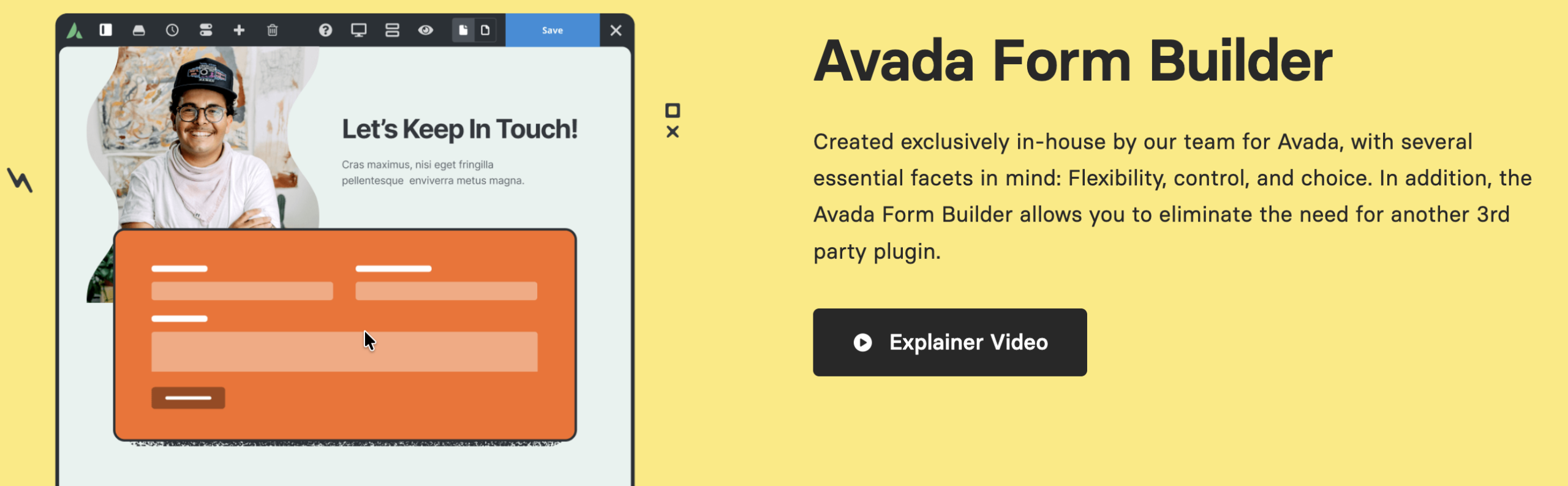
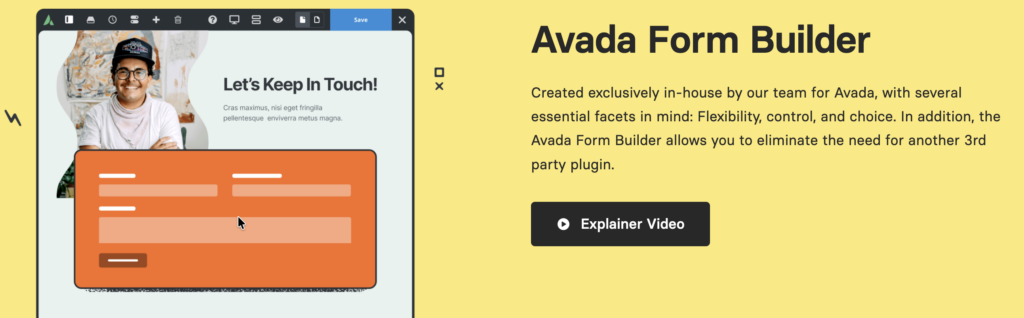
Avada Form Builder is a great choice when you need to create contact forms, surveys, quizzes, and more. In this post, we will review available anti-spam services such as Google reCAPTCHA and Cloudflare Turnstile, tools like honeypots, and anti-spam plugins including CleanTalk, Akismet, hCaptcha, and OOPSpam available to Avada users as of March 2026.
Avada Form Builder https://avada.com/feature/form-builder/
Avada Form Builder, Avada Website Builder, Avada WordPress Theme and Plugins
First, let’s take a closer look at what Avada is and how it works.
Avada Form Builder is a flexible drag-and-drop form solution built directly into the Avada WordPress theme, allowing users to create contact forms, registration forms, surveys, polls, quizzes, feedback forms, and other interactive form types without installing additional plugins. It offers an intuitive visual interface that makes form creation fast and accessible for both beginners and experienced website owners. To help protect websites from unwanted submissions, Avada Form Builder supports built-in spam protection features and integration with popular anti-spam services such as Google reCAPTCHA, Cloudflare Turnstile. With proper spam protection enabled, website owners can reduce bot submissions, fake registrations, and malicious form activity while maintaining a smooth experience for real visitors. This improves data quality, saves administrative time, and keeps communication channels reliable.
In my personal opinion, Avada is a very flexible theme that offers many features out of the box. However, one downside is that it may require some time to build and launch the first version of a website using this theme. I spent more than hour to launch a demo site (including purchasing the theme), it’s much more my average installation process for a theme, which usually takes 10-15 minutes.
The theme is premium and costs $69, with 6 months of support included. Its official website is avada.com, and it can be purchased and downloaded from Envato Market. Envato Market shows 1,054,005 sales, 26.5k reviews with average score 4.78.
Anti-Spam plugin by CleanTalk
As the anti-spam solution, I’m going to use the Anti-Spam by CleanTalk plugin for WordPress. Let’s see what this plugin is.
Anti-Spam by CleanTalk is a cloud-based spam protection plugin that automatically blocks spam submissions on WordPress websites without using CAPTCHAs. It protects contact forms, registration forms, comments, surveys, polls, and other interactive elements from both automated bots and manual spam. Avada users can also protect Avada Form Builder forms, including contact forms, feedback forms, surveys, and registration forms, without adding extra CAPTCHA challenges for visitors. The service analyzes submissions using advanced filtering algorithms and a global spam database that tracks suspicious activity by IP addresses, email addresses, and other parameters. CleanTalk works in the background, allowing real visitors to submit Avada forms normally while blocking spam attempts automatically. Website owners can also review detailed logs of blocked submissions and manage personal allow and deny lists for IP addresses, email addresses, and countries.
According to WordPress.org, Anti-Spam by CleanTalk for WordPress has over 200,000 active installations, with 3,168 reviews and an average rating of 4.8.
To install the Anti-Spam plugin, go to your WordPress admin panel → Plugins → Add New.
Then enter «СleanTalk» in the search box and click the Install button for «Spam protection, Anti-Spam, FireWall by CleanTalk».
After installing the plugin, click the «Activate» button.
After it is done go to the plugin settings and click the «Get Access Key Automatically» button. Then just click the «Save Settings» button.
That’s it! From now your WordPress website and Avada forms are protected from spam.
How to check spam protection
You can test the work of anti-spam protection for your Avada forms by applying a test email,
stop_email@example.com
Test sequence is,
Open a page with your form in Incognito Window.
Fill out the form with any valid data plus stop_email@example.com in the Email field.
Submit the form.
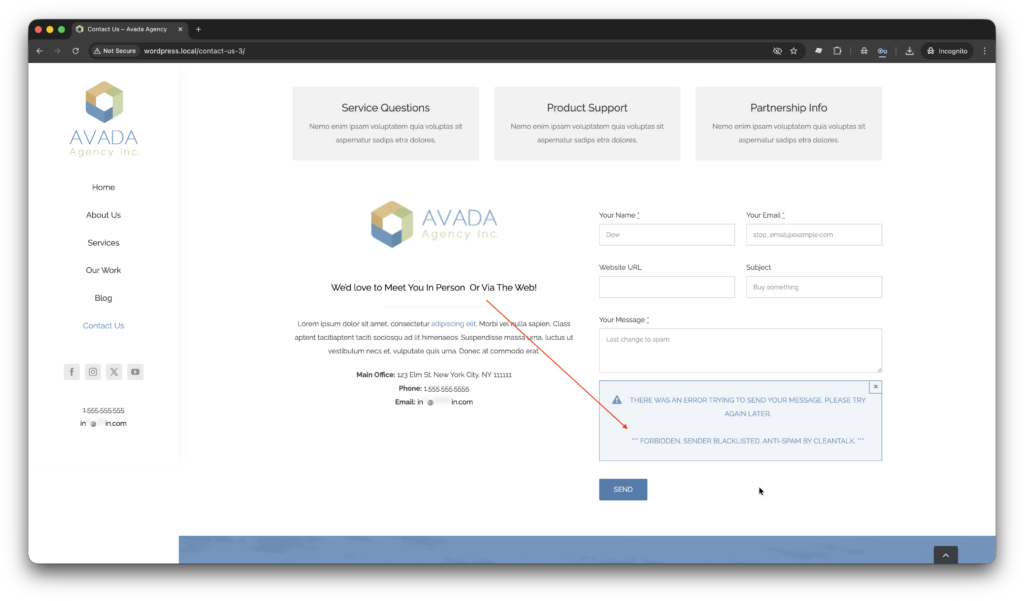
You should get a message like this,
*** Forbidden. Sender blacklisted. Anti-Spam by CleanTalk. ***
Spam (test) submission is blocked at Avada form.
Cloud Dashboard
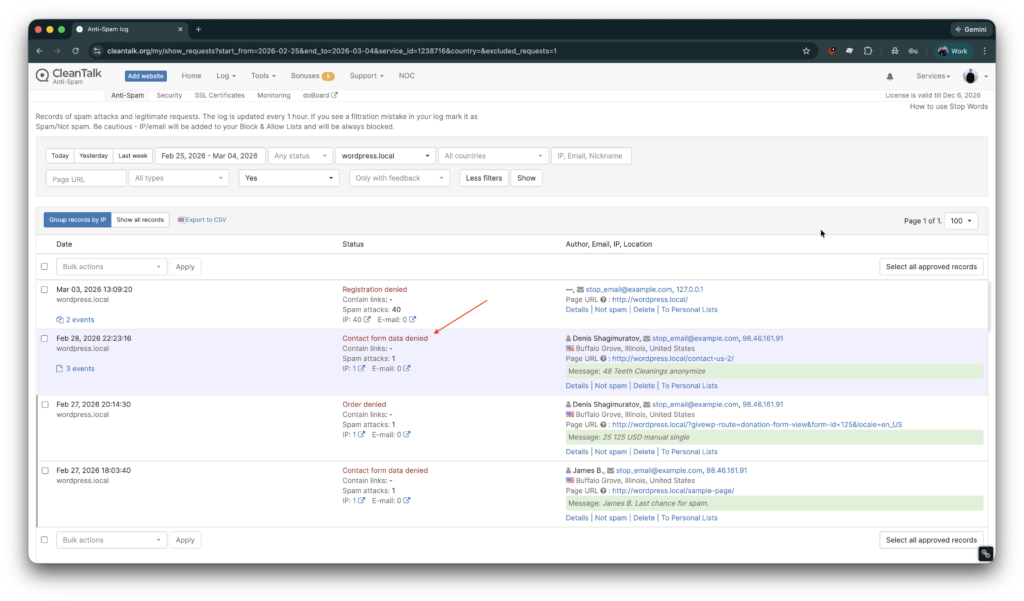
In the Cloud Dashboard you can find extra details regarding all submissions made via form,
IP, Email of the sender. As well as history of activity a sender among other sites connected to CleanTalk’s cloud. Geolocation of the sender. Date and time of submission.
Tools to move the sender to Block or Allow lists.
Cloud Dashboard, Anti-Spam Log, spam submission is blocked for an Avada form.
If you have any questions, add a comment and we will be happy to help you.
Create your Cleantalk account – Register now and enjoy your spam-free Avada forms.
There are two anti-spam services integrated into the Avada forms core,
Google reCAPTCHA is the first services, that we have in the core. By analyzing user behavior and verifying whether a visitor is human, reCAPTCHA adds an extra layer of security to contact forms, registration forms, surveys, and other form types created with Avada. It is widely used and easy to integrate, making it a convenient option for many website owners. reCAPTCHA can help reduce the number of fake submissions and automated attacks targeting Avada forms. However, depending on the version used, it may also add additional steps for visitors, such as solving challenges or running background behavioral analysis.
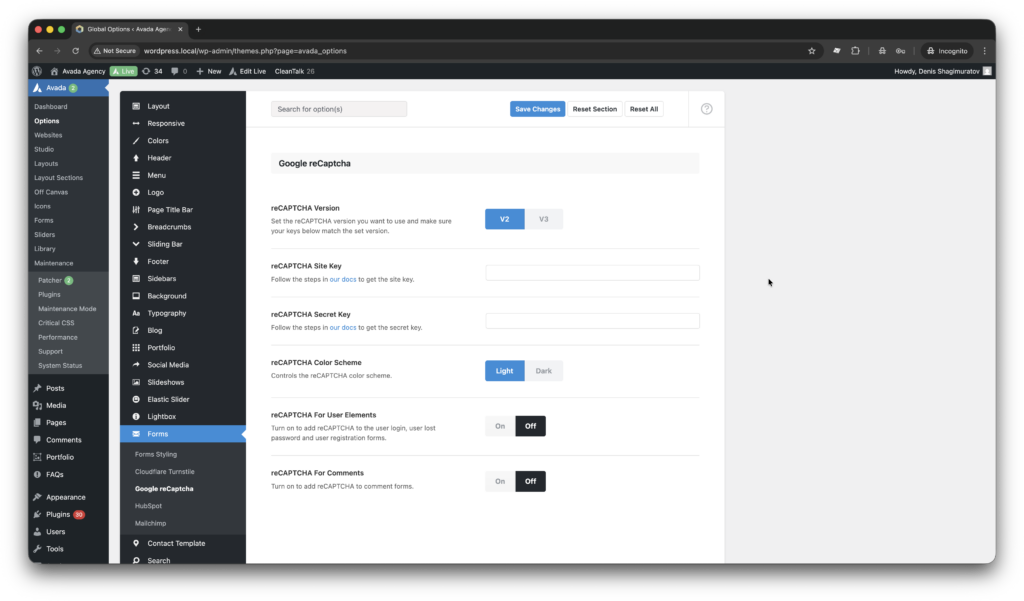
Service is available under settings Settings are under path WordPress console -> Avada > Maintenance -> Forms -> Google reCaptcha.
To activate this service obtain Site key and Secret key on the site.
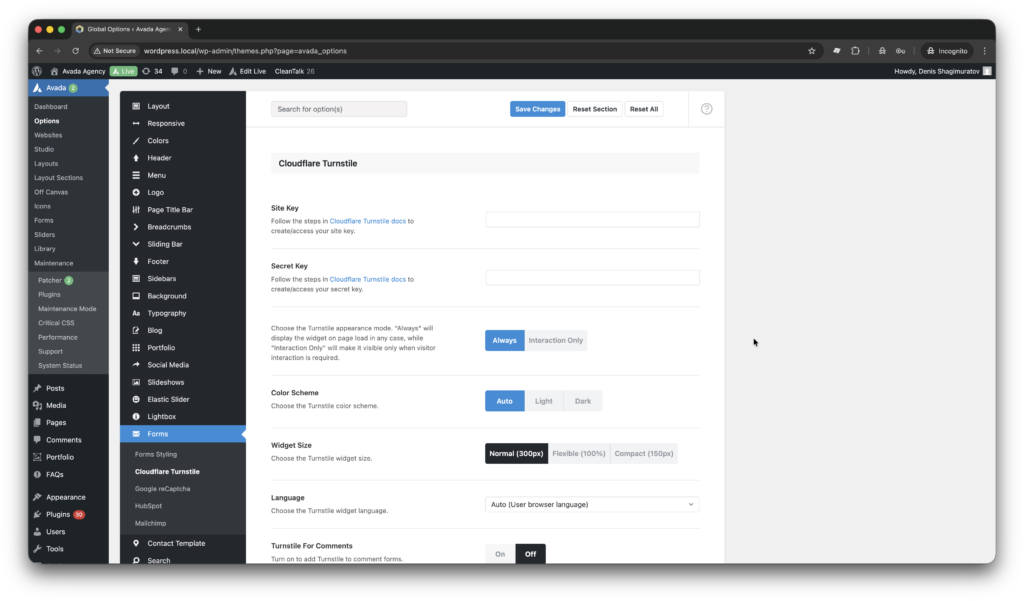
Cloudflare Turnstile provides an easy way for Avada Form Builder users to protect their forms from automated spam and bot submissions. Unlike traditional CAPTCHAs, Turnstile verifies visitors quietly in the background, helping reduce friction for real users filling out contact forms, registrations, surveys, or polls created with Avada. It integrates easily into websites and focuses on privacy by avoiding invasive tracking methods. For Avada users, this means stronger bot protection while maintaining a smoother and more user-friendly form experience.
Main benefits of Cloudflare Turnstile over Google reCAPTCHA.
One of the main benefits is a better user experience, as Turnstile verifies visitors automatically in the background without showing image puzzles or interactive challenges.
It also focuses more on privacy, because it does not rely on extensive user tracking or Google cookies.
Turnstile is designed to be lightweight and fast, which can help maintain page performance on Avada-based websites.
Service is available under settings Settings are under path WordPress console -> Avada > Maintenance -> Forms -> CloudFlare Turnstile.
Here we have few additional anti-spam mechanics available for Avada users.
Akismet is one of the most popular anti-spam services for websites, with background spam checking as its key feature. Unfortunately,Akismet is not available for Avada users, either as an element or as an integration within the plugin, and I have found no evidence that such integration exists.
Honeypot is a simple anti-spam technique that works silently in the background. It adds an invisible field to your Avada forms that real visitors never see, but spam bots often fill out automatically. When the hidden field is completed, the submission is identified as spam and blocked before it reaches your website. The main benefit for Avada users is that honeypot protection does not require CAPTCHA or extra steps from visitors, helping keep the form experience fast and user-friendly while reducing automated spam.
This technique works through a form element. This is the best guide to activate a honeypot for your form
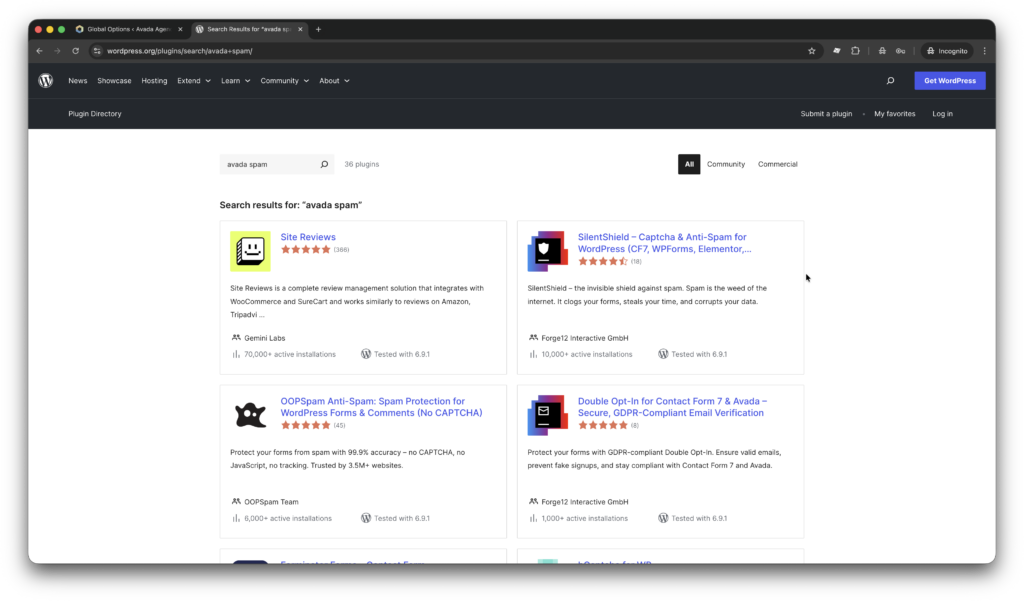
Also in the market we have universal, anti-spam plugins SilentShield, OOPSpam, hCaptcha and a few more that protects Avada users against spam. These plugins are listed in wordpress.org.
SilentShield, OOPSpam, hCaptcha as anti-spam plugins for Avada users.
Frequently Asked Questions (FAQ)
Is WP Armour compatible with Avada?
There is no evidence that WP Armour support Avada users.
I have problems with the reCaptcha, I have registered and put the key ods, but it’s not working.
You have to all the form elements enabled from the builder options. Here is the guide.
Does this come with captcha? or can google captcha work and be added to contact form?
Yes, you can definitely add Google reCaptcha to your contact form or login element with Avada.
Recommended Anti-Spam Stack for Avada Form Builder (2026)
Finally, here in March 2026 I can recommend the following anti-spam stack for Avada users.
Small Websites and Personal Blogs: CleanTalk Anti-Spam + Avada Honeypot field.
For small websites, portfolios, and personal blogs using Avada Form Builder, CleanTalk alone is often enough to stop most automated spam and manual submissions.
High-traffic Avada websites and agency projects often experience both automated and manual spam attacks. In this setup, CleanTalk performs the main filtering, SpamFireWall blocks bot traffic early, and Turnstile provides an additional verification step for sensitive forms such as registrations or payments. Website administrators can further refine protection using CleanTalk’s logs and personal filters by IP address, email, or country.
By this point, spam issues should be resolved on your site. If not, Sign Up for an account and our support team will be happy to help you.
Stop spam without frustrating your visitors
Create your CleanTalk account and start blocking spam forms, surveys, polls and quiz answers — no CAPTCHA challenges and no impact on visitors.
Many reCAPTCHA v3 users complain about always receiving a score of 0.9 despite multiple attempts and changes in their Google Cloud integration. In this article, we reproduce this issue and explain why reCAPTCHA always returns a score of 0.9.
Research Objective
Users complain that when testing reCAPTCHA v3, they always receive the same score of 0.9. However, in the same environments with reCATPCHA v2, the score varies.
What is a Score?
The score is the result of the reCAPTCHA check. The closer it is to 1, the more likely the visitor is human. The closer it is to 0, the more likely the visitor is a bot.
How reCAPTCHA v3 Works
Note: The following findings are based on publicly available code and our interpretation.
A user integrates the ReCaptcha script on a form page.
A unique frontend token is added to each form.
The script loads additional obfuscated code.
The obfuscated code collects frontend data (a “black box” not accessible due to Google’s code obfuscation).
Aggregated and encoded data + frontend token is sent to Google’s cloud to get a result token.
The result token is sent to the backend of the testing environment.
The backend validates the token via Google’s API, sending the backend token, result token, and the visitor’s IPaddress.
Based on the score result, the backend environment can decide whether to allow the visitor to proceed.
The backend environment decides whether to allow the visitor to proceed based on the score.
We believe reCAPTCHA v3 relies on machine learning based on the traffic environment. The exact decision-making algorithms are proprietary and remain a trade secret of Google.
Why You Always Get a Score = 0.9 in reCAPTCHA v3
ReCaptcha v3 relies on machine learning based on traffic data.
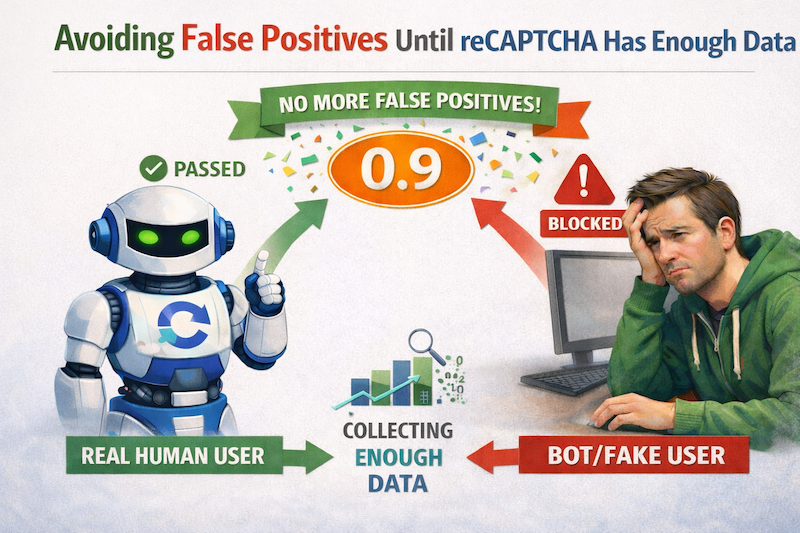
A consistent score of 0.9 indicates the system lacks sufficient data about your typical traffic to make an accurate decision. To avoid false positives, the system grants a 0.9 score to all visitors until trained.
Why You Get Score <> 0.9 in reCAPTCHA v2
ReCaptcha v2 does not use machine learning for decision-making. It operates in one of two modes:
in the user interaction mode (presence of click-the-flag mechanism on the page).
ReCaptcha v3 integrated according to instructions.
Bot
A simple bot created in Python using Selenium. The bot was run from three IP addresses, emulating the following parameters
headless
user agents
headers
clicks
form submissions
Process
The bot ran for 24 hours, performing sequential visits and form submissions with random parameters. No live traffic was sent to the site.
Results
All bot requests returned a score of 0.9.
The score did not change over time.
No statistics appeared in Google Analytics. We hypothesize that traffic presence, volume, and quality in Google Analytics may act as a training marker for the ReCaptcha system.
How to Get an Accurate Score in a Test Environment
The reCAPTCHA v3 model assumes long-lasting training on live traffic. This means that the test environment must be loaded in the same way as the production environment. Which will undoubtedly cause some difficulties in deploying such an environment and getting the payload.
We believe that to get the right score a user will have to turn to testing in a productive environment. However, the policy of most companies we know of (including CleanTalk of course) restricts any testing in a production environment.
Unfortunately, we couldn’t find specific terms for the duration of training in Google’s official documentation. We believe that the duration of training depends on the following parameters:
Traffic load
Ratio of bots to real users
Percentage of “intelligent” bots among total bot traffic
Without live traffic, no settings or configurations will yield an accurate score in a test environment.
If you keep getting a repeated 0.9 score and want to inspect what your environment is actually returning, try our reCAPTCHA v3 score test. It helps you review not only the score itself, but also the validation details behind it.
CleanTalk’s Solutions
If you would like to try a reCAPTCHA alternative, please find more details about CleanTalk’s solutions below. There, we explain how to use the API, plugins, and ready-to-use libraries to protect against spam bots without issues such as a 0.9 score being assigned to every visit.
CleanTalk provides a cloud-based Anti-Spam service for websites, blocking spam in real time without CAPTCHAs. It integrates with CMS platforms like WordPress, Drupal, Joomla, and etc. Securing comments, registrations, and contact forms. Features include SpamFireWall, email validation, and detailed logs, ensuring seamless protection and improved user experience.
The best way to connect your site is to install one of our Anti-Spam plugins.
Anti-Spam CleanTalk API
CleanTalk offers a suite of APIs that integrate anti-spam functionalities into various applications. The Anti-Spam API includes methods like,
the ip_info() method returns country codes for IP addresses.
For managing personal lists and uptime monitoring, the Dashboard API offers dedicated methods. These APIs enable developers to enhance their applications’ security and spam prevention capabilities effectively.
As a WordPress user let me share my experience of using CAPTCHA less and CAPTCHA style Anti-Spam tools on the example of Contact form 7.
Is reCAPTCHA good or bad for Contact form 7?
Contact Form 7 users may prefer Anti-Spam plugin by CleanTalk over reCAPTCHA for several reasons, as each solution has its own advantages and disadvantages. Here are some potential reasons why some users prefer Anti-spam by CleanTalk:
Simplicity: Anti-spam by CleanTalk offers a simpler and more user-friendly solution compared to reCAPTCHA. It doesn’t require users to solve puzzles or click checkboxes, which can be seen as an added step that may deter some visitors from submitting forms.
Reduced User Friction: reCAPTCHA can sometimes lead to a less than ideal user experience, especially for those who find it challenging to complete the visual or interactive challenges. Anti-spam by CleanTalk doesn’t require any user interaction, so it doesn’t add any friction to the form submission process. More drawbacks of CAPTCHA/reCAPTCHA.
Invisible to Users: Anti-spam by CleanTalk works invisibly in the background, so users are not aware of its presence. In contrast, reCAPTCHA typically requires users to complete a task to prove they are not a bot.
Accessibility: Some users have accessibility concerns with reCAPTCHA, as it relies on visual verification. Anti-spam by CleanTalk does not present accessibility challenges in the same way, making it a more inclusive solution.
Accuracy: Anti-spam by CleanTalk uses a combination of methods, including machine learning and a vast database of known spam sources, to identify and block spam submissions. This approach can be effective in detecting and preventing spam without relying on user interaction.
Reduced False Positives: reCAPTCHA, while effective at blocking bots, may occasionally generate false positives, blocking legitimate users. Anti-spam by CleanTalk aims to minimize false positives, ensuring that genuine inquiries are not inadvertently marked as spam.
Customization: Users have the ability to customize Anti-spam by CleanTalk settings to meet their specific needs and preferences, tailoring the spam protection to their site’s requirements.
Integration: Anti-spam by CleanTalk is designed to seamlessly integrate with Contact Form 7 and other popular form plugins, making it easy for users to implement spam protection without significant configuration.
Anti-Spam by CleanTalk
It’s important to note that the choice between Anti-spam by CleanTalk and reCAPTCHA may depend on the specific needs and preferences of individual website owners. Some users may prioritize ease of use and a seamless user experience, while others may prioritize the high level of bot detection offered by reCAPTCHA. Ultimately, the choice between these solutions should align with your website’s goals and the user experience you want to provide. Additionally, some users may opt to use both solutions in combination to enhance spam protection further.
How to install Anti-Spam by CleanTalk?
To install and configure the “Anti-Spam by CleanTalk” WordPress plugin for your website, follow these steps:
1. Log in to Your WordPress Dashboard:
Navigate to your WordPress admin dashboard by entering your site’s URL followed by “/wp-admin” (e.g., “https://yourwebsite.com/wp-admin“).
2. Access the Plugins Section:
In the WordPress dashboard, locate and click on the “Plugins” option in the left-hand menu.
3. Click “Add New”:
On the Plugins page, click the “Add New” button at the top of the screen. This will take you to the Add Plugins page.
4. Search for “Anti-Spam by CleanTalk”:
In the search bar on the Add Plugins page, type “Anti-Spam by CleanTalk” and press Enter. The search results will appear.
5. Install the Plugin:
Locate the “Anti-Spam by CleanTalk” plugin in the search results. Click the “Install Now” button next to the plugin’s name.
6. Activate the Plugin:
After installation, a new button will appear that says “Activate.” Click this button to activate the Anti-Spam by CleanTalk plugin.
7. Enter Your Access Key:
Once the plugin is activated, you’ll need to enter your access key to enable the anti-spam features. You can obtain the access key by signing up for CleanTalk on their website (https://cleantalk.org/) and subscribing to their service. After subscribing, you’ll receive an access key via email.
a. In the WordPress dashboard, go to “Settings” in the left-hand menu.
b. Click on “Anti-Spam by CleanTalk” from the submenu.
c. Enter your access key in the provided field.
d. Click the “Check Access Key” button to validate your access key.
8. Configure Settings:
Once your access key is validated, you can configure the plugin settings according to your preferences. The settings allow you to customize the anti-spam protection for your site, including options for comments, registrations, contact forms, and more.
9. Save Changes:
After configuring your settings, don’t forget to click the “Save Changes” button to apply your chosen anti-spam settings.
10. Verify That It’s Working:
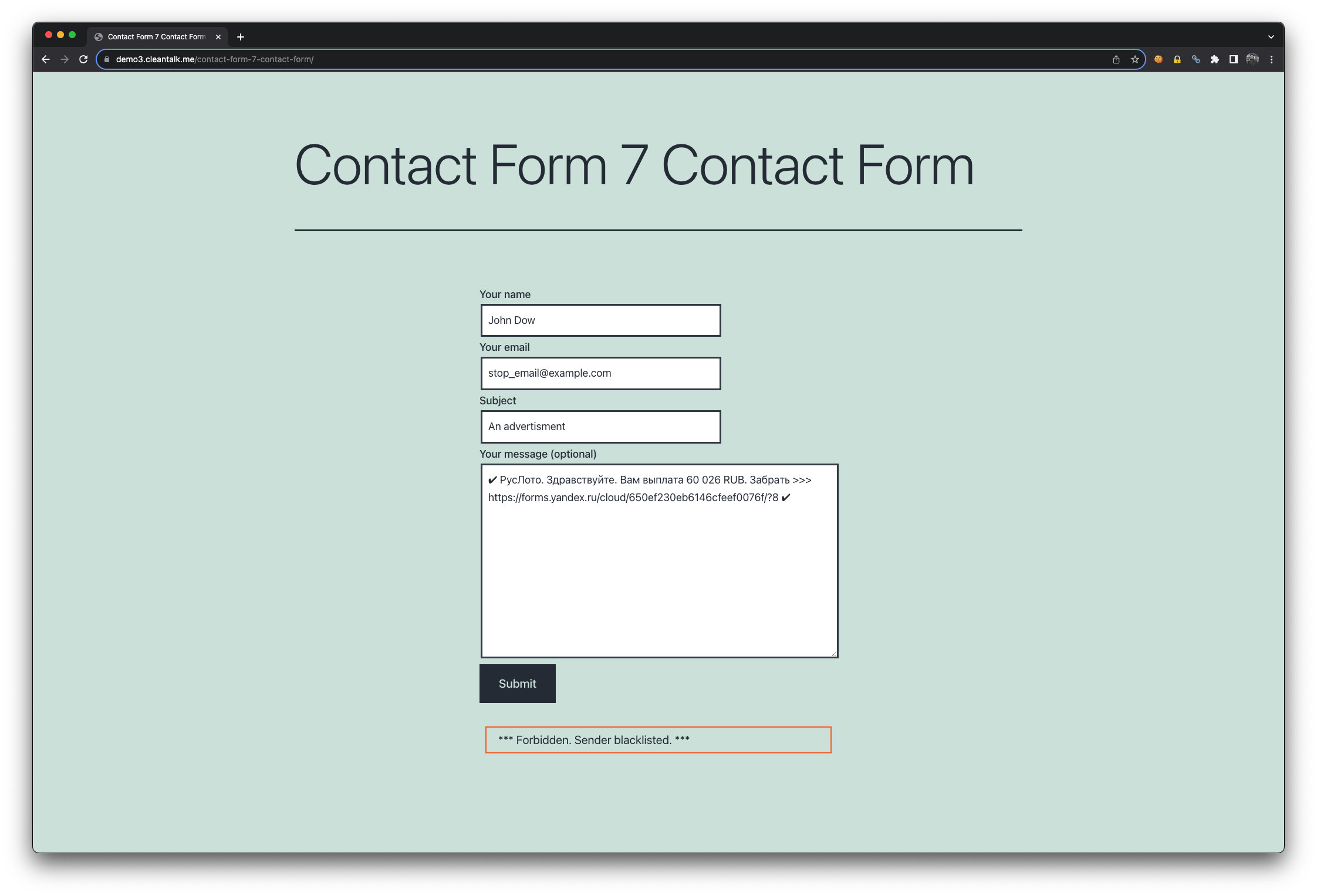
To ensure that the plugin is effectively blocking spam, just use email stop_email@example.com in a contact form 7. You have to see a special response from Anti-Spam by CleanTalk that describes a reason for blocking.
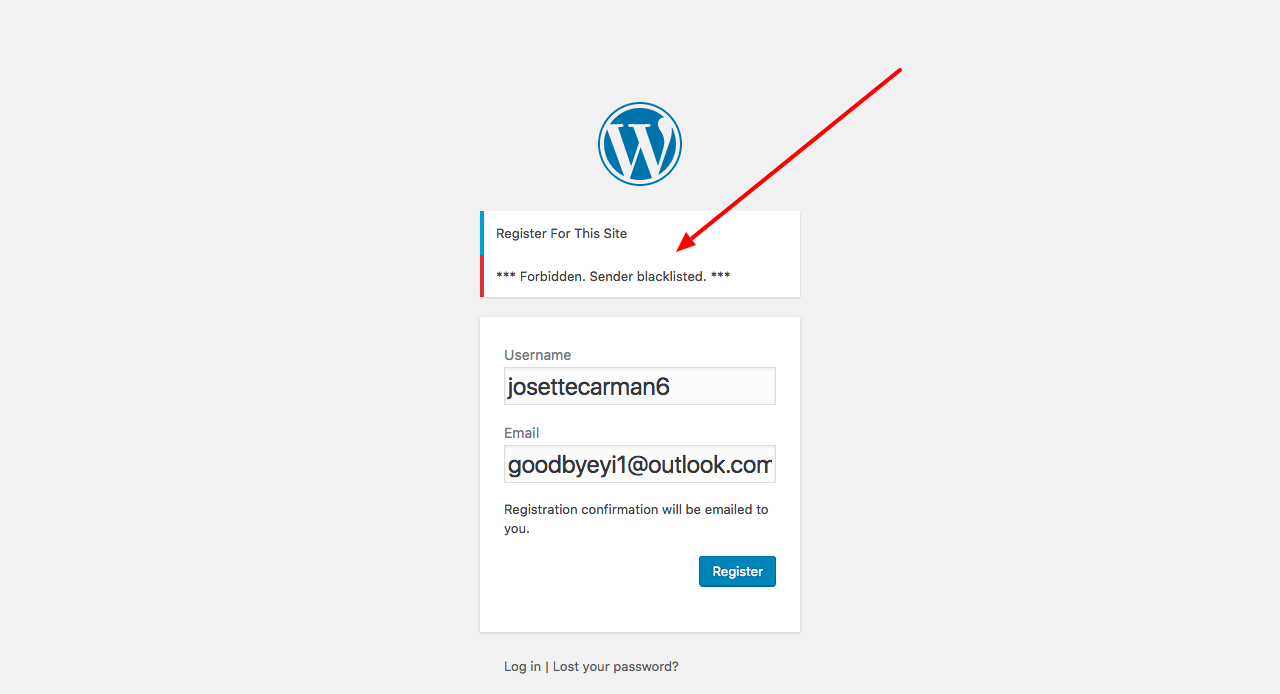
*** Forbidden. Sender blacklisted. ***
Anti-Spam by CleanTalk shows the reason of blocking form submission.
11. Periodic Review:
Periodically review the plugin’s dashboard to check its performance and verify that it’s actively blocking spam submissions. CleanTalk provides statistics on the number of spam attempts blocked.
That’s it! You’ve successfully installed and configured the “Anti-Spam by CleanTalk” plugin on your WordPress website. This plugin will help protect your site from unwanted spam submissions and improve the overall security and user experience of your WordPress site.
In today’s digital landscape, protecting your WordPress website from spam and malicious activities is paramount. One of the most common tools used to achieve this is CAPTCHA. However, whether to use CAPTCHA or not can be a topic of debate among website owners. This article will explore the pros and cons of using CAPTCHA on your WordPress site, helping you make an informed decision.
What is CAPTCHA?
CAPTCHA, which stands for “Completely Automated Public Turing test to tell Computers and Humans Apart,” is a security measure used to determine whether the user is a human or a bot. It typically requires users to solve puzzles, enter text from distorted images, or check a box to verify their humanity.
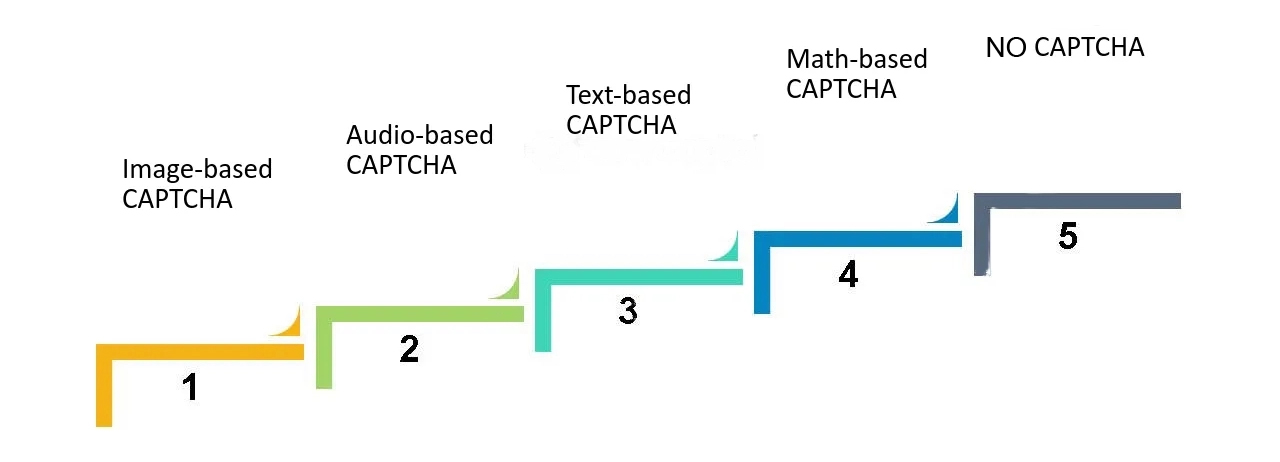
Types of CAPTCHA
Before diving into the pros and cons, it’s useful to understand the different types of CAPTCHA you might encounter:
Text-based CAPTCHA Users are asked to enter characters from a distorted image.
Image-based CAPTCHA Users select images that match a given description (e.g., select all images with traffic lights).
Checkbox CAPTCHA (CAPTCHA) Users simply check a box to confirm they are not a robot.
Invisible CAPTCHA This version works in the background and only challenges the user if it detects suspicious behavior.
Pros of Using CAPTCHA on WordPress
Spam Protection Benefit: CAPTCHA effectively prevents automated bots from submitting forms, which is crucial for reducing spam in comments, registration forms, and contact forms. Explanation: Bots often target forms to post spammy content or create fake accounts. CAPTCHA acts as a gatekeeper, allowing only genuine human interactions.
Enhanced Security Benefit: By blocking automated scripts and bots, CAPTCHA adds an extra layer of security to your WordPress site. Explanation: This can be particularly important for sites that process sensitive information or have user registration features, as it helps prevent brute-force attacks and data scraping.
Reduced Server Load Benefit: Limiting spam and bot traffic can reduce the load on your server, improving overall site performance. Explanation: Bots generating excessive requests can slow down your site or even crash it. CAPTCHA helps mitigate this risk by filtering out non-human interactions.
User Verification Benefit: CAPTCHA ensures that submissions (like comments or sign-ups) are made by real users, maintaining the quality and integrity of your site’s content. Explanation: This is especially useful for sites with user-generated content, where maintaining a community of genuine users is crucial.
Flexible Integration Benefit: Many WordPress plugins offer easy CAPTCHA integration for various forms and functionalities. Explanation: Popular plugins like Contact Form 7, WPForms, and others allow you to add CAPTCHA to protect your forms with minimal effort.
Cons of Using CAPTCHA on WordPress
User Experience Impact CAPTCHA can create friction in the user experience, potentially deterring visitors from completing forms or engaging with your site. Users may find solving CAPTCHA puzzles frustrating or time-consuming, leading to higher abandonment rates, especially on mobile devices.
Accessibility Issues CAPTCHA can pose significant challenges for users with disabilities, making it difficult or impossible for them to interact with your site. Visually impaired users, for example, may struggle with image-based CAPTCHAs, while others with cognitive disabilities may find the puzzles confusing. Even audio CAPTCHAs can be problematic for those with hearing impairments.
False Positives Sometimes, legitimate users can be incorrectly flagged as bots, preventing them from completing their intended actions. This can happen due to various reasons, such as users failing to solve the CAPTCHA correctly or using certain browser extensions that interfere with CAPTCHA detection.
Maintenance and Compatibility CAPTCHA implementations may require ongoing maintenance and updates to remain effective and compatible with your WordPress site. As bots evolve, CAPTCHAs must also be updated to stay ahead. Additionally, plugin conflicts or updates can sometimes cause compatibility issues, requiring troubleshooting and technical know-how.
Increased Load Time Adding CAPTCHA can slightly increase page load times, which might impact your site’s performance. Each CAPTCHA requires additional resources to render and validate, which can contribute to longer loading times, particularly if not optimized.
Alternatives to CAPTCHA
Given the potential drawbacks, you might wonder if there are alternatives to CAPTCHA that can provide security without compromising user experience. Here are a few options:
1. Anti-Spam Plugins
How it works: Plugins like CleanTalk analyze form submissions and user behavior to filter out spam without the need for CAPTCHA. Benefit: They offer seamless protection with minimal impact on user experience.
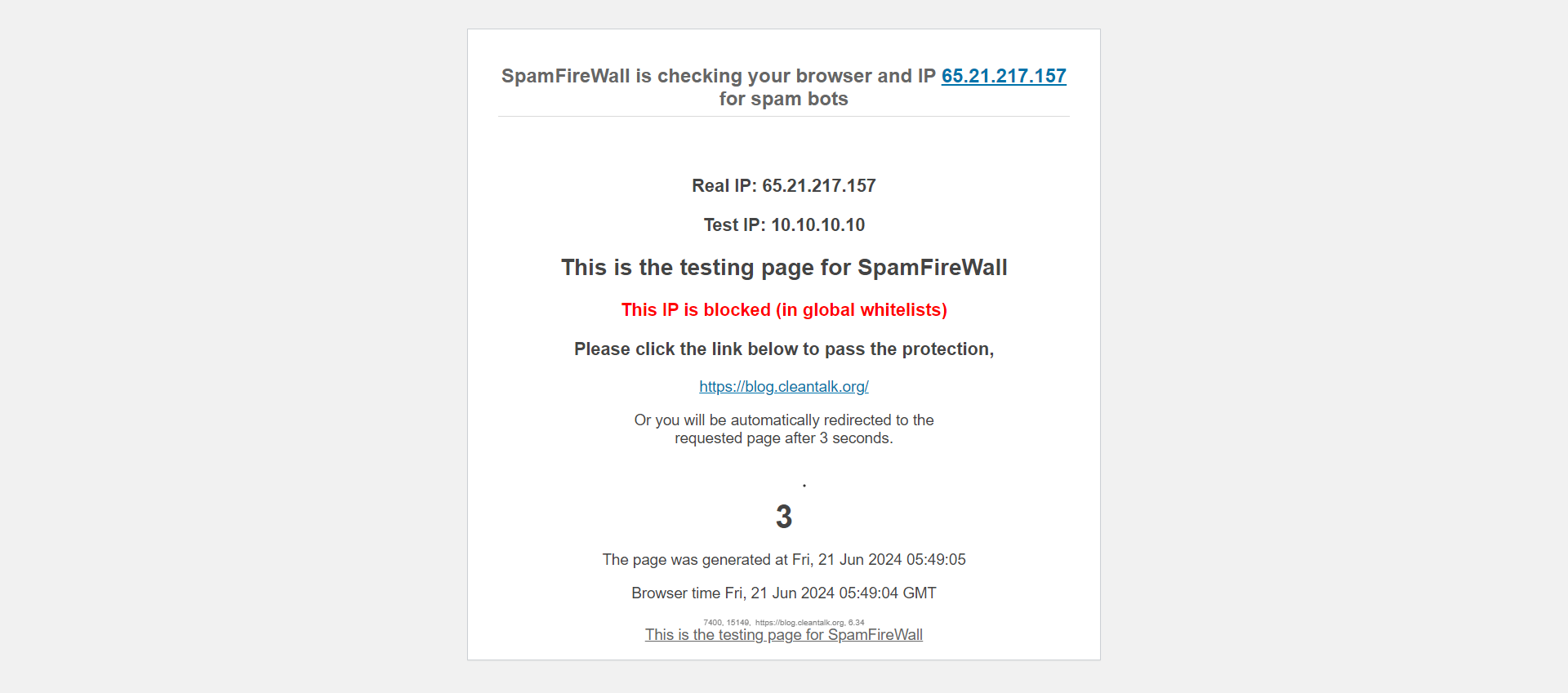
After the Anti-Spam is installed and activated, it protects your website and all forms from spam bots, keeping them from overloading your site. That’s how the website “looks” for spam bots:
Protection of your forms will also triggered even before a form is submitted, thus protecting your forms from getting spammed. That’s how it “looks”:
“Also, take a look at what we think about the pros and cons of reCAPTCHA in our dedicated post, reCAPTCHA Alternative.”
2. Honeypot Fields
How it works: Hidden form fields are added that human users can’t see but bots will fill out. If these fields are completed, the submission is flagged as spam. Benefit: This method is invisible to users and doesn’t affect their experience.
3. Time-Based Methods
How it works: Measures the time taken to complete a form. Bots typically submit forms almost instantly, whereas humans take longer. Benefit: This is a passive method that doesn’t require any action from the user.
4. JavaScript-Based Solutions
How it works: Uses JavaScript to detect bots based on behavior and patterns that are unusual for human users. Benefit: These solutions operate behind the scenes, making them less intrusive for users.
Conclusion
CAPTCHA is a simple and free tool that will help you eliminate most spam bots. It is very useful for users in the first stage of launching their WordPress website.
However, in the next step, you may need a more advanced solution. For example, one that will give much more protection against spam bots to increase the speed of your site, and also, will be completely invisible to save precious time of your site visitors. As such a solution, we recommend CleanTalk Anti-Spam, a service we have been improving for more than 10 years. The full list of features can be found here.
Consider your audience and the nature of your site when deciding. If your site handles sensitive information or has high spam vulnerability, CAPTCHA could be beneficial. However, for sites focused on user engagement and accessibility, exploring alternatives might be more appropriate.
We’re reaching out to let you know about a security vulnerability that was recently disclosed in the CleanTalk Anti-Spam plugin for WordPress. We’ve already released a fix, and we want to make sure you’re protected.
What happened?
On February 14, 2026, a vulnerability (CVE-2026-1490) was publicly disclosed affecting CleanTalk Anti-Spam plugin versions 6.71 and earlier. The issue was found in the checkWithoutToken function, which relied on reverse DNS (PTR record) resolution to verify incoming requests. An attacker could spoof a PTR record to impersonate CleanTalk servers, potentially allowing them to install unauthorized plugins on a vulnerable site. In a worst-case scenario, this could lead to remote code execution through a chain of exploits.
Here’s the important part: this vulnerability only affects sites running with an invalid or expired or missing API key. If your CleanTalk subscription is active and your API key is valid, the exploitable code path is never triggered. That said, we strongly recommend updating regardless – it’s simply good practice.
What you need to do:
Update the plugin to version 6.72 or later – the fix is already available in the WordPress plugin repository Verify your API key is active and valid in your CleanTalk dashboard at https://cleantalk.org/my or in your WP Dashboard->Settings->Anti-Spam by CleanTalk. If you have auto-updates enabled, you may already be on the latest version — but please double-check
Keeping plugins up to date is the most effective way to maintain website security.
What we’ve done on our end: We patched the checkWithoutToken function to no longer rely solely on PTR records for authorization. The updated verification process uses stronger validation methods that cannot be spoofed. The fix was released in version 6.72, which is available now.
A note from our team: We take security seriously – both yours and our own. No software is immune to vulnerabilities, but what matters is how quickly they’re addressed and how transparently they’re communicated. We identified the issue, developed a fix, and released the update promptly.
We’re also conducting an internal review of similar patterns across our codebase to prevent this class of vulnerability from recurring. If you have any questions or need assistance updating, our support team is here to help at support@cleantalk.org.
CleanTalk added spam protection for wpForo Forum multi-layout bulletin board using direct form integration. So in case, you prefer using wpForo be sure to use the most effective Anti-Spam plugin. Read the guide below and learn 4 steps to protect your wpForo Forms from spam.
Once the CleanTalk Anti-Spam plugin is installed it starts to protect all of the existing forms on your WordPress website. It may not only be wpForo forms but also many others.
To install the Anti-Spam plugin, go to your WordPress admin panel → Plugins → Add New.
Then enter «СleanTalk» in the search box and click the Install button for «Spam protection, Anti-Spam, FireWall by CleanTalk».
After installing the plugin, click the «Activate» button.
After it is done go to the plugin settings and click the «Get Access Key Automatically» button. Then just click the «Save Settings» button.
That’s it! From now you know how to completely protect your wpForo Forum plugin from spam.
How to check spam protection for wpForo Forms
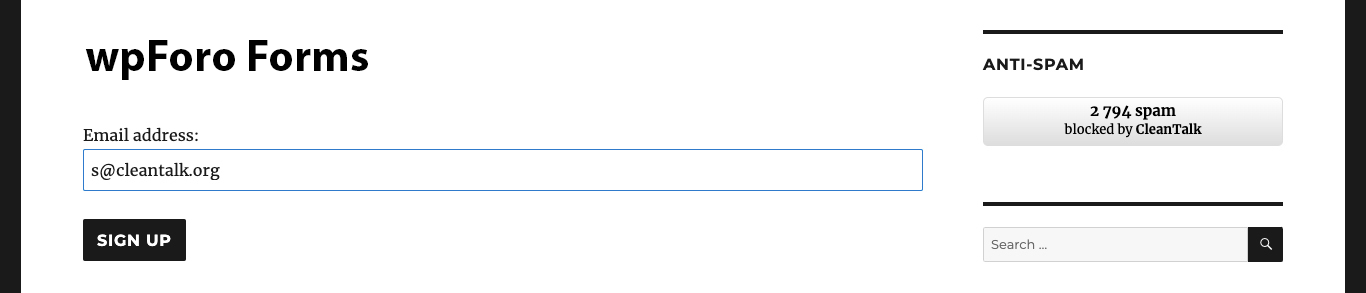
You can test the work of Anti-Spam protection for your СonvertKit Forms by using a test email s @ cleantalk.org (without spaces). First, open the form in an Incognito browser tab. Fill in all the required form fields and send a form. After submitting the form, you will see a block message about the block on the form submission.
If you have any questions, add a comment and we will be happy to help you.
Create your CleanTalk account – Register now and protect your СonvertKit Forms from spam in 5 minutes
Update
The protection works only for website visitors, not for website admins. Be sure to test the form protection using Incognito mode.
Additional features
CleanTalk protects all forms at once: comments, registrations, feedbacks, contacts, reviews.
Installation takes about 1-2 minutes.
Smart 99% protection against spambots.
Always online – 24/7 technical support.
Logs, SpamFireWall, personal lists, country filters, stop-words, and many others.